Skills & Know-How
12 Effective Ways to Sharpen a Pocket Knife
We may earn a commission if you buy through our links, at no extra cost to you. We don't test every product ourselves. We read and weigh real buyer reviews to give a fair, balanced picture. How we research.
In this guide
The simplest way to sharpen a pocket knife is with a soft Arkansas whetstone: lay the blade at a 10 to 15 degree angle, add water or honing oil, and draw it across the stone five times per side. A honing rod or pull-through sharpener works too. Test the edge on rope before you call it done.
A dull pocket knife is easy to end up with and frustrating when you need it. The good news is that sharpening one is simple once you know a few basic methods, and you have plenty of options to choose from.
How do I sharpen my pocket knife? There are 12 ways to do it well:
- Test the sharpness of the blade first
- Pick a sharpener that is easy to carry
- Whetstones
- Synthetic stones
- Use honing solution or water while you sharpen
- Manual pull-through sharpeners
- Automatic knife sharpeners
- Pivot sharpeners
- Honing rod (sharpening steel)
- Tungsten carbide file
- Everyday objects
- Store your knife so it stays sharp
Below, I walk through each of the 12 methods in more detail. You will also see how to sharpen your knife with everyday objects if you ever get caught without a sharpener.
How often should I sharpen my pocket knife?
Sharpen your pocket knife regularly so it keeps cutting well. A dull blade is also a safety problem. When a blade is dull, you push harder to make the cut, and that extra force can slip and hurt you or damage the blade. OSHA’s own guidance on knife handling backs this up: dull knives tend to slip and cause more injuries than sharp ones, because a sharp edge needs less force to do the same cut.
Higher-quality blades can hold an edge for years, depending on how often and how hard you use them. Every blade needs sharpening eventually. Watch for a drop in how well the blade cuts, and that tells you it is time.
1. How to test the sharpness of your pocket knife
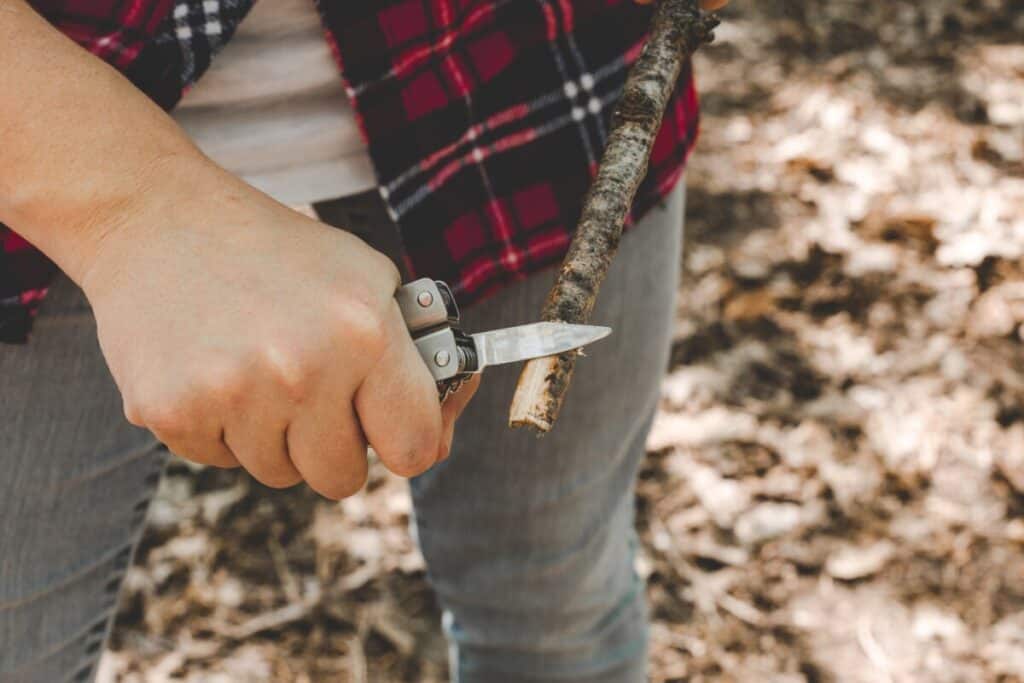
When it starts taking extra force to cut, you know your knife needs sharpening. But how do you tell for sure? There are simple tests, and it is worth checking each of your knives before you plan to use them.
The best way to test a knife’s sharpness is to use it the way you normally would. Grab some scraps of rope and a few sticks or branches from your yard. That is the kind of thing most people cut with a pocket knife. Run each of your knives through them.
Then set aside any knife that struggles to cut. Test them ahead of time so you are not surprised later. Even unused knives go dull over time, especially if they are stored poorly. People often assume a knife they rarely use stays sharp. It does not.
2. Choose a pocket knife sharpener that is portable
If you use your knife a lot, you may need to sharpen it often enough that you will end up doing it away from home. If you spend a lot of time outdoors or work in remote spots, look for a sharpener that is easy to carry.
If you are often far from home, it also helps to put together an emergency kit in case you get stranded. A pocket knife and a small sharpener are worth including, since together they cover a lot of uses.
Most pocket knife sharpeners are portable, as you would expect, because it does not take a big tool to sharpen a small blade. Still, I will point out which ones travel best. Some are small enough to drop in a pocket or tuck into an emergency kit.
3. Whetstones
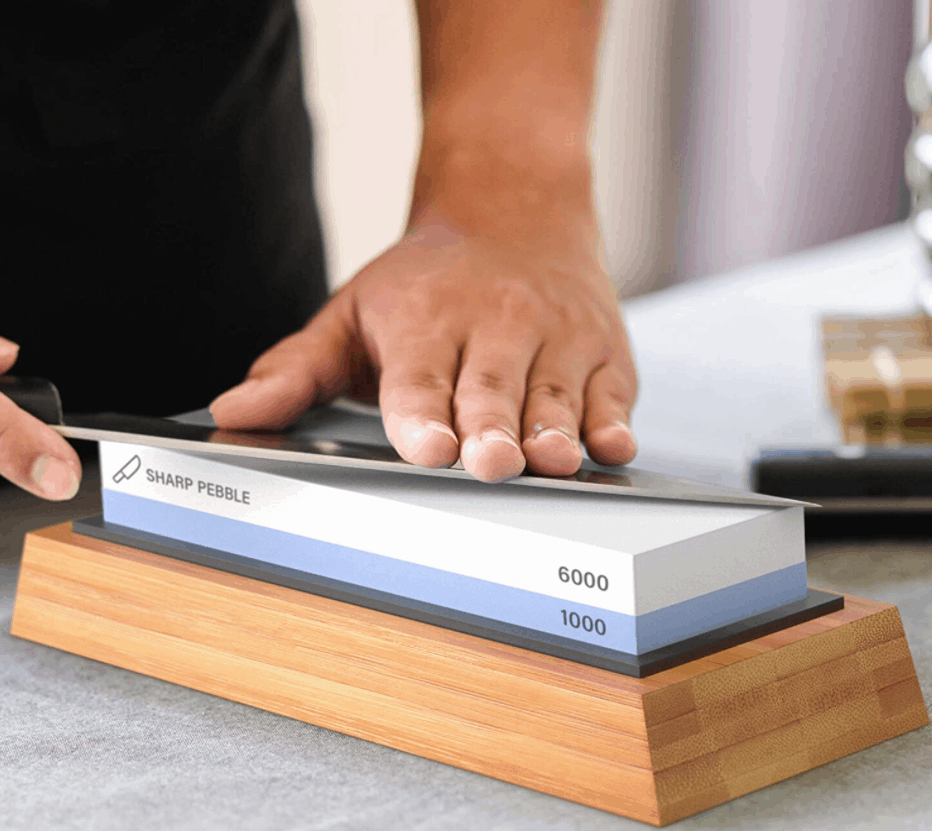
You may have seen sharpening stones, or whetstones, packed into emergency kits. That is because they are useful and easy to carry in a pocket. For a long hiking trip, a quality sharpening stone is one of the best ways to keep your knife sharp.
A pocket knife and sharpening stone combo comes in handy in plenty of other situations too. It is a go-to tool for anyone who spends time outdoors, especially off the beaten path.
Whetstones are most often made from a stone called Arkansas stone, a form of Novaculite. They come in four standard grades, and each grade has its own use.
The four standard grades of whetstone are:
- Washita: removes nicks from the blade, fairly coarse grit
- Soft Arkansas: a general-purpose stone for finishing edges, medium grit
- Hard Arkansas: only for fine-finishing, extra fine grit
- Black Arkansas: a rare stone used for honing surgical instruments
If you are going to use just one whetstone, go with a Soft Arkansas stone. It is the most versatile of the bunch, and you can find one sized for pocket knives. One example is this Premium Whetstone Knife Sharpening Stone. It comes in a leather pouch that is easy to carry.
4. Synthetic stone
There are also synthetic sharpening stones that can cost less than real Arkansas stone. Most synthetic stones are made from aluminum oxide, though some use silicon carbide.
Aluminum oxide stones, often called India stones, are coarser than Soft Arkansas stones. People often pair them with Arkansas stones so they have every level of coarseness covered.
Silicon carbide stones are the fastest way to sharpen a knife. Like the aluminum oxide stones, they come labeled fine, medium, or coarse. They also cost less than natural Arkansas stones.
You will often see a synthetic stone packaged with a natural stone in a sharpening kit. That is the case with this 2-stone sharpening kit. It includes a synthetic stone, a natural stone, and a bottle of honing solution. It covers a lot of uses while keeping the quality you get from real Arkansas stone.
The downside of synthetic stones is that they take longer to sharpen a knife than natural stones do. Natural stones get you a sharp edge faster when you are out in the field.
How to sharpen a pocket knife using a stone
Sharpening a pocket knife with a stone is pretty easy, and it works well once you get the hang of it. Follow along with this video:
- Start on the side of the stone with the roughest grit. Rough grits are usually porous and feel coarse to the touch. You can also spot the rough side by putting water on it and watching the water soak in
- Prep the stone by adding lubricant, either mineral oil or water, on top
- Lay the blade flat on the stone, then raise it to a 10 to 15 degree angle
- Slowly draw the blade downward. You do not need much pressure, since the stone does most of the work
- Never bring the knife back up toward your body
- Pass each side of the blade over the stone at least 5 times
5. Use honing solution or water when you sharpen your knife
It is a good idea to use some kind of lubricant or honing solution when you sharpen. It helps you sharpen the knife without damaging it.
One kind of damage is a buildup of metal debris called swarf on the surface of the blade. Let that build up and the knife cuts worse.
Sharpening also generates a lot of heat. Even sharpening by hand gets things hot. Some of the same friction tricks used to sharpen knives can also help you get a fire going without a lighter when you are off-grid.
The sharpening stone kit above came with a bottle of honing solution. You can also buy it on its own, like this W.R. Case & Son Honing Oil. With many stones, you can use mineral oil or even just water.
The point is simple. Use something so that sharpening helps your knife instead of hurting it.
6. Manual pull-through knife sharpener
Another portable option is the manual pull-through sharpener. These usually have a few different slots built to sharpen different knives. If you want to sharpen several types of knives, a manual pull-through sharpener is a good fit.
Take this adjustable manual knife sharpener. It sharpens both standard and serrated knives. The two-stage system has a coarse and a fine slot, so it handles more than a traditional whetstone.
How to use a pull-through knife sharpener
The instructions for adjustable pull-through sharpeners are all similar. You can see how easy they are by reading the steps for the Smith’s Adjustable Angle Pull-Through Knife Sharpener.
Start by setting the sharpening angle with the knob next to the slots. Being able to adjust the angle is one thing these sharpeners do that a stone cannot, where you have to eyeball it. The recommended sharpening angle for pocket knives is 20 degrees.
Then place the knife in the coarse or fine slot. There is also a slot for serrated knives. The manufacturer recommends pulling the knife through from heel to tip, or toward you.
To take care of a pull-through sharpener:
- Clean it gently with a damp cloth
- Never rinse it out with water
- Store it in a dry, ventilated place
7. Automatic knife sharpener
The fastest way to sharpen a knife is with an automatic sharpener. Skip the whetstone or manual sharpener and let the machine maintain your blade. These handle a range of knives the same way manual sharpeners do.
One popular pick is the Work Sharp Knife Sharpener. It has a fine grit honing rod for refining smooth edges, and it works on pocket knives, kitchen knives, and serrated knives.
An automatic sharpener is worth the cost if you use your pocket knife often. It is not very portable, since it needs a 110v power source. You can run it off a 12v power inverter in a truck, boat, camper, or other vehicle.
Battery-powered knife sharpener
The catch with most automatic sharpeners is that they need to be plugged in. They are fine when you can reach a vehicle’s power, but not when you are out in the field.
That is where the Smith Cordless Knife and Tool Sharpener comes in. It runs on a rechargeable lithium-ion battery. It is best for someone with many types of knives who needs a sharpener in the field on a regular basis. Otherwise it may be more than you need, given the price.
How to use a powered knife sharpener
A powered sharpener is handy for a lot of jobs, but the instructions are a bit more involved. Because it does so much, it is easy to pick a setting that will actually damage your knife.
The instruction manual for this powered knife and tool sharpener has plenty of helpful tips, including a section on sharpening a pocket knife.
Sharpening a pocket knife starts with installing a belt made for pocket knives. Picking the right belt matters, since one with the wrong coarseness can damage the blade.
The exact steps vary by model. These sharpeners usually include an angle guide so you set the knife at the right angle while you sharpen.
You will also usually switch to a different belt before you finish. The first belt leaves a burr on the knife that needs to be honed off. Swapping the belt is easy, just a minor hassle. This sharpener is great for many jobs, but I would not buy it if all you want to do is sharpen pocket knives.
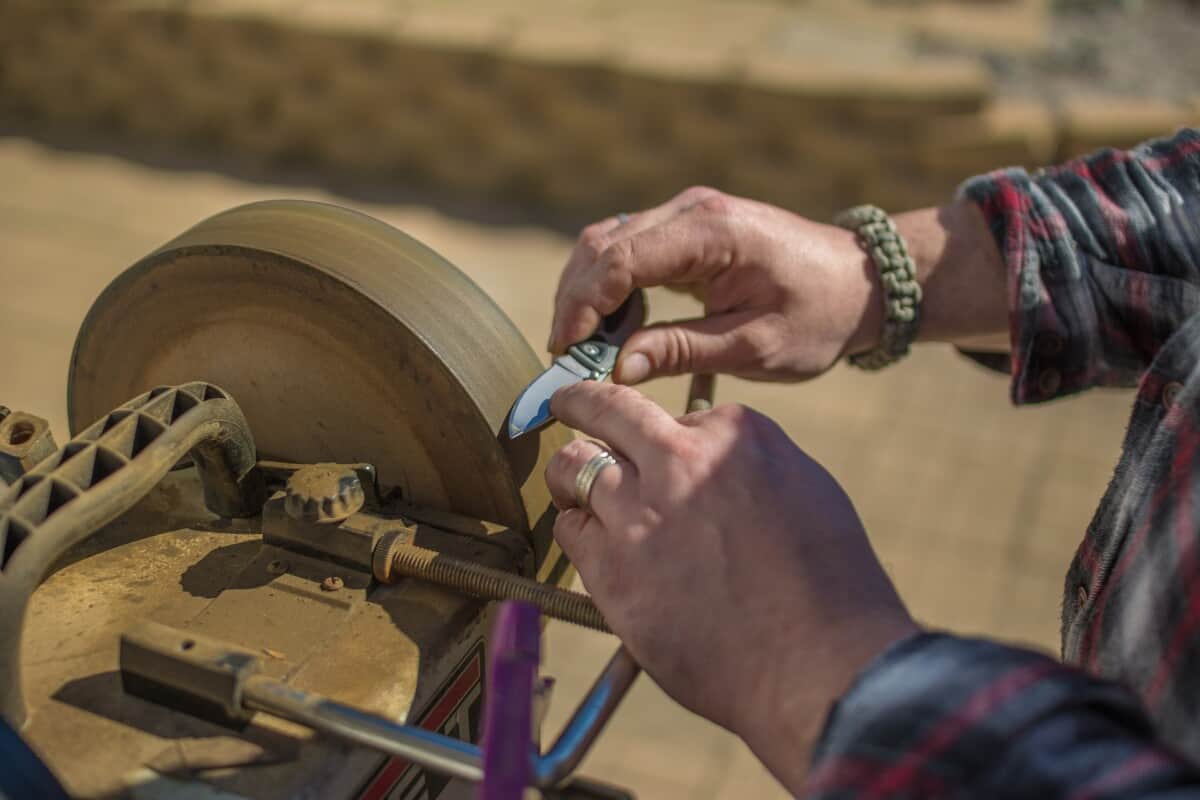
8. Carbide/ceramic pivot knife sharpener
If you have shopped for pocket knife sharpeners, you may have seen pivot sharpeners. They have a few different slots for specific jobs. A pivot sharpener is a good choice if you want something easy to carry.
This Work Sharp EDC Pivot Knife Sharpener does a lot. It has a convex-carbide sharpener on one side, a ceramic hone on another, and a diamond plate on the third. It is not just for pocket knives. The diamond plate sharpens fish hooks, and the convex-carbide side puts a convex cutting edge on your blade.
9. Use a honing rod
Another good way to maintain a pocket knife is a honing rod, like this BloominGoods 10-inch Knife Sharpening Steel. Honing rods work well on pocket knives, and they are best known for use in commercial kitchens.
A honing rod is technically not a sharpener, but it does the important job of keeping your knife in shape. It realigns the edge, folding the steel back into place so the knife cuts well again. A honing rod extends the life of your blade.
One downside is that honing rods are not very portable. Carrying one on a long off-road trip can be a nuisance. You can make it easier by choosing a retractable rod.
Retractable rods include the Dret Diamond Retractable Sharpening Rod. It has a tapered rod for serrations and a groove for fish hooks and pointed tools.
How to use a honing rod on a pocket knife
A honing rod is great for bringing back a serrated-edge blade. Over time, a serrated edge breaks down and falls out of alignment. One of the best ways to realign it is a sharpening steel, also called a honing rod.
Start by holding the knife firmly and letting the blade hang over the edge of your workbench, table, or a stump. Then:
- Place the honing rod on the first scallop (that is what the saw-like notches are called)
- Do not use a rod wider than the scallops themselves. You may need to use only the very tip of a tapered rod
- With light pressure, run the rod over the scallop in a downward motion. Do not pull the rod back up toward yourself. Use a downward motion only
- Pass over each scallop a few times before you finish
- You can watch this instructional video
10. Use a tungsten carbide sharpener
You can also sharpen your pocket knife with a tungsten carbide file like the Gatco Edgemate Sharpener. A carbide file is a good way to restore a dull blade. It is not for serrated blades, but it is handy for straight ones.
If you use a file, it works best on a knife made of steel softer than the file itself. If the blade is as hard as the file or harder, the file will slip on the blade and get damaged.
Only make forward strokes when you file a knife. Backward strokes will damage the blade. Tungsten carbide sharpeners should not be used too often because they remove material fast.
11. You can sharpen a pocket knife using everyday objects
You may end up in the field with a dull knife and no stone or sharpener. You can use everyday objects to get the blade working again, at least for a while.
Coffee mug
One everyday object you can use to sharpen a pocket knife is a coffee mug. Look for one with a rough, flat bottom that you do not mind scratching up a little.
Set the mug down on a surface that is smooth, flat, and not slippery. Turn it so the bottom faces up. Hold it down firmly so it does not slip. Put the blade against the bottom of the cup and slide it back and forth a few times.
Wipe debris off the blade with a clean cloth. This is not the preferred way to sharpen a knife. But if you are in a bind without a stone or kit, a household item is often enough to get the blade working again for now.
Bottom of a plate
Using the bottom of a plate is a lot like using a coffee mug. You sharpen against the porcelain ring on the underside of the plate, as shown here.
Hold the blade at a 20 degree angle against the rough porcelain ring on the bottom of the plate. Slide the blade in one direction only. Repeat several times on each side, then rinse the blade off in the sink.
Car window
If you are in the field without a sharpener, you can use the top edge of your car window to sharpen your knife. Start by rolling the window down about halfway.
Lay the blade flat and horizontal on the top edge of the window. Then:
- Tilt the blade up until its angle matches the angle of the grind
- Place a finger on the top of the spine to control the knife
- Make at least 3 passes on each side
12. Store your pocket knives properly
If you are still shopping for a knife worth keeping sharp, our roundup of pocket knives under $50 is a good place to start.
A big part of keeping a knife sharp is storing it in a way that does not harm the blade. Pocket knives often come with protective cases. Keep your knives in those cases when you are not using them, and keep the blades folded into the handles. OSHA’s safe knife handling guidance makes the same point for any blade: store it with the edge covered or folded away, never loose in a drawer or bag where a hand could land on it by accident.
There are many bags and containers made for pocket knives. One popular case is the Kershaw Knife Storage Bag. This nylon bag holds up to 18 knives. It is a worthwhile buy for anyone who has a mix of camping, hunting, and fishing knives to organize.
You might also like a leather pouch, like this one, that straps to your belt. It is one of the most popular ways for outdoors folks to carry a knife so it is safe and easy to reach in the field.
Coming soon
The part of being prepared most families never finish
The Family Emergency Binder puts your family's contacts, documents, and plans in one place — a 15-minute quick start tonight, finished over a weekend. Join the list and we'll email you the moment it's ready, at the $19 launch price for a limited time.