Skills & Know-How
How to Shut Off Your Water Main (and Turn Off Water to the House)
In this guide
If there’s standing water, don’t touch light switches or electrical appliances while you’re standing in it. If reaching the valve means wading through water near outlets, cords, or appliances, stop and stay out. Ready.gov says to turn off the electricity only if it is safe to do so. Call 911 if anyone is hurt, and call your water utility’s emergency line about shutting the water off at the meter. Otherwise, to shut off your water main and turn off the water to your whole house, find the main shutoff valve where the water line enters the house and close it by hand: a round wheel turns clockwise until it stops, and a lever turns a quarter turn so it sits across the pipe. Then open a faucet and watch it until the flow stops.
If nothing is leaking right now, use the practice run and shutoff card near the end to find and test yours today.
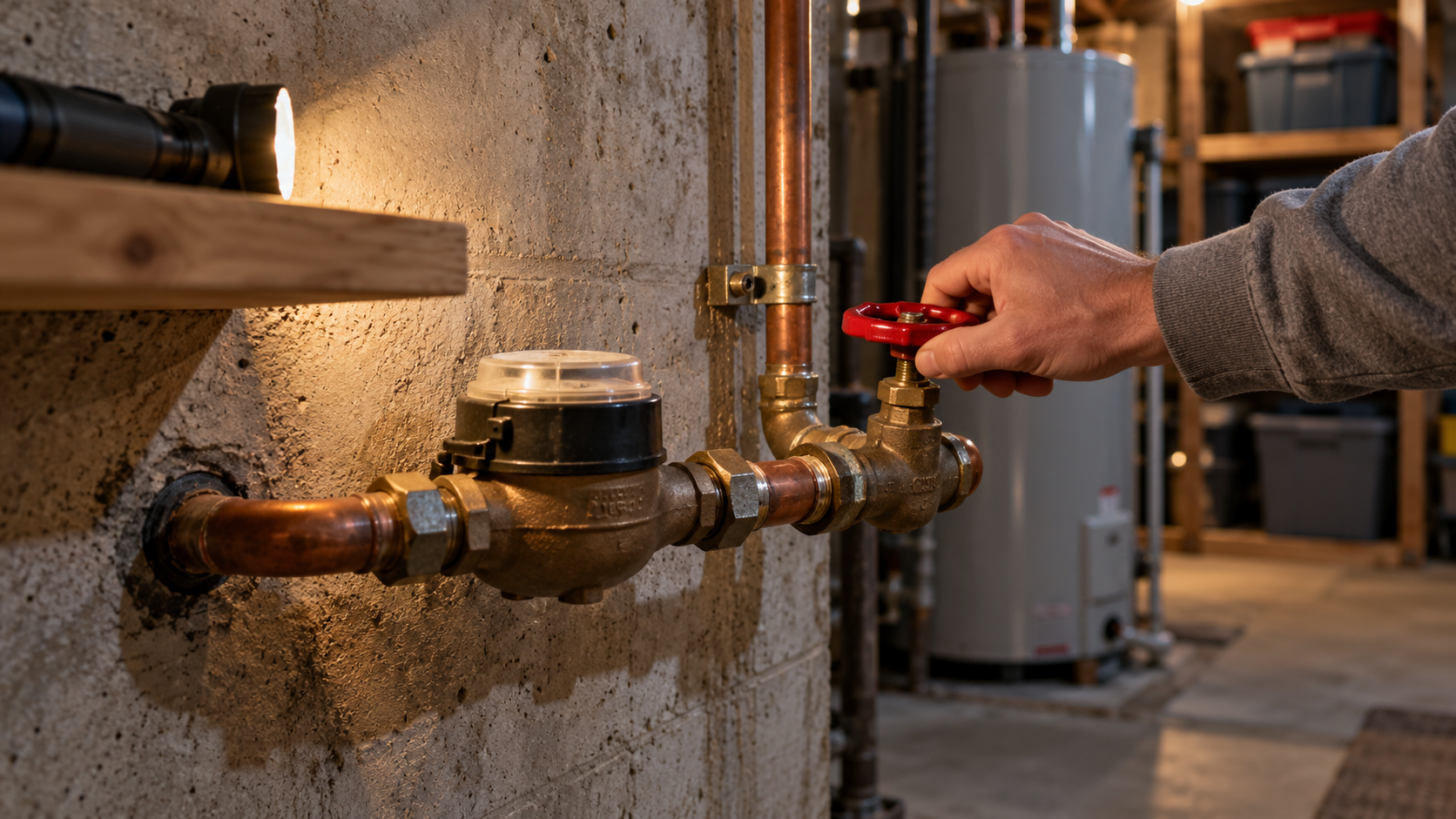
The image at the top is an illustration, not a photo of a real home. Your valve may look different, so go by the handle descriptions below.
Shut off the water in 4 steps
If the leak is coming from one toilet, sink, or appliance supply line, try the small shutoff valve on that line first; it stops water to that fixture only. For a burst pipe or anything else, use the main. If water is pouring out right now, do this, and keep the safety rule above in mind. The Missouri Public Service Commission’s utilities guide (reprinted from the national utility regulators’ association) says that with standing water in your home you may need to shut off the electricity too, and not to use an appliance or even flip a switch while you’re standing in it.
- Go to the main valve. Check where the water pipe comes into the house: the basement wall facing the street, a crawlspace, the garage, near the water heater, or outside by a hose spigot. If you can’t find it in a couple of minutes, call your water utility’s emergency line. Some utilities let customers use a valve in the meter box near the street and some don’t, so read the meter box section before you open the lid.
- Close it by hand. Wheel handle: turn clockwise until it stops. Lever handle: turn it a quarter turn so it’s crossways to the pipe. Don’t use a wrench or a hammer on it.
- Open a faucet to check. Turn on a cold-water faucet in the house (or the hose spigot next to the valve), and watch it. Water already in the pipes will still run out, so expect some flow at first. It should slow and stop, and it should not pick back up. That shows the valve has cut off that faucet; a separate line that bypasses the house valve can still carry water (see below). If it keeps running at normal pressure, that faucet is still being supplied: either the valve isn’t fully closed or a line bypasses it. (Western Water and the Arizona guide both use this faucet test.)
- Open the highest faucet in the house. Home-repair guides suggest this after the main is off, to let air into the lines and ease the pressure left in them while you deal with the mess or wait for a plumber.
If water is still coming out after step 3, jump to what to do if the water keeps running.
Where is the main water shutoff valve?
The main valve sits on the pipe that brings water into your home, usually close to where that pipe comes through the foundation or wall. Where that is depends on how the house was built and where you live. Home-repair guides list the same handful of spots, and the utility sources named below agree on the basics:
- In a basement, look on or near the wall facing the street, since that’s the direction the line comes from.
- In a crawlspace home, check where the line enters the crawlspace, or sometimes near the water heater or under the kitchen sink.
- On a slab (no basement), it’s often near the water heater, in the garage, or under the kitchen sink.
- In warm climates, it’s frequently outside. The Western Municipal Water District in California tells customers to look in the front, side, or backyard, or in the garage.
- In cold climates, it’s usually indoors, where the pipe is protected from freezing.
The Missouri Public Service Commission’s guide gives a similar short list: on a wall near the front of the house, near the water heater, in the garage, or buried outside near the street in a covered box.
If you still can’t find it, call your water utility and ask, and read the meter box section below before you open that lid.
Gate valve or ball valve: which way is off?
Two common kinds of valve are used as main shutoffs.
A gate valve has a round wheel handle, like an outdoor spigot. It closes by turning clockwise, and it can take several turns before it stops.
A ball valve has a straight lever handle. It only needs a quarter turn. When the lever lines up with the pipe, water flows. When it sits across the pipe, the water is off.
The Arizona Municipal Water Users Association’s home water guide spells out both directions, and it adds a warning worth taking seriously: old or corroded shutoff valves can fail or break, so turn them by hand only.
What if the valve won’t turn, or the water keeps running?
The valve won’t budge. Don’t force it. Old valves can break when forced, and then you have a second problem. Stop and call your water utility’s emergency number. Ask whether you can use the valve at the meter or whether they will send someone. Once things are calm, have a plumber look at the stuck valve.
You closed it, but water is still running. A few things cause this:
- A worn valve may slow the water to a trickle without stopping it. If that’s what you see, call your utility about shutting off at the meter, and get the house valve replaced.
- Some supply lines can bypass the house valve. The Arizona water guide tells homeowners to look for lines like that and close their valves too, and says some irrigation systems can be isolated at the backflow device. If the leak is outside, look for a separate valve near the sprinkler backflow device.
- You may have closed a fixture valve, not the main. Small valves under sinks and behind toilets only stop water to that one fixture. The main is on the bigger pipe where water enters the house.
You can’t find the valve at all. Call your water provider’s emergency line, and use the meter box only if your utility allows it (see below). Once the leak is handled, find the main valve and fill in the shutoff card below.
How to shut off water at the meter box
The meter box is a backup, and the first thing to know about it is whether your utility wants you in there. Rules differ from one utility to the next. Four examples:
- Austin Water tells customers to first try the property owner’s shutoff valve, typically on your side of the meter at the meter box. If you can’t find that valve or it’s damaged, Austin says to use the City’s shutoff valve in the meter box. Renters are told to check with their property manager.
- Western Water in Southern California describes a customer shutoff valve inside the meter box, on the pipe between the meter and the home, that closes with a quarter turn clockwise.
- Garden Grove, California says its City shutoff valves are not to be operated by anyone but City staff except in extreme emergencies, and that whoever damages one is liable for the repair.
- The Arizona Municipal Water Users Association guide says to contact your water provider for instructions if you need the water shut off at the meter.
So try the house valve first. If that fails, call your utility’s emergency line, or use the meter box valve only if your utility’s own instructions say you may. Look up your utility’s page or call them on a calm day, and write the answer down next to the emergency number.
If your utility does allow it:
- The meter box usually sits in the ground near the street, with a lid that may say “water meter.” Some lids need a meter key, a long T-shaped tool sold at hardware stores (Austin Water mentions one).
- Some lids are wired to the meter inside the box. Austin Water warns not to damage those wires.
- If the box has a customer or property owner’s valve, it is on the house side of the meter in the examples above. Not every property has one. The City of Forney, Texas notes that a plumber can install one on the customer side of the meter.
To check that the water is off at the meter, Western Water says to turn on water somewhere in the home, or watch the meter’s indicator stop turning. Running a faucet matters here: a meter that isn’t moving while nothing in the house is open tells you nothing about the valve.
What the meter’s leak indicator does and doesn’t tell you
Many meters have a small low-flow indicator, often a triangle on the meter face. The City of Port Townsend, Washington says that if it spins with all water turned off, that points to a leak. After a shutoff, treat it as a second check only, and only with a faucet open in the house. If it moves with your main closed and a faucet open, water is still flowing through the meter. That could be a house valve that didn’t fully close, a line that bypasses it, or a leak between the meter and the house valve, so call your utility or a plumber to track it down. If it stays still with a faucet open, that’s a good sign, but it doesn’t tell you the broken pipe has drained or that the house is safe. With every tap closed, a still indicator tells you nothing about the shutoff.
Last checked October 21, 2026: the Austin Water, Western Water, Garden Grove, Forney, Port Townsend, and Arizona guide pages cited in this section.
How to turn the water back on
Go slow. Western Water warns that opening the valve too quickly can damage the pipes in your home.
- Close the faucets you opened to drain, but leave one open (or the hose spigot near the valve) so air can escape.
- Open the main valve a little, then pause. You’ll hear air and sputtering at the open faucet.
- When the sputtering stops and water runs steady, open the valve all the way.
- Run each faucet in the house for a moment to clear the last of the air.
When you’ll need to do this
Burst pipes and big leaks come first: the sooner the valve is closed, the less water gets out.
Frozen pipes are another. The American Red Cross notes that pipes often freeze against exterior walls or where the water service comes into the house through the foundation, which is often right next to the main valve. Water expands as it freezes and can burst the pipe. If you can’t find or thaw the frozen section, the Red Cross says to call a licensed plumber. Our guide to staying warm without power says to find the valve before a pipe breaks.
After an earthquake, the Red Cross advises checking for damage to your gas, water, electrical, and sewage systems and turning off any utility that’s damaged. Its preparation list includes learning how to turn off the utilities in your home before anything happens.
Gas is different from water. If you suspect a gas leak, the Red Cross says to leave your home, call 911, and report it to your utility company once you’re somewhere safe. Our family emergency plan covers when to turn the gas off and has space to write down all three shutoff locations.
Do this once, before you need it
Do the first run on a quiet afternoon, not during a leak. Bring a flashlight and something to write with.
- Find it, using the list above.
- Test it. Close the valve, confirm at a faucet, then turn it back on slowly. If it’s stiff or doesn’t fully stop the water, you’ve found out on your schedule instead of during a flood. Call a plumber about replacing it.
- Label it with a bright tag or a strip of colored tape on the handle.
- Clear the path. Move whatever is stacked in front of it.
- Photograph it: one wide shot showing where it is in the room, and one close-up of the handle.
- Write it down. The Family Emergency Binder has a Home & Property section with a spot for utility shutoffs and a photo, so a babysitter or grandparent could find it too.
- Show everyone. Walk every adult and older kid to the valve and show them which way it turns. If you’ve tested it and it turns easily by hand, let them try it once. If it’s stiff, show them where it is and leave it alone until it’s replaced.
Your water shutoff card
Fill this in during the practice run and keep it with your emergency papers.
| What to write down | Your answer |
|---|---|
| Where the main valve is (room, wall, what’s next to it) | |
| Valve type: wheel (turns to close) or lever (quarter turn) | |
| Did it fully stop the water when you tested it? Date tested | |
| Water utility emergency number (24-hour line) | |
| Does your utility allow customers to use the meter box valve? Who told you, and when? | |
| Where the meter box is, and where the meter key is kept (if you have one) | |
| Any second valve to close (irrigation, a line that bypasses the main) | |
| Plumber’s name and number |
The third line matters most, because until you’ve closed the valve once, you don’t know whether it works. If yours slowed the water but didn’t stop it, the Missouri PSC guide says a valve that won’t fully close may be rusted or damaged and should be replaced by a qualified technician.
While you’re at the meter, you can also run the EPA’s leak check: read your water meter, use no water for two hours, then read it again. Do this with the main open and every tap and appliance off. If the number changed, you probably have a leak somewhere. According to the EPA, nine percent of homes have leaks that waste 50 gallons or more a day.
Frequently asked questions
Can I still flush the toilet with the water shut off?
Yes, once. The water already in the tank gives you one flush, but the tank won’t refill. After that, pour about a gallon of water straight into the bowl to flush. We cover the bucket method in our article on flushing when the power is out.
Is there still usable water in the house after I shut off the main?
Some. Water sits in your pipes and in the water heater tank. After a disaster, the Missouri PSC guide notes that water in the heater and toilet tanks can drain away by gravity unless you trap it by closing the main house valve, and that cracked lines can contaminate the supply, so it’s wise to keep the main shut until officials say the water is safe to drink. Our guide to storing water in a small space explains how to get it out safely if you need it.
Do I need to turn off the water heater?
Whether to turn the heater off depends on the model and the job. If you’ll be draining the pipes or the tank, or the water will be off for a long repair, follow the heater’s manual or ask the plumber doing the work.
I rent. Should I know where the main shutoff is?
Yes. A leak in your unit can ruin your own things, not just the building. Ask your landlord or property manager where the shutoff for your unit is and whether you’re allowed to use it. Austin Water gives renters the same advice.
Your next step
Pick an evening this week. Find the valve, close it once and confirm at a faucet, then fill in the first three lines of the shutoff card. While you’re at it, call your utility’s customer line, ask whether you may use the meter box valve, and write down the answer and the date.
Coming soon
The part of being prepared most families never finish
The Family Emergency Binder puts your family's contacts, documents, and plans in one place — a 15-minute quick start tonight, finished over a weekend. Join the list and we'll email you the moment it's ready, at the $19 launch price for a limited time.