Skills & Know-How
Does Bottled Water Expire? How to Store It for Emergencies
General information only, not professional advice. In an emergency, call 911 and follow local officials. How we use sources
We may earn a commission if you buy through our links, at no extra cost to you. We don't test products ourselves. We choose picks from the maker's own specs, the retailer listing and, where a safety rule applies, official government guidance. Specs shown are the maker's or seller's claims, and we have not tested any safety or fire rating. How we choose.
In this guide
Bottled water does not spoil on a schedule. FDA staff have written that the agency requires no expiration date and considers sealed bottled water safe indefinitely, though long storage can change its taste and smell. The CDC still says to observe the date printed on store-bought water. Keep it cool and dark, and replace it when that date passes.
If you have a case of water in the garage from three summers ago, this page is for you. The safety advice below comes from federal agencies, quoted word for word where it comes from a federal page. Follow your local emergency officials, call 911 in an emergency, and when in doubt, don’t drink it.
What does the FDA say about bottled water shelf life?
The FDA regulates bottled water as a food. We could not find a current fda.gov page that answers the shelf-life question. The clearest answer we found is a 2002 article by two FDA staff members, Lauren M. Posnick and Henry Kim, in Food Safety Magazine. In our words: they wrote that the FDA considers bottled water to have an indefinite safety shelf life when it is made under the FDA’s manufacturing and quality rules and kept in an unopened, properly sealed container, and that this is why the FDA does not require an expiration date. They added that long storage can give the water an off odor or taste, and that bottlers may print a date on their own.
Source: Lauren M. Posnick and Henry Kim (FDA), Bottled Water Regulation and the FDA, Food Safety Magazine, August 1, 2002, accessed November 2026.
Two things to notice. “Indefinite” has conditions: sealed, and stored properly. And the date on the bottle is the bottler’s choice, not a federal rule. The article is from 2002, so treat it as the best statement we found, not a current FDA page.
So why does the CDC say to watch the date?
Because an emergency is the wrong time to find out your water tastes bad. The CDC’s guidance for building a home supply says:
Unopened, commercially bottled water is the safest and most reliable source of water in an emergency.
Observe the expiration date for store-bought water.
Source: CDC, How to Create an Emergency Water Supply, accessed November 2026.
The two do not necessarily conflict. The FDA is speaking about safety. The CDC is giving a practical rule for your kit. Our reading: if there is a date, use it as your swap-out date. If your bottles have none, write the purchase date on the case and pick a replacement interval you will actually keep. That interval is our habit, not an agency rule.
How should you store bottled water?
Ready.gov, run by the Department of Homeland Security and FEMA, gives the short version:
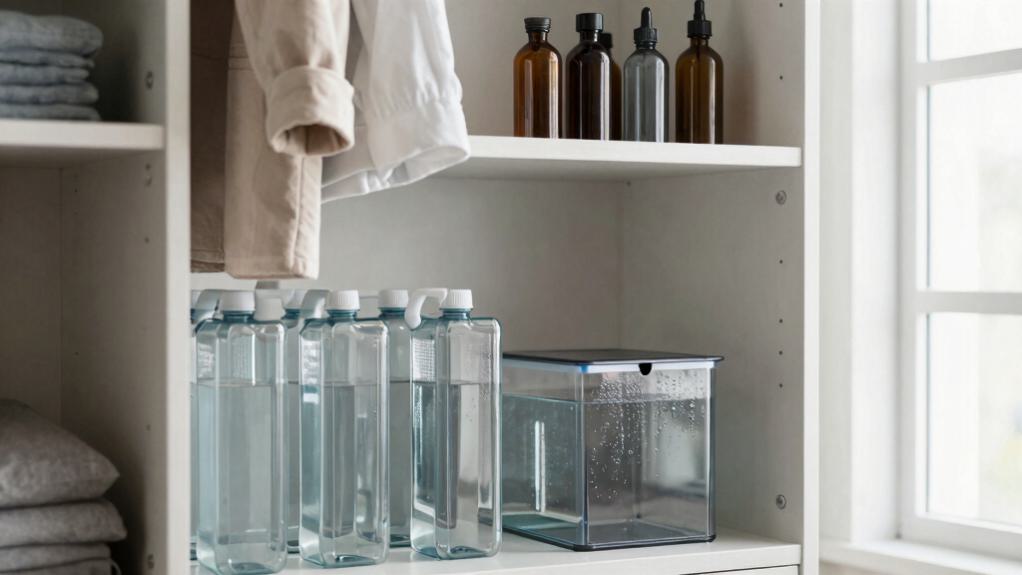
Buy commercially bottled water and store it in the sealed original container in cool, dark place.
Source: FEMA, Ready.gov: Water, accessed November 2026.
The CDC adds the details for stored water:
Keep containers in a place with a cool temperature (50°F –70°F).
Keep containers away from direct sunlight.
Keep containers away from toxic substances, such as gasoline or pesticides.
Source: CDC, How to Create an Emergency Water Supply, accessed November 2026.
The FDA adds a point about floods:
Make sure to have a supply of bottled water stored where it will be as safe as possible from flooding.
Source: FDA, Food and Water Safety During Power Outages and Floods, accessed November 2026.
| Spot | Fits the guidance? | Why |
|---|---|---|
| Hall closet or pantry shelf | Usually | Cool, dark, and away from chemicals |
| Garage next to gasoline or pesticides | No | The CDC says to keep containers away from them |
| Sunny window or porch | No | The CDC says to avoid direct sunlight |
| Basement floor in a flood-prone house | Risky | The FDA says to store it where it is as safe from flooding as possible |
How do you know if old bottled water is still okay?
Start with the sealed container and the label. Then use your nose. The FDA’s guidance:
If your bottled water has an odor, do not drink or use it. Instead, dispose of it, or if applicable, call your bottled water provider to make arrangements to get a replacement.
Source: FDA, Food and Water Safety During Power Outages and Floods, accessed November 2026.
If the seal is broken, the container is damaged, or anything seems off, don’t drink it. Use another source and treat it as the CDC describes in our water filters and tablets guide.
What about water you fill yourself?
This is where the six-month rule comes from. The CDC says:
If you are filling containers with water to store, replace the water every 6 months.
Label container as “drinking water” and include storage date.
Source: CDC, How to Create an Emergency Water Supply, accessed November 2026.
Ready.gov agrees:
Water that has not been commercially bottled should be replaced every six months.
Source: FEMA, Ready.gov: Water, accessed November 2026.
The CDC also recommends FDA-approved food-grade containers and gives steps for washing and sanitizing them before use, so read that page before you fill anything. It is the main reason a case of sealed bottles is the simpler choice for a first kit.
| Store-bought and sealed | Filled at home | |
|---|---|---|
| Date | Observe the label (CDC) | Label it and replace every 6 months (CDC, Ready.gov) |
| Container | Original sealed bottle | Food-grade, cleaned and sanitized first (CDC) |
| Where | Cool, dark place | Cool, away from sunlight and chemicals |
How much should you store?
The CDC says:
Store at least 1 gallon of water per person, per day for 3 days.
Try to store a 2-week supply if possible.
Source: CDC, How to Create an Emergency Water Supply, accessed November 2026.
For a family of four, three days is 12 gallons. If space is tight, our guide to storing water in a small space shows where it can hide. The CDC suggests more for pregnant women, people who are sick, pets and hot climates.
What would we buy?
A case of sealed bottled water is the easy start. It meets the CDC’s first choice and needs no cleaning. For a bigger supply, food-grade containers are what the CDC describes, and stackable ones save space. Read each listing for the capacity and material before you buy.
- Bottled drinking water, by the case: the simplest first step. Check the date on the box.
- Reliance Aqua-Tainer: a well-known jug for filling at home. See listing for size and material.
- WaterBrick: stackable containers for tight spaces. See listing for size and material.
We may earn a commission if you buy through these links, at no extra cost to you. We have not tested these products ourselves.
Put the date where you will see it
Write the purchase date and a replace-by date on the case with a marker, and add a line about where the water lives to your household records. The Home & Property section of our Family Emergency Binder checklist is a good place to note that, next to the water shutoff, so anyone in the house can find it.
Frequently asked questions
Does bottled water expire?
According to a 2002 article by FDA staff, the FDA does not require an expiration date and considers sealed bottled water to have an indefinite safety shelf life. Bottlers may add a date on their own, and the CDC says to observe it.
Is it safe to drink bottled water past the date?
FDA staff have written that long storage can cause an off odor or taste. If your water has an odor, the FDA says not to drink it. If you are unsure, use another source.
How long can I store bottled water?
There is no federal number. Ready.gov says to store it in the sealed original container in a cool, dark place, and the CDC says to follow the date on the label.
How often should I replace water I stored myself?
The CDC and Ready.gov both say every six months.
Final thoughts
Check the date on the water you already have, move it somewhere cool and dark, and write a replace-by date on the case. Then store a gallon per person per day for three days. If officials tell you the tap is unsafe, follow them, call 911 in an emergency, and when in doubt, don’t drink it.