Skills & Know-How
Do All Two-Way Radios Work Together?
In this guide
Yes, many two-way radios can work together, even across brands, as long as they use the same service and frequency. Match the channel number and privacy code on FRS or GMRS handhelds and they’ll usually connect. Business radios often run custom frequencies and may need a dealer to reprogram one to match the other.
Two-way radios are handy when you are camping, hiking, or anywhere cell service drops out. They keep your group in touch. The kids like them too. If you don’t own a set yet, our roundup of the best two-way radios for emergencies is a good place to start. But at some point you may notice that the radios you own come from different brands, and they may not talk to each other the way you expected.
Different radios run on different frequencies, though, so you may need to change some settings before they connect.
Some two-way radios simply cannot reach others, no matter what you do. To know which settings to change, it helps to understand a few basic differences between radios.
Two-way radio basics
Different types of radios

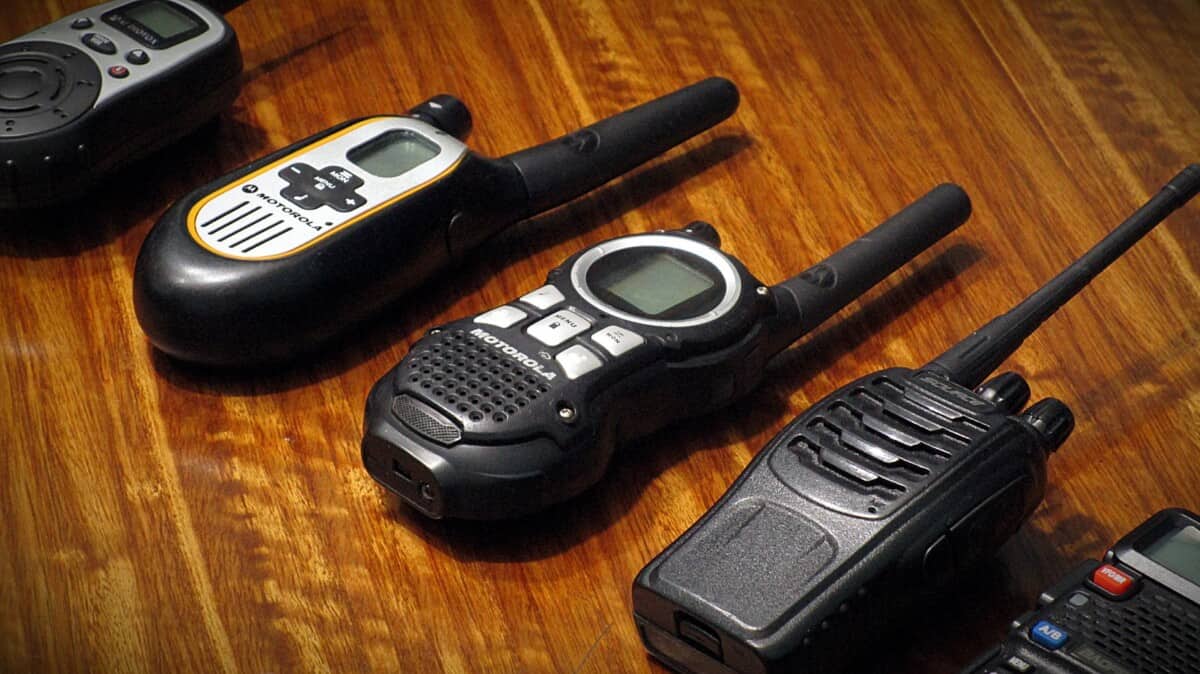
A two-way radio is a transceiver, which means it can both send and receive. There are three main types.
- Stationary radios sit in one place, like an air traffic control room or a taxi dispatch desk. They do not move.
- Mobile radios are mounted in cars and other vehicles.
- Handheld radios, often called walkie-talkies, fit in your hand and go with you. Radios like this are the backbone of a good family emergency communication plan, especially once cell towers get overloaded.
Duality
Radios send signals in different ways. The most common is half-duplex mode, where one person talks at a time. The person speaking holds down the transmit button, and the other person waits until that button is released before answering. A few radios use full-duplex mode, which lets both people talk at once.
UHF versus VHF
UHF and VHF are two parts of the radio spectrum. UHF signals have a higher frequency and shorter waves. They pass through objects well but do not cover as much ground, and they cost more to use over long distances. VHF signals have longer waves, so they reach farther and cost less for more range.
Range
How far a two-way radio reaches depends on several things. Antenna length matters. So does whether the radio uses UHF or VHF, along with what is around you when you transmit.
Analog or digital
Radios are either analog or digital. Analog radios carry one conversation at a time, but they often sound clearer. Digital radios can carry several conversations at once. They are more complicated, which usually makes them harder to pair with other types of radios. Simple handhelds like walkie-talkies tend to be analog.
Radio purposes

Two-way radios are usually sold for one of two settings: commercial use or business use.
- Commercial use: These radios run on one of two frequency bands, FRS or GMRS. Because the choices are limited, these radios can often be mixed and matched across brands. To do it, set the radios to the same frequency, put them on the same channel number, and set a privacy code.
- Business use: These are trickier. Most store-bought radios use UHF, VHF, or 800/900 MHz, but dealers sometimes put their radios on a custom frequency they set up themselves. To make these work with other brands, you usually have to go back to the dealer the radio came from.
Radios that work together
Maybe you bought a handheld two-way radio years ago and now need another, and you are not sure whether to buy one or a pair. A radio can sometimes reach a different type of radio, but some pairings are too hard for the average person to set up. Others are known to work together easily. Here are some that do.
Commercial radios
Radios built for the same purpose are more likely to work together. Even among commercial radios, some pair more reliably than others.
FRS/GMRS frequencies
Before 2017, these were two separate services. FRS radios had 14 channels, and GMRS radios had 22. That year, the FCC’s Part 95 Reform folded the two together: FRS is now authorized on 22 channels in the 462 and 467 MHz range, all shared with GMRS. FRS still needs no license, while GMRS requires one (no test, just a fee) that also covers your immediate family. Even before the merge, FRS radios could reach GMRS radios. As long as your radio has one of these services and is set to the same channel number with a privacy code, the radios should connect. They usually cannot reach other commercial radios, though.
Business radios
If a business wants to add to or replace its old radios, finding a compatible one can be a headache. It is very hard to find a radio that works with one you already own, even on the same frequency like 800/900 MHz. Still, most business radios can be configured to work with other types.
- Wattage compatibility: Radios that run on one or two watts are usually compatible. Some two-watt brands known to work with other business radios of the same model are the Motorola CLS Series, the two-watt RM Series, and the two-watt Kenwood radios with a Protalk label.
- DMR radios: Radios that use DMR digital technology work with each other. DMR is popular because it lets you add features like text messaging and GPS. Brands like TYT, Motorola, and Vertex Standard use DMR.
How to make radios work together
If you are set on getting your radios talking, here is how. The steps differ for commercial and business radios.
Commercial radios
For commercial handhelds, the steps are simple.
- Set the same channel: Put both radios on the same channel and set a privacy code. For some handheld brands, that is all it takes. If they still will not connect, move to step two.
- Check for CTCSS blocking: CTCSS stands for Continuous Tone Coded Squelch System. It is a blocking feature in some handhelds that keeps others from using the radio. It sends a tone you cannot hear along with your transmission. If the tone does not match what the other radio is set to accept, your message will not go through. Turn CTCSS off in your radio’s function settings.
- DCS blocking: If the radios still will not connect, check for Digital Code Squelch, or DCS. It works much like CTCSS, except the radio sends a digital code instead of a tone. Turn DCS off in the features settings.
- Channel switching: Depending on the radio, the channels may not line up between the two units. This is common with older radios that ran on different frequencies, like an FRS radio and a GMRS radio. Because the channel counts differ, channel 2 on one radio might match channel 4 on the other. To fix it, try each channel combination until one works, or look up the matching channels online.
These steps mainly apply to handhelds. Step one works for most other commercial radios on FRS/GMRS services.
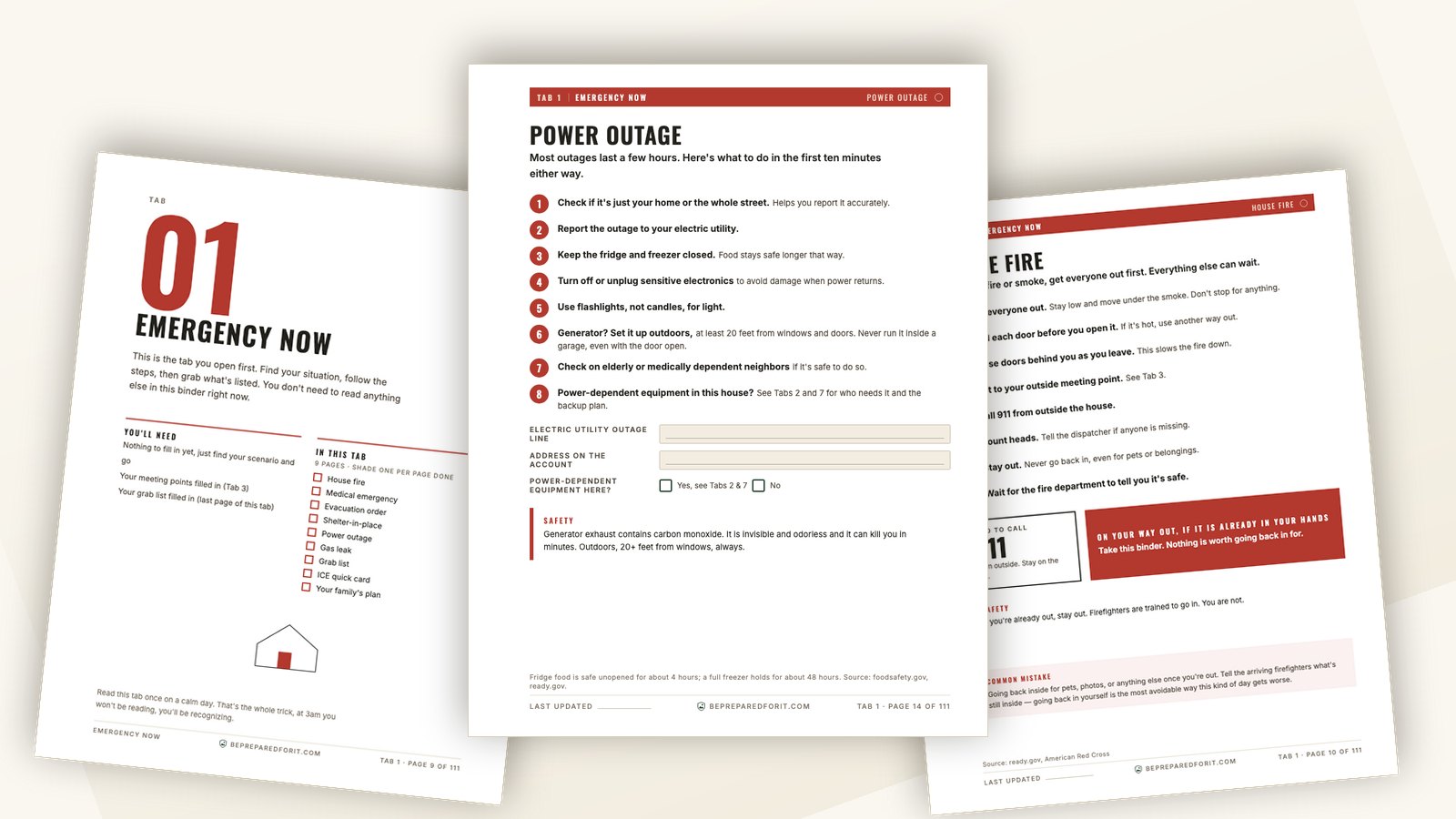
Once you land on a channel and privacy code that works, write it down somewhere the whole family can find it, like your emergency binder, instead of trusting everyone to remember it during a power outage.
Business radios
Because business radios are built for specific industries and uses, getting different models from different makers to work together is hard. These steps give you the best shot.
- Same frequency: Start here. Radios on different frequencies cannot connect. If your radio runs on 800/900 MHz, the other one has to as well.
- Check for custom programming: Many dealers load special programming onto their radios. It changes various parts of the radio, including the frequency. If yours has custom programming, you probably cannot make it work with others.
Get the default frequency: If you want a new radio that works with your old one, ask the store or maker to set the new radio to the default frequency. If both radios use the same frequency and still will not connect, take the old radio to the shop and ask them to restore the default settings. That should let the two connect. The same approach works for two old radios on the same frequency.
- Check the wattage: Wattage is the radio’s transmit power. Higher wattage reaches farther. Radios at four or five watts are usually incompatible. Radios at two watts are more likely to work with others.
- Check for digital radios: Look at the digital technology your radio uses. The three main ones are DMR, NXDN, and 900 MHz. If both radios use the same one, they might work together.
DMR radios: DMR stands for digital mobile radio. It was built to work across brands. But many brands add their own features that block that compatibility. Even so, many DMR radios can still reach NXDN radios if the owner uses a digital converter. NXDN radios: NXDN is an advanced digital system that lets you encrypt your transmission, so your conversations stay private. That also tends to make these radios incompatible with others. They can sometimes be made to work with DMR radios, though.
- Take it in: Business radios have far more parts and differences than commercial ones, so most people will not know whether their radio is compatible with another. If you cannot figure it out, take it to a specialist who can.
Radios that don’t work together
Some radios are compatible, or can be made compatible. Others simply are not.
Commercial radios
Most handheld commercial radios can be made to talk to each other. Many other commercial radios are not built to reach a different type.
- CB radios: CB stands for citizens band. The FCC runs it as its own service on 40 channels between 26.965 and 27.405 MHz, a different band than FRS, GMRS, or most business radios. Base stations and higher-power setups can reach well beyond a handheld’s range. Think of the radios cops used in old TV shows. They are big and powerful, but they do not work with any other kind of two-way radio.
- Marine radios: Marine radios are for people heading out on the water. Older models used the same frequencies as most handheld commercial radios, so they could pair with them. Government rules banned those older models, so today’s marine radios do not work with any other commercial two-way radio.
- MURS radios: MURS stands for Multi-Use Radio Service. These look like a normal handheld walkie-talkie but run on a different frequency, like CB radios. They are set by the government, work only over short distances, and sit somewhere between commercial and business use. Because of their frequency, they do not work with any other commercial two-way radio.
Business radios
Business radios are so hard to pair that the list of incompatible ones is long. Instead of listing them, here are a couple of signs your business radio will not work with other models.
- High-watt radios: Radios with high wattage give you a much larger range, but that power also makes them incompatible with other radios, even ones on the same frequency.
- 900 MHz radios: Radios on the 900 MHz frequency are highly technical. They do not work with anything on a different frequency, and often not even with radios on the same frequency.
Radios are just one piece of being ready to ride out a longer outage or storm; see our guide on building a 72-hour emergency kit on a budget for the rest of the list.
In conclusion
So, do all two-way radios work together? No. Radios on different frequencies cannot connect at all. If your radio is on the same frequency as the other one, then things like transmit power and custom settings come into play. The ones most likely to work together with little fuss are handheld radios, like your trusty camping walkie-talkie.
Coming soon
The part of being prepared most families never finish
The Family Emergency Binder puts your family's contacts, documents, and plans in one place — a 15-minute quick start tonight, finished over a weekend. Join the list and we'll email you the moment it's ready, at the $19 launch price for a limited time.