Buying Guides
Best Two-Way Radios for Emergencies: 6 Picks for Families
General information only, not professional advice. In an emergency, call 911 and follow local officials. How we use sources
We may earn a commission if you buy through our links, at no extra cost to you. We don't test products ourselves. We choose picks from the maker's own specs, the retailer listing and, where a safety rule applies, official government guidance. Specs shown are the maker's or seller's claims, and we have not tested any safety or fire rating. How we choose.
The best walkie talkies for emergencies are rechargeable radios with a few channels to spare and a clear answer on whether you need a license. For most families, the Motorola Talkabout T210TP 3-pack is our pick: three radios that Motorola lists as FRS and license free, 22 channels, and a rechargeable pack with AA batteries as a backup. Motorola rates it at up to 1 mile in a neighborhood, and that is the number to plan on, whatever the box claims for open country.
When the power goes out or cell service drops, a two-way radio can still let your family talk. The features that decide whether it helps are easy to miss, and so is the license question. We compared all six picks from their Amazon listings, and the Motorola from its maker's spec sheet, in the table below, then added the FCC's own wording on FRS, GMRS and ham radio. A family radio does not replace your local emergency officials or 911, so follow their instructions first.
At a glance
Our top picks
The picks we'd buy for our own family. Prices update on Amazon; we may earn a commission at no cost to you.
Motorola Talkabout T210TP Two-Way Radios (3-Pack)
- Battery Type: 800 mAh NiMH rechargeable, or 3 AA
- Channels: 22 FRS channels
- Range: Up to 1 mile in a neighborhood (per Motorola)
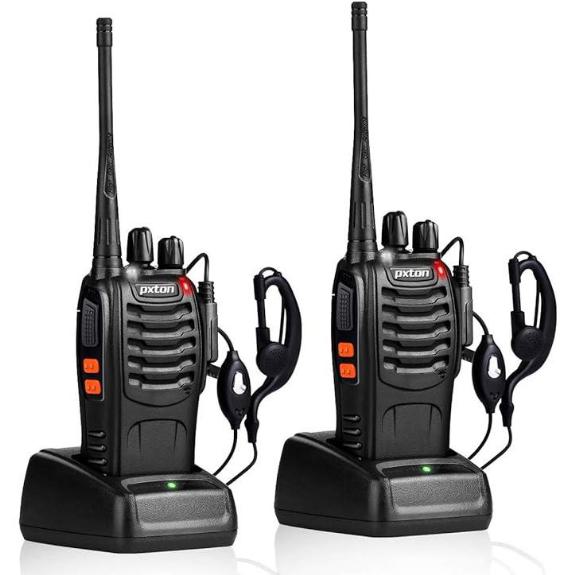
pxton Walkie Talkies Long Range Two-Way Radios (2-Pack)
- Battery Type: Li-ion rechargeable
- Channels: 16 preset channels
- Range: Maximum 2 miles (per listing)
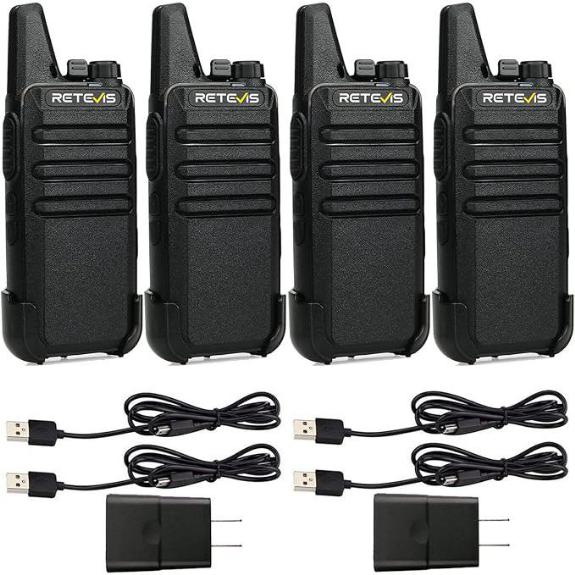
Retevis RT22 Rechargeable Walkie Talkies (4-Pack)
- Battery Type: USB-C rechargeable, 1000 mAh
- Channels: 16 channels
- Range: Maximum 2 miles (per listing)
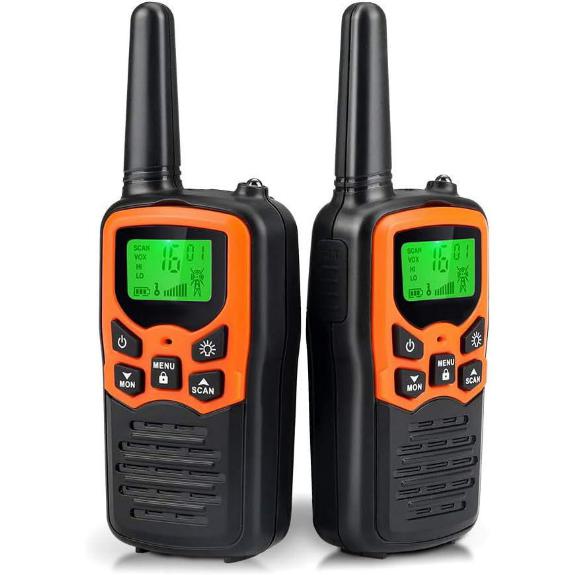
MOICO Long Range Walkie Talkies for Adults (2-Pack)
- Battery Type: AAA (not included)
- Channels: 22 FRS channels
- Range: 0.5-1 mile (urban), further in open areas
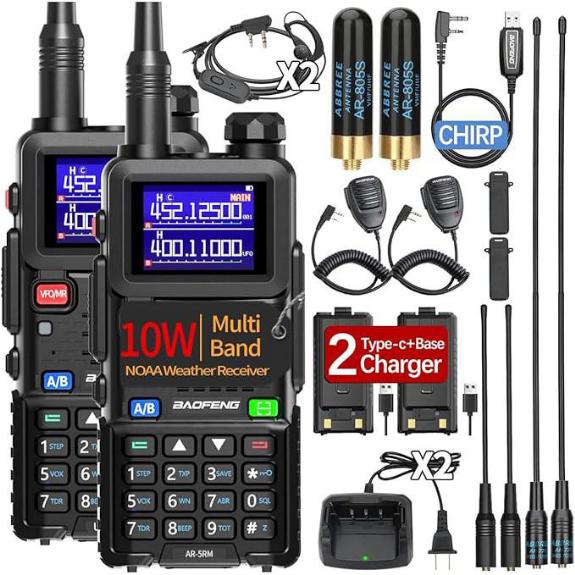
Baofeng AR-5RM 10W Walkie Talkies 2-Pack with Programming Cable
- Battery Type: 2500mAh Li-ion rechargeable
- Channels: 999 storage channels
- Range: Maximum 5 miles (per listing)
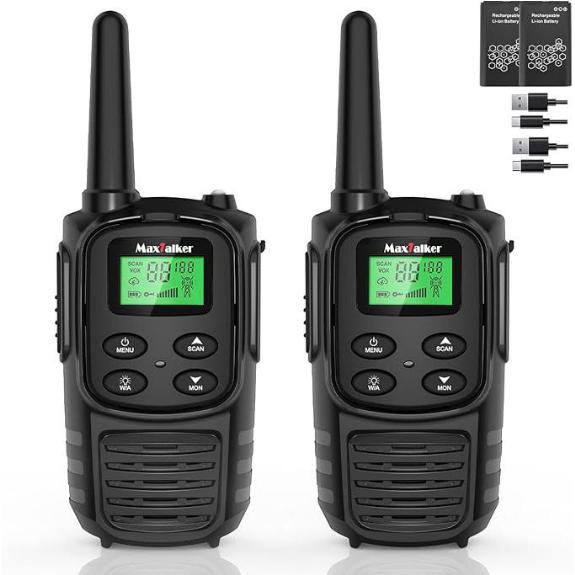
MT10 Rechargeable Walkie Talkies for Adults (2-Pack)
- Battery Type: 1200mAh Li-ion rechargeable
- Channels: 22 channels, 99 CTCSS tones
- Range: Lists up to 5 miles (spec table says 5 kilometer)
The full breakdown
A closer look at each pick
Motorola Talkabout T210TP Two-Way Radios (3-Pack)
The Motorola Talkabout T210TP is the pick we would hand to a family, because the maker settles the license question for you. Motorola's spec sheet lists the frequency band as FRS 462-467 MHz and calls these "FRS radios-license free," so you can check that against the FCC rules below.
The 3-pack gives you three radios, three rechargeable NiMH battery packs, two USB chargers, belt clips and name stickers, according to Motorola. You get 22 channels and 121 privacy codes, which filter out other users on your channel but do not keep your conversation private. iVOX/VOX lets you talk hands-free.
Power is where this set fits an outage. Motorola rates the 800 mAh pack at up to 18 hours and says the radio also runs on standard AA batteries, up to 45 hours on three alkalines, so a drawer of AAs keeps it going when there is nothing to charge from. Charging is micro-USB, not USB-C.
Motorola's range figures are honest about the gap: up to 20 miles from mountain to valley, up to 1 mile in a neighborhood. Plan on the neighborhood number. Motorola lists no weather alert feature and gives no water rating, so pair it with a weather radio and keep it dry.
- Battery Type
- 800 mAh NiMH rechargeable, or 3 AA alkaline
- Channels
- 22 channels, 121 privacy codes
- Range
- Up to 1 mile in a neighborhood, up to 20 miles mountain to valley (per Motorola)
- VOX Hands-Free
- iVOX/VOX hands-free
- Weather/Emergency Features
- None listed by Motorola
- Durability Rating
- No water rating given by Motorola
- Additional Feature
- 3-radio family pack; Micro-USB charging; 2-year radio warranty (per Motorola)
pxton Walkie Talkies Long Range Two-Way Radios (2-Pack)
If you want reliable radios on a tight budget, pxton's rechargeable two-way radios do the job without costing much.
You get 16 preset channels and 50 CTCSS and 105 CDCSS privacy codes that filter out other users on your channel. VOX voice control lets you talk hands-free when you are busy with something else. The scanning function and low battery alarm both help you stay on top of things.
The battery lasts 8 to 96 hours depending on use and charges in 3 to 4 hours. The listing gives a maximum range of 2 miles and calls the shell drop-proof and rainproof.
This listing says "Certified under FCC Part 90" and never says FRS, so check the manual or ask the seller which service and channels the radios use before you count on them being license-free.
The listing also says the seller provides lifetime after-sales service.
- Battery Type
- Li-ion rechargeable
- Channels
- 16 preset channels
- Range
- Maximum 2 miles (per listing)
- VOX Hands-Free
- VOX voice control included
- Weather/Emergency Features
- Night flashlight, low battery alarm
- Durability Rating
- Drop-proof and rainproof
- Additional Feature
- 2-unit starter pack; Lightweight compact design; Lifetime after-sales service (per listing)
Retevis RT22 Rechargeable Walkie Talkies (4-Pack)
Small, affordable, and built for everyday use, the Retevis RT22 rechargeable walkie-talkies are a good fit for families who need reliable short-range radios.
The thumb-length blunted antenna stays out of the way and will not snag on your gear, and the separate belt clip lets you grab the radio fast. The USB-C port means you can charge over USB-C, and the listing says the 1000 mAh battery lasts about 10 hours.
The 300 mW speaker gives you clear audio, and the squelch function cuts the static from weak signals. Hands-free operation keeps your hands open for other tasks. The listing calls these FRS radios, says they are license-free and meet FCC rule part 95, lists 16 channels and a maximum range of 2 miles, and describes the radio as water resistant.
- Battery Type
- USB-C rechargeable, 1000 mAh
- Channels
- 16 channels
- Range
- Maximum 2 miles (per listing)
- VOX Hands-Free
- Handsfree operation supported
- Weather/Emergency Features
- Squelch function for clarity
- Durability Rating
- Water resistant (per listing)
- Additional Feature
- USB-C charging port; Thumb-length safety antenna; 300 mW speaker
MOICO Long Range Walkie Talkies for Adults (2-Pack)
For families who want reliable radios without spending much, the MOICO Long Range Walkie Talkies give you good value. You get 22 FRS channels with 99 privacy codes, which adds up to 2,178 combinations. The codes filter out other users on your channel but do not keep your transmissions private. The listing calls it a license-free radio application. VOX hands-free operation has three sensitivity levels so you can do more than one thing at once.
Expect 0.5 to 1 mile of range in town, more in open areas, though buildings and weather will cut it down. The back-lit LCD keeps you going after dark, and the built-in LED flashlight works as emergency lighting too. A detachable belt clip keeps your hands free, and the drop-proof shell takes rough handling. The spec table also says water resistant. These run on four AAA batteries each, which the listing says are not included, and the light, compact build is easy to pack.
- Battery Type
- AAA (not included)
- Channels
- 22 FRS channels
- Range
- 0.5-1 mile (urban), further in open areas
- VOX Hands-Free
- VOX with 3 sensitivity levels
- Weather/Emergency Features
- LED flashlight, back-lit LCD
- Durability Rating
- Drop-proof hard shell, water resistant (per spec table)
- Additional Feature
- Back-lit LCD screen; 2178 privacy combinations; AAA battery powered
Baofeng AR-5RM 10W Walkie Talkies 2-Pack with Programming Cable
This one is different from the rest. The listing says you can transmit on VHF and UHF amateur bands, so read the FCC license section below before you use it, because operating an amateur station requires an FCC amateur operator license. Pick a license-free FRS radio instead if you want something to hand your kids. For anyone who wants wide frequency flexibility, the Baofeng AR-5RM 10W Walkie Talkies cover a lot of ground. You can receive signals across five frequency ranges, with 999 storage channels. The built-in NOAA Weather Receiver lists 10 weather channels, and the listing gives a maximum talking range of 5 miles.
The design fits the hand well, and the 1.77-inch color screen is easy to read during long use. USB-C charging works from power banks, cars, and laptops, according to the listing, so you can top up the 2500mAh battery away from an outlet. Frequency copy makes programming simpler, and the included cable lets you customize further.
The speaker mic delivers clear hands-free audio in noisy spots. The kit comes with two radios, dual antennas, speaker mics, earpieces, and all the charging gear.
- Battery Type
- 2500mAh Li-ion rechargeable
- Channels
- 999 storage channels
- Range
- Maximum 5 miles (per listing)
- VOX Hands-Free
- Hands-free speaker mic included
- Weather/Emergency Features
- NOAA Weather Receiver, 10 weather channels
- Durability Rating
- Not water resistant (per listing)
- Additional Feature
- 999 storage channels; Frequency copy feature; Programming cable included
MT10 Rechargeable Walkie Talkies for Adults (2-Pack)
Families who would rather not keep buying disposable batteries will like the MaxTalker MT10 rechargeable walkie talkies. The 1200mAh lithium battery is listed at 72 hours of standby time, with no more throwaway AAAs.
The listing says up to 5 miles in its bullet points, but its spec table says 5 kilometer, so treat the range as unsettled and do not rely on it. The listing says FRS, with 22 channels and 99 CTCSS tones.
You also get NOAA weather scan and alert features and hands-free VOX operation, plus a built-in LED flashlight. The spec table says the radio is not water resistant.
- Battery Type
- 1200mAh Li-ion rechargeable
- Channels
- 22 channels, 99 CTCSS tones
- Range
- Lists up to 5 miles (spec table says 5 kilometer)
- VOX Hands-Free
- VOX (Voice Activated Transmission) included
- Weather/Emergency Features
- NOAA Weather Scan and Alert, LED flashlight
- Durability Rating
- Not water resistant (per listing)
- Additional Feature
- 72-hour standby time; 99 CTCSS tones; Great family gift
In this guide
Best walkie talkies for emergencies, compared
Here is how the six picks line up. Every cell comes from what the Amazon listing says, or for the Motorola what Motorola’s own spec sheet says, not from our own measurements, and range is the figure each one gives. Where a listing contradicts itself, the cell says so. The MT10 is the clearest case: its bullet points say 5 miles and its spec table says 5 kilometer.
| Radio | Channels | Range (listing) | Weather alerts | Battery | License |
|---|---|---|---|---|---|
| Motorola Talkabout T210TP 3-pack | 22 | Up to 1 mile in a neighborhood, up to 20 miles mountain to valley | Not listed | 800 mAh NiMH rechargeable, up to 18 hours, or 3 AA | FRS per maker |
| pxton 2-pack | 16 | Maximum 2 miles | Not listed | Rechargeable, 8 to 96 hours depending on use | Not stated; Part 90 certification listed |
| Retevis RT22 4-pack | 16 | Maximum 2 miles | Not listed | USB-C rechargeable, 1000 mAh, about 10 hours | FRS per listing |
| MOICO 2-pack | 22 | 0.5 to 1 mile, up to 3 miles in the open | Not listed | AAA, not included | FRS per listing |
| Baofeng AR-5RM 2-pack | 999 storage channels | Maximum 5 miles | NOAA receiver, 10 weather channels | 2500mAh rechargeable, USB-C | Amateur license required |
| MT10 2-pack | 22 | Up to 5 miles in bullets, 5 kilometer in spec table | NOAA scan and alert | 1200mAh rechargeable, 72-hour standby | FRS per listing |
“FRS per listing” means the seller calls it an FRS radio. “FRS per maker” means Motorola’s own spec sheet lists the FRS band and calls the radio license free. We have not verified the certifications ourselves, so the cards and the section below tell you what to check.
Do you need a license for walkie talkies?
It depends on which radio service the radio uses, and the box or listing is where to find out. Three services come up with handheld radios. Each one works differently, so here they are one at a time, using the FCC’s own words.
FRS: no individual license
FRS stands for Family Radio Service, the short-distance service that most blister-pack walkie talkies are built for. The FCC says:
The service is licensed-by-rule so the general public can use the devices without having to obtain a license and channel sharing is achieved through a listen-before-talk etiquette.
Source: Federal Communications Commission, “Family Radio Service (FRS)” (fcc.gov), accessed November 2026.
The Licensing tab of the same page puts the condition plainly:
This means an individual license is not required to operate an FRS radio provided you comply with the rules.
Source: Federal Communications Commission, “Family Radio Service (FRS)” (fcc.gov), accessed November 2026.
Compliance includes the equipment itself. The FCC’s Operations tab says:
A FRS transmitter may not be modified and must be certified by the FCC.
Source: Federal Communications Commission, “Family Radio Service (FRS)” (fcc.gov), accessed November 2026.
That is why the pxton 2-pack listing matters. It says “Certified under FCC Part 90” and does not say FRS, which is a different set of rules from the Part 95 rules the FCC cites for FRS. A listing that leaves out the service name does not tell you the radio is license-free, and it does not tell you the radio needs a license either. When in doubt, don’t transmit until the manual or the seller gives you a straight answer.
GMRS: license required
GMRS is the General Mobile Radio Service, a licensed service that uses channels around the same 462 MHz and 467 MHz frequencies as FRS. The FCC says:
An FCC license is required to operate GMRS system. Licenses are issued for a ten-year term and can be renewed between 90 days prior to the expiration date and up to the actual expiration date of the license.
Source: Federal Communications Commission, “General Mobile Radio Service (GMRS)” (fcc.gov), accessed November 2026.
The same page explains who can get one and who is covered:
You may apply for a GMRS license if you are 18 years or older and not a representative of a foreign government. If you receive a license, any family member, regardless of age, can operate GMRS stations and units within the licensed system.
Source: Federal Communications Commission, “General Mobile Radio Service (GMRS)” (fcc.gov), accessed November 2026.
The FRS page also covers radios once sold as dual-service FRS and GMRS. In the FCC’s account, one that exceeds the FRS limits or uses certain GMRS-only channels is a GMRS device that needs an individual license. If a box mentions both services, read that FCC page before you transmit.
Amateur (ham): exam and license required
Amateur radio is a service for people with a personal interest in radio, and it has its own operator license. Of the six picks, only the Baofeng AR-5RM is a ham radio, since its listing describes transmitting on the VHF and UHF amateur bands. The FCC says:
Operation of an amateur station requires an amateur operator license grant from the FCC. Before receiving a license grant, you must pass an examination administered by a team of volunteer examiners (VEs).
Source: Federal Communications Commission, “Amateur Radio Service” (fcc.gov), accessed November 2026.
So the Baofeng is not a radio to hand to a child or a neighbor. We keep it in the list for people who already hold a ham license, and we do not recommend it as a first family radio.
Which one fits your family
For radios the whole household can pick up without paperwork, shop for ones whose listing names FRS and whose manual agrees. If you want GMRS, apply for the license first. A radio like the Baofeng makes sense only for someone who holds, or plans to earn, a ham license. One more FCC detail affects every FRS buyer. The FCC’s Data tab says:
All channels are shared with GMRS, so you may hear communications from licensed GMRS stations on these channels.
Source: Federal Communications Commission, “Family Radio Service (FRS)” (fcc.gov), accessed November 2026.
Strangers on those channels may hear you, which matters for the sections below.
What to look for in emergency walkie talkies
Five things separate one emergency two-way radio from another: range, battery, weather alerts, durability and channels. The sections below take them in that order.
Range and coverage
Most listings in this guide claim a few miles at best, Motorola claims up to 20 miles from mountain to valley, and the number to plan on is much smaller. The FCC’s Operations tab for FRS says:
The usual range of an FRS device on channels 8-14 is less than one-half mile, but longer range communications can be achieve on channels 1-7 and 15-22 depending on conditions.
Source: Federal Communications Commission, “Family Radio Service (FRS)” (fcc.gov), accessed November 2026.
The FCC’s wording includes a typo, and we left it as published. The practical rule is to plan on about a mile or less between buildings, and to expect less on channels 8-14. Motorola rates the T210 at up to 1 mile in a neighborhood, the pxton and Retevis listings give a maximum of 2 miles, the MOICO listing says 0.5 to 1 mile in town, and the Baofeng and MT10 listings give a 5 mile figure, with the MT10’s own spec table disagreeing about whether that means miles. A listing’s maximum is a best case, usually over open ground, so use it to compare radios against each other and not to promise your family a distance.
Walls, hills and storms all weaken the signal, so try the radios between the places your family would actually be before you need them.
Battery
A radio is only useful while its battery holds a charge. Motorola rates the T210’s 800 mAh pack at up to 18 hours and three AA alkalines at up to 45 hours, the pxton 2-pack listing says 8 to 96 hours depending on use, the Retevis lists about 10 hours on a 1000 mAh battery, and the MT10 lists 72 hours of standby on 1200 mAh. Standby and talking are different numbers, and the listings give no talk-time figure, so keep a charging plan.
Charging is the other half. The Retevis, Baofeng and MT10 listings mention USB-C, which means a power bank can top them up when an outlet is dead. A charged power bank kept with the radios covers that job. The Motorola charges over micro-USB, and Motorola says it also runs on standard AA batteries, so a pack of AAs is a backup when nothing is left to charge from. The MOICO pair uses AAA batteries that the listing says are not included, so buy them with the radios. Whether to stock disposable or rechargeable AAAs is a separate question, and our guide on whether batteries expire covers it.
Weather alerts
A storm can turn fast, so it helps to have a way to hear warnings. Ready.gov names NOAA Weather Radio as one of the ways alerts reach you:
Pay attention to EAS, NOAA Weather Radio, or local alerting systems for current emergency information and instructions.
Source: Ready.gov, “Tornadoes” (ready.gov), accessed November 2026.
Of the six radios here, the Baofeng AR-5RM lists a NOAA weather receiver with 10 weather channels and the MT10 lists NOAA weather scan and alert. The other four do not list a weather feature. If weather alerts are your main reason for buying, you have two choices. You can pick one of those two radios, or you can add a dedicated weather radio, which is what we would lean toward because it is built for that one job. The resources page lists one, and our guide to the best NOAA weather radios compares dedicated models. The National Weather Service explains how the service works on its NOAA Weather Radio page.
Also sign up for your community’s warning system, and follow your local officials when a warning goes out. Our guides to preparing for a tornado and preparing for a hurricane cover what to do before those storms arrive.
Durability
Check what each listing says, and read the spec table as well as the bullets. The pxton and MOICO listings say drop-proof, and those two spec tables, along with the Retevis one, say water resistant. The Baofeng and MT10 spec tables say not water resistant, and Motorola gives no water rating for the T210. None of the six listings promises the radio will survive being submerged. Water resistant and waterproof are different claims, and you should stay out of floodwater whatever your radio says.
Channels and privacy codes
Sixteen channels sounds like plenty until two households are stepping on each other. The FCC says FRS has 22 channels, none assigned to a single user, and that users “must cooperate in the selection and use of the channels.”
CTCSS and CDCSS privacy codes are settings that make your radio ignore transmissions that do not carry your code. They do not make a conversation private, because anyone on the same channel can still hear you, and they do not stop another group from transmitting at the same moment. The FCC’s line that all FRS channels are shared with GMRS applies here as well. The MOICO and MT10 listings give 99 CTCSS tones, Motorola lists 121 privacy codes for the T210, and the pxton 2-pack lists 50 CTCSS and 105 CDCSS codes.
If you are mixing brands, our guide on whether all two-way radios work together explains what has to match. Read each manual before the first outage, since a radio set to a code the others lack will seem silent.
Using radios when the power is out
Most of what makes a radio useful in an outage happens before the outage.
Check the radios and the supply behind them while the lights are still on. Charge the rechargeable models, or fit fresh AAAs in the MOICO pair, and keep any charger or power bank where you can find it in the dark. Our power outage guide walks through the rest of the house.
Agree on one channel and one privacy code, then write them down. The family plan is the right home for them, so put them in your family emergency plan and on your binder checklist next to your meeting spots. If everyone owns a copy, a child who lost track of the setting does not have to guess.
Treat the channel as a shared space. Listen for a few seconds before you talk, which is the etiquette the FCC describes, and keep your messages short. Because privacy codes do not keep others out and the FCC says FRS channels are shared with GMRS, do not say anything on the radio that you would not want a stranger to hear. That includes names, your address and whether anyone is home.
Keep a plan for when the radios fall short. Phone calls and radios both compete for limited capacity in a crisis. Ready.gov’s After a Tornado advice says:
Save your phone calls for emergencies and use text messaging or social media to communicate with family and friends.
Source: Ready.gov, “Tornadoes” (ready.gov), accessed November 2026.
A short text can get through when a call cannot, and a radio can cover the hallway, the yard or the next house when neither does. Choose your family channel in advance, and do not count on anyone else monitoring it.
Where the radios live is our suggestion, not a rule. A home set can sit with your other outage supplies where you can reach it without a light, and a pair can ride in each car if your family drives separately. Rehearse once so everyone knows which button talks.
If something is wrong, call 911 and follow your local emergency officials. A family radio only helps your own household talk to itself.
Frequently asked questions
Do emergency radios require FCC licenses?
The answer depends on the service. The FCC says FRS is “licensed-by-rule so the general public can use the devices without having to obtain a license,” and that an individual license is not required for an FRS radio “provided you comply with the rules.” For GMRS, “An FCC license is required to operate GMRS system.” Ham radio needs an amateur operator license. The pxton 2-pack listing says “Certified under FCC Part 90” and does not name FRS, so confirm with the seller or the manual before you assume anything. When in doubt, don’t transmit.
Can I use a GMRS or ham radio without a license?
No. The FCC says a GMRS license is required to operate a GMRS system and that operating an amateur station requires an amateur operator license grant from the FCC, which you earn by passing an exam. A radio’s ability to tune a frequency does not give you permission to use it. If a radio’s service is unclear, do not transmit until you have the answer.
How far do walkie talkies really reach?
Plan on about a mile or less in town. The FCC says the usual range of an FRS device on channels 8-14 is less than one-half mile, with longer range possible on other channels depending on conditions. The listings give maximums from 2 to 5 miles, and the MT10’s own spec table says 5 kilometer. Motorola says up to 20 miles from mountain to valley but up to 1 mile in a neighborhood. Treat every maximum as a best case.
Can walkie talkies get weather alerts?
Some can. Of the six here, the Baofeng AR-5RM lists a NOAA weather receiver with 10 weather channels and the MT10 lists NOAA weather scan and alert. The others do not list a weather feature, so a dedicated weather radio is the way to cover them.
Are walkie talkies waterproof for floods?
Not reliably. Some listings say water resistant, others say not water resistant, and none promises the radio survives submersion. Stay out of floodwater and follow your local officials’ instructions.
Conclusion
Pick the radio that fits your family, confirm what its listing says about the radio service, and then make sure everyone knows how to use it. For most households the Motorola Talkabout T210TP is our pick, since Motorola’s own spec sheet lists it as FRS and license free. The MOICO, Retevis and MT10 listings name FRS, the pxton 2-pack listing cites Part 90 instead, the MT10 and the Baofeng AR-5RM add weather features, and the Baofeng needs a ham license.
Pairing radios with a written family communication plan means everyone knows what to do before you press the button. The American Red Cross recommends picking an out-of-area contact and two meeting spots as part of that plan, since it may be easier to reach someone long distance when local phone lines are overloaded or down. In any emergency, call 911 and follow your local emergency officials.