The Family Emergency Binder
Home Inventory Checklist for Insurance (Free Printable, Room by Room)
In this guide
A home inventory checklist is a room-by-room record of what you own, made for insurance claims after a fire, storm, or theft. Walk each room with your phone recording, write down the brand, model, serial number, and purchase date of anything valuable, keep receipts or photos as proof, and store a copy outside your home. Our free printable puts all 13 rooms on two pages as tick boxes, with a table for your high-value items and the off-site test at the end.
You don’t have to catalog every fork on day one. A narrated video of each room, saved somewhere off-site, is a usable first record. FEMA also says to write down descriptions, including year, make, and model, so the written list comes next.
Want the list on screen instead? Jump to the room-by-room checklist. If you want a full page per room with space to tape photos, the Oklahoma Insurance Department’s free 18-page home inventory PDF does that.
Why a home inventory matters when you file a claim
After a loss, your insurance company will ask what you had. Without an inventory, you may be rebuilding that list from memory and whatever receipts and photos you can track down, possibly from a hotel room. Small things are easy to leave off: the drawer of chargers, the tools in the garage, the winter coats in the hall closet.
FEMA’s guide to documenting and insuring your property (FEMA P-1097) says an inventory helps you prove the value of what you owned, which could speed up your claim, and documents losses for any tax deduction you can claim. It also helps you work out how much insurance to buy, while you can still change it.
The Nebraska Department of Insurance puts the practical point plainly in its storm preparation brochure: the more detail you include, the easier it will be for your insurer to evaluate your loss.
Do it in three passes
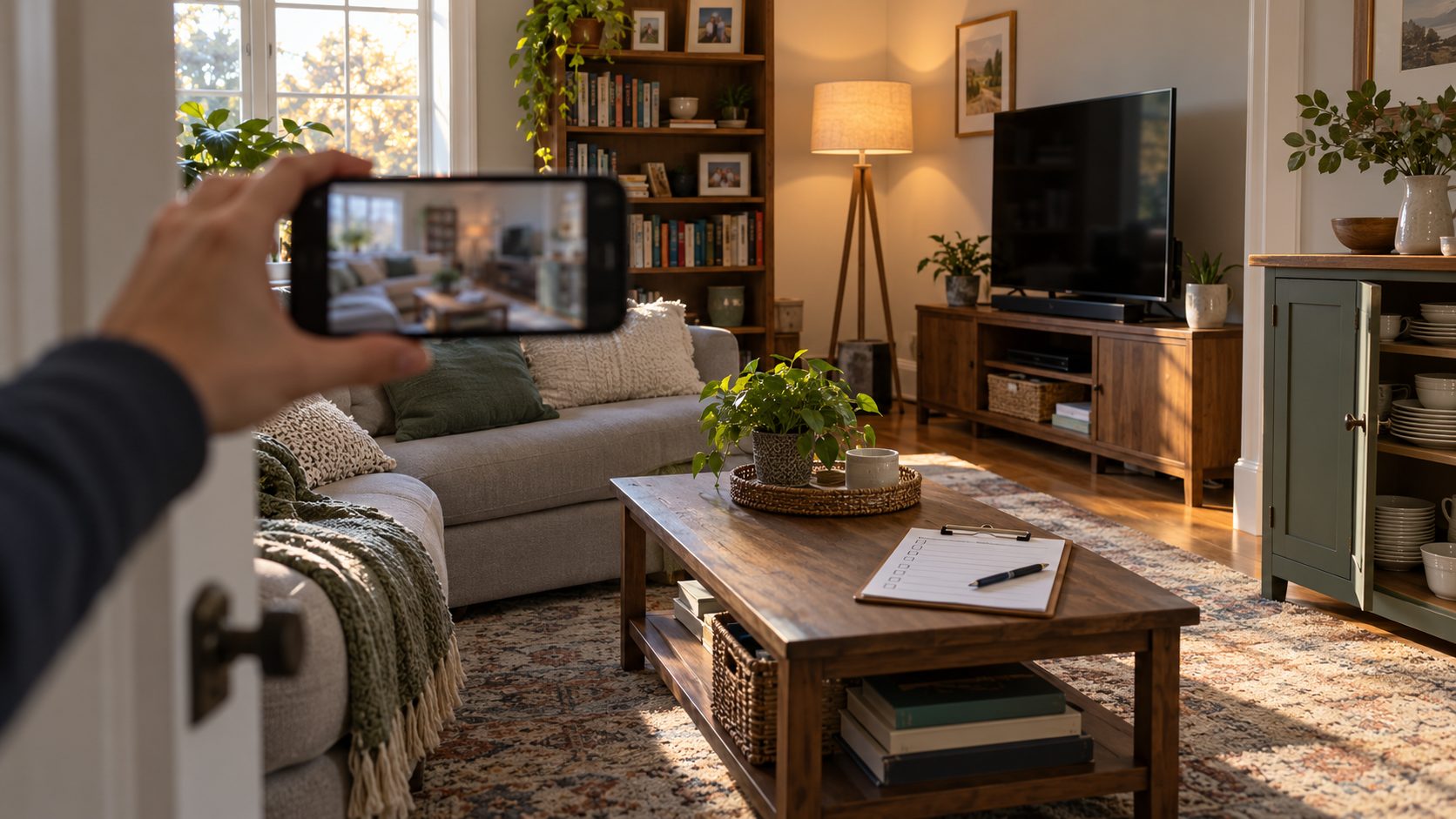
Pass 1: A video of every room. Walk through the house with your phone recording. Open closets, cabinets, and drawers as you go, and say out loud what you’re looking at: “Samsung TV, bought around 2023. Couch from the furniture store on Main.” Include the garage, attic, basement, and any shed. This is the Nebraska Department of Insurance’s own fallback: if you don’t have time for a full list, video or photograph every room, open drawers and closets, and don’t skip the basement, garage, and storage buildings. Upload the video somewhere outside the house before you put the phone down, to a private account with a strong password (FEMA says to secure electronic copies with strong passwords), and put the date in the file name. A video is a first record, not the whole job: serial numbers, dates, and prices are hard to read on camera, which is what pass 2 is for.
Pass 2: A short list of high-value items. Pick out the things that would hurt most to replace: electronics, jewelry, appliances, instruments, tools, collectibles, furniture sets. For each one, take a wide photo and a close-up, plus a photo of the serial or model number label, and fill in the details from the table below. The Oklahoma Insurance Department’s home inventory file has photo tips worth borrowing, including having a family member in all pictures to help verify ownership, and holding the camera at a 45-degree angle for shiny or reflective surfaces. Save receipts or order emails in the same folder.
Pass 3: The full room-by-room checklist. Use the checklist further down to find everything else, one room at a time, and record it on a room page (below). This is the part you can spread over weeks: the kitchen one evening, the garage on a Saturday.
What’s on the free printable
The printable is a two-page US Letter PDF that follows the three passes above. Every tick box and tan line is a fillable field, so you can fill it in on a computer in Acrobat, Preview or most browsers, or print it and use a pen. Here’s what’s on each page.
Page 1: the three passes and the first nine rooms
Under the title, one line sets the rules: the list is for insurance claims after a fire, storm or theft, items marked with an asterisk (*) are easy to miss, and everyday things get grouped with a rough count.
Next come three boxes, one per pass, each a short version of the steps above: Pass 1, Video; Pass 2, Valuables; Pass 3, This list. If someone else in the house is helping, those three boxes are enough to get them started without this article.
The rest of page 1 is nine room boxes: living and family room, kitchen, dining room, bedrooms, kids’ rooms, bathrooms, home office, laundry room, and closets and storage. Each box has two parts:
- The room tracker, in the box’s header. Three tick boxes labeled Video, Valuables and Done. Tick Video when that room is in your pass 1 recording, Valuables when its high-value items are on the page 2 table, and Done when you’ve worked through its list.
- The item list. The same items as the checklist further down this article, each with its own tick box. Tick a line once it’s recorded: on video, plus a written entry or a counted group like “about 20 shirts” on your room page. The asterisks mark the easy-to-miss ones, like pantry food, under-bed boxes, and holiday decorations.
Page 2: four more rooms, then the records
Page 2 starts with the last four room boxes: garage, attic and basement, outdoors, and away from the house. That last one is for a storage unit, a child’s dorm room, or things kept at work. List them whether or not you think your policy covers them, then ask your agent.
Below the rooms is the “High-value items” table, seven rows, labeled “one row per item, matching the photos.” Its columns are Room, Item, Brand and model, Serial number, Bought, Paid, Replace today, and Proof. Fill it in during pass 2, straight from your photos: copy the serial number from the photo of the label, and in Proof write what backs it up, such as “receipt in folder” or “order email.” If you run out of rows, print page 2 again.
Then two blocks sit side by side:
- Where the copies live. Five lines: where the video and list are stored, the second copy off-site, who else can open it, your insurer’s name, and where the policy is kept. Write locations, like “shared cloud folder, Home Inventory” or “flash drive at my sister’s,” never a password or a policy number.
- The off-site test. The four checks from the off-site test section below, as tick boxes.
A footer line repeats when to update it: after big purchases, gifts, renovations or a move, and when you review your policy each year. The last box, “Why dates and prices matter,” is the one-paragraph version of the actual cash value and replacement cost section below.
The printable doesn’t include a page-per-room item table. If you want one, copy the room page below or use the Oklahoma form.
What to write down for each item
Photos and video show what you had, but the written details pin down which model it was and how old. FEMA says to write down the year, make, and model alongside your photos and video, and notes that for valuable items you may want an appraisal. Nebraska’s list adds brand name, price, purchase date, serial number, and receipts.
| Field | Why it matters |
|---|---|
| Item and room | So the list matches the video and nothing is counted twice |
| Brand and model | Separates a basic model from a high-end one |
| Serial number | Ties the record to the exact item you owned |
| Purchase date | Used to figure depreciation if your policy pays actual cash value |
| What you paid | Shows what the item cost new, next to today’s price |
| Cost to replace today | What a similar new item costs now |
| Proof you have | Receipt, order email, appraisal, photo of the box |
For valuable items, use one row per item. For everyday things, a row per group with a rough count keeps the job finishable: “kitchen dishes, about 40 pieces” or “about 20 shirts.” Add detail later where you can; Nebraska’s point about detail making a loss easier to evaluate applies to these rows too.
High-value item worksheet
This is the same table as page 2 of the printable. To keep it on paper without the printable, copy it into a notebook, or use the column names as headers in a spreadsheet. The first row is an example.
| Room | Item | Brand and model | Serial number | Bought | Paid | Replace today | Proof |
|---|---|---|---|---|---|---|---|
| Living room | 65-inch TV | (brand, model) | (from label) | 2023 | $ | $ | Order email, photo of label |
For a spreadsheet, add one more column for the photo or video file name, so each row points to its picture.
Room tracker
On the printable, the tracker is the three tick boxes (Video, Valuables, Done) at the top of each room box. In a spreadsheet, make one row per room with those three columns and put the date in each cell when that pass is done for the room.
Room page
The printable’s room boxes are tick lists for tracking your progress, not a place to record each item. The written list still matters, since FEMA says to write down descriptions alongside photos or video, so keep it on room pages, and use the high-value table on page 2 for valuables. For a room with a lot worth itemizing, like a kitchen full of small appliances or a garage of tools, make a room page. Copy the table into a document or spreadsheet and print one per room, or draw the columns in a notebook. If you’d rather print a ready-made form, the Oklahoma PDF linked above has a page for each room. When the ten rows run out, start a second page for the same room. Group everyday things with a count; give valuables their own row and a matching row in the worksheet above.
Room: ____________________ Video file name: ____________________ Date: __________
| Item or group | How many | Brand and model | Serial number | Year bought | Paid | Replace today | Photo or receipt |
|---|---|---|---|---|---|---|---|
The purchase date and the replacement price matter for different reasons, depending on how your policy pays. FEMA P-1097 describes two common settlement types:
Actual cash value pays the estimated current value, after depreciation. FEMA’s example: if you bought a large TV five years ago, you’ll get the estimated value of a five-year-old TV. That’s why the purchase date matters.
Replacement cost pays what it costs to replace the item at current market rates. FEMA says that for replacement cost coverage, it’s important to have an accurate assessment of what it would cost to replace your belongings, and that an up-to-date inventory helps you pick the right amount of insurance. Your policy says which settlement type you have, or your agent can tell you.
To check your coverage amount, you’ll need room pages with a “replace today” column, like the table above; the printable doesn’t have one. The Oklahoma form lists original cost and estimated present value, so add your own replacement-cost column if you use it. Add up that column, counting each item once (valuables already have a row there, so don’t add the worksheet on top). FEMA’s guide separates coverage for the dwelling, other structures, and personal property, so leave out things that may count as part of the house, like built-in appliances or a furnace, and ask about those separately. Then ask your agent how that total compares with your policy’s personal property limit, including any special limits on certain items.
High-value items deserve one more step. The Nebraska Department of Insurance suggests asking whether you own possessions, such as jewelry, electronic equipment, or antiques, that may exceed normal coverage limits. If your list turns up a ring, a watch, or a collection worth more than you’d guessed, ask your agent whether it needs separate coverage. FEMA’s documents checklist (FEMA P-1096) files appraisals, photos, and lists of valuable items with your insurance policies, so keep them with your other important documents.
The room-by-room home inventory checklist
Work through each room in the same order every time: big items, then electronics, then what’s inside drawers, cabinets, and closets. Items that are easy to miss are marked. These are the same lists as the room boxes on the printable, in the same order.
A few things on these lists, like built-in appliances, light fixtures, a furnace, or a playset, may be covered as part of the house or other structures rather than as your belongings. FEMA’s guide separates coverage for the dwelling, for other structures such as garages, decks, and fences, and for personal property. Record them anyway, and ask your agent how your policy classifies them.
Living room and family room
- Sofas, chairs, coffee and side tables, bookcases
- TV, soundbar, speakers, streaming boxes, game consoles and games
- Lamps, rugs, curtains and blinds
- Artwork, framed photos, mirrors, decor
- Books, records, DVDs (easy to miss: these add up as a group)
- Fireplace tools, baskets, throws and pillows
Kitchen
- Refrigerator, range, oven, microwave, dishwasher (note model and serial on each)
- Small appliances: coffee maker, mixer, blender, air fryer, toaster
- Cookware, bakeware, knives, utensils
- Dishes, glassware, flatware
- Pantry food and freezer contents (easy to miss)
- Cabinet contents you rarely open: serving platters, holiday dishes (easy to miss)
Dining room
- Table, chairs, buffet or china cabinet
- China, crystal, silver, table linens
- Light fixtures or chandelier
Bedrooms
- Beds, mattresses, dressers, nightstands
- Clothing, shoes, coats (easy to miss: open the closet doors on camera and count by category, not piece by piece)
- Jewelry and watches (photograph each piece)
- TVs, laptops, tablets, chargers
- Bedding, pillows, linens
- Under-bed storage boxes (easy to miss)
Kids’ rooms
- Furniture, cribs, car seats, strollers
- Toys, games, books, sports gear
- Electronics: tablets, game systems, headphones
- Clothes, which get replaced often and add up
Bathrooms
- Vanity contents, hair dryers, straighteners, electric toothbrushes and razors
- Towels, bath mats, shower curtains
- Scales, medical devices (easy to miss)
Home office
- Desk, chair, shelving, filing cabinet
- Computers, monitors, printer, router, external drives
- Phones and tablets
- Office supplies
Laundry room
- Washer and dryer (model and serial)
- Iron, steamer, drying racks
- Vacuum, mop, cleaning supplies (easy to miss)
Closets and storage
- Hall closet coats, boots, umbrellas
- Linen closet contents
- Holiday decorations (easy to miss: a few bins can hold a lot)
- Luggage, sewing machine, craft supplies, keepsakes
Garage
- Power tools, hand tools, tool chests, ladders
- Lawn mower, trimmer, leaf blower, snow blower
- Bikes, sports and camping gear, kayaks
- Freezer or second refrigerator, shelving, stored items in bins
Attic and basement
- Everything in boxes: label the boxes and photograph what’s inside
- Spare furniture, old electronics, seasonal clothing
- Furnace, water heater, and air conditioner: FEMA’s flood insurance guidance lists them under a flood policy’s building coverage, so check how your own policies treat them. Their model and serial numbers are handy to have either way
- Valuables stored low in a basement are worth moving. FEMA P-1096 suggests putting them higher and in waterproof containers.
Outdoors
- Patio furniture, grill, fire pit, umbrellas
- Shed and its contents
- Playset, trampoline
- Planters, outdoor lighting, hoses and garden tools
Away from the house
- A storage unit, a child’s dorm room, or things kept at work (easy to miss). List them either way, and ask your agent whether your policy covers belongings kept away from home.
For a paper version, the Oklahoma Insurance Department’s home inventory file gives each room its own page with space to tape photos and receipts, and ends with a summary page that totals original cost and present value.
Where to keep your home inventory
At least one copy has to live somewhere the same fire or flood can’t reach. An inventory saved only on the computer in the den burns with the den. The Nebraska Department of Insurance says to store the information off the premises, Oklahoma’s says to keep it in a safe deposit box or another safe place outside your home, and FEMA says to store it where it can be easily reached after a disaster.
Places to keep a copy (more than one is fine):
- Cloud storage. Upload the video, photos, and list to a cloud folder you can open from any phone. Ready.gov’s financial preparedness page suggests a safety deposit box, an external drive, or the cloud for important documents.
- A trusted relative or friend. FEMA suggests leaving copies with someone you trust. A flash drive in a drawer at your sister’s house counts. FEMA also says to protect electronic copies with strong passwords.
- A safe deposit box or a fireproof and waterproof box. FEMA lists both for paper copies and drives. A box at home beats a desk drawer, but keep another copy outside the house too.
Keep bank account numbers, card numbers, and passwords out of the inventory, especially any copy you hand to a relative. For insurance, FEMA says to keep your policy number, your insurer’s phone number, and claim filing instructions in a secure, convenient location, and Nebraska’s brochure suggests storing them with the inventory. If your inventory copy is shared widely, keep the policy number with the policy itself and note in the inventory where that is.
Then write down where the inventory itself is. The “Where the copies live” block on page 2 of the printable is built for this. The Home & Property section of our emergency binder checklist lists a room-by-room photo or video inventory, stored with the binder or backed up online. Add a short note in the binder saying where each copy lives, so whoever opens it knows the video is in a shared cloud folder and the printed list is with your sister.
The off-site test
Once pass 1 is done, check that the copy outside the house actually opens. Open it from the remote copy, not from a file saved on the phone that recorded it: go to the cloud service’s website in a browser and play the video from there, since the website shows what’s stored in the cloud rather than what’s on your phone. Do this from your own computer or another device you trust, not a borrowed one. If your copy is a drive at a relative’s house, ask them to plug it in and open one file while you’re on the phone with them.
The four checks are tick boxes on page 2 of the printable.
- Does the video open from the remote copy?
- Does the file name or folder show the date it was recorded?
- Can you find your insurer’s name and where the policy is kept?
- Have someone else in the house, or a relative, find the inventory and open it without your help. Give them access through the cloud service’s own sharing feature (view-only is enough) rather than your password. Did they get in?
After pass 2, add one more check: pick one valuable item and find its photo, its serial number, and its receipt or order email from the remote copy.
When all four work, including the other person actually opening it, you’ve confirmed that a copy outside the house opens and that someone besides you can get to it.
Keep it current
A home inventory doesn’t need constant updating. Add to it when something changes:
- You buy something expensive or get a valuable gift
- You renovate a room or replace appliances
- You move
- You get rid of high-value items
FEMA recommends reviewing your policy every year and updating it for new purchases, renovations, and rising rebuilding or replacement costs, and Nebraska says to examine your policy at least once a year. Flip through the inventory at the same sitting. When a big purchase comes home, photograph the item, its serial label, and the receipt before the box goes out.
If you ever have to use it
If you have a loss, FEMA P-1097 says to file your claim promptly, since many policies have time limits, to photograph and video the damage, and to keep receipts for repair supplies and for hotel and restaurant costs if you have to stay somewhere else. Your inventory gives the adjuster a starting list instead of a blank page.
An inventory documents what you had. It doesn’t create coverage. FEMA says most homeowner policies don’t cover flood or earthquake damage, so if those are risks where you live, that’s a separate conversation with your agent.
Frequently asked questions
What should be on a home inventory checklist?
Every room, including the garage, attic, basement, shed, and outdoor areas, plus what’s inside drawers, cabinets, and closets. For each valuable item, record the brand, model, serial number, purchase date, price, and cost to replace it today, with a photo and a receipt where you have one. Group everyday items by category with a rough count.
Do I need receipts for everything?
Keep the ones you have, and start saving them now for anything expensive; the Nebraska and Oklahoma insurance departments both list receipts as part of a good inventory. For things you bought without keeping one, photos, video, and a written description with brand, model, and approximate age still document what you owned. If you’re unsure what proof your insurer will want, ask your agent.
Should renters make a home inventory too?
Yes. FEMA’s guide lists personal property coverage for things like furniture and clothing among the coverage types a renters policy can include, so your inventory is the record you’d use for that part of a claim. The same checklist works. Skip appliances that belong to the landlord.
Is a video enough, or do I need a written list?
A narrated video is a solid start, and the Nebraska Department of Insurance suggests one if you don’t have time for a full list. A written list adds what video can’t show clearly: serial numbers, purchase dates, and prices. Do the video first, then add the list for valuable items.
Should I use a spreadsheet, an app, or paper?
Whatever you’ll actually keep up. A spreadsheet in a cloud folder is easy to update and share. Paper works if you also keep a copy outside the house; our free printable, the worksheet above, or the Oklahoma Insurance Department’s free form will do. Whichever you pick, run the off-site test above.
Is there a free printable home inventory checklist?
Yes. Ours is a free two-page fillable PDF with 13 room boxes to tick off, a room tracker on each, a seven-row high-value item table, a block for where the copies live, and the off-site test. Enter your email in the signup box on this page to get it. The Oklahoma Insurance Department also publishes a free 18-page form with a page for each room.
How often should I update a home inventory?
Once a year when you review your insurance policy, and after big purchases or renovations. FEMA says to review your policy annually and update it for new purchases and renovations, and the Nebraska Department of Insurance says to examine your policy at least once a year. We’d also update it after gifts or a move.
Where to start
Start with pass 1. If you haven’t got it yet, grab the free printable so the room boxes can track your progress. Record a narrated video of every room, drawers and closets open, garage and attic included, and upload it somewhere outside the house. Then write down where you put it, so someone else could find it too.
The binder
The part of being prepared most families never finish
The Family Emergency Binder puts your family's contacts, documents, and plans in one place: start with the essentials, then build on it a few sittings at a time. $19, instant download.
See what's inside