In this guide
An emergency binder checklist covers seven categories: contacts, documents, finances and insurance, home and property, medical and health, evacuation and shelter, and wills and wishes. For each item, you either gather the actual paper or note where the original lives, using carrier names and locations instead of account numbers, PINs, or passwords.
Building the list is the easy part. The habit that keeps it useful, and safe, long after tonight is knowing where things are, not what’s inside them.
Note where things are, not what’s in them
Most checklists like this one ask you to gather categories: contacts, documents, money, property. The harder question is what to actually write down for each one.
The safest answer is a locator, not a ledger. For every item below, note where the original or the account lives, a fireproof box in the hall closet, a safe deposit box at First National, a specific folder in the cloud, never the account number, routing number, PIN, Social Security number, or password itself. Anyone who finds a locator list learns where to look. Anyone who finds a list of real account numbers has everything they need to act on them.
That’s a higher bar than most versions of this exercise set. Even the federal government’s own version, FEMA’s Emergency Financial First Aid Kit, instructs people to write down full account numbers, routing numbers, and the verification codes off the back of their credit cards. Ready.gov’s own financial-preparedness guidance points the safer direction: gather the documents, then store copies somewhere accessible, a safe deposit box, an external drive, or the cloud, rather than a page of numbers anyone could use.
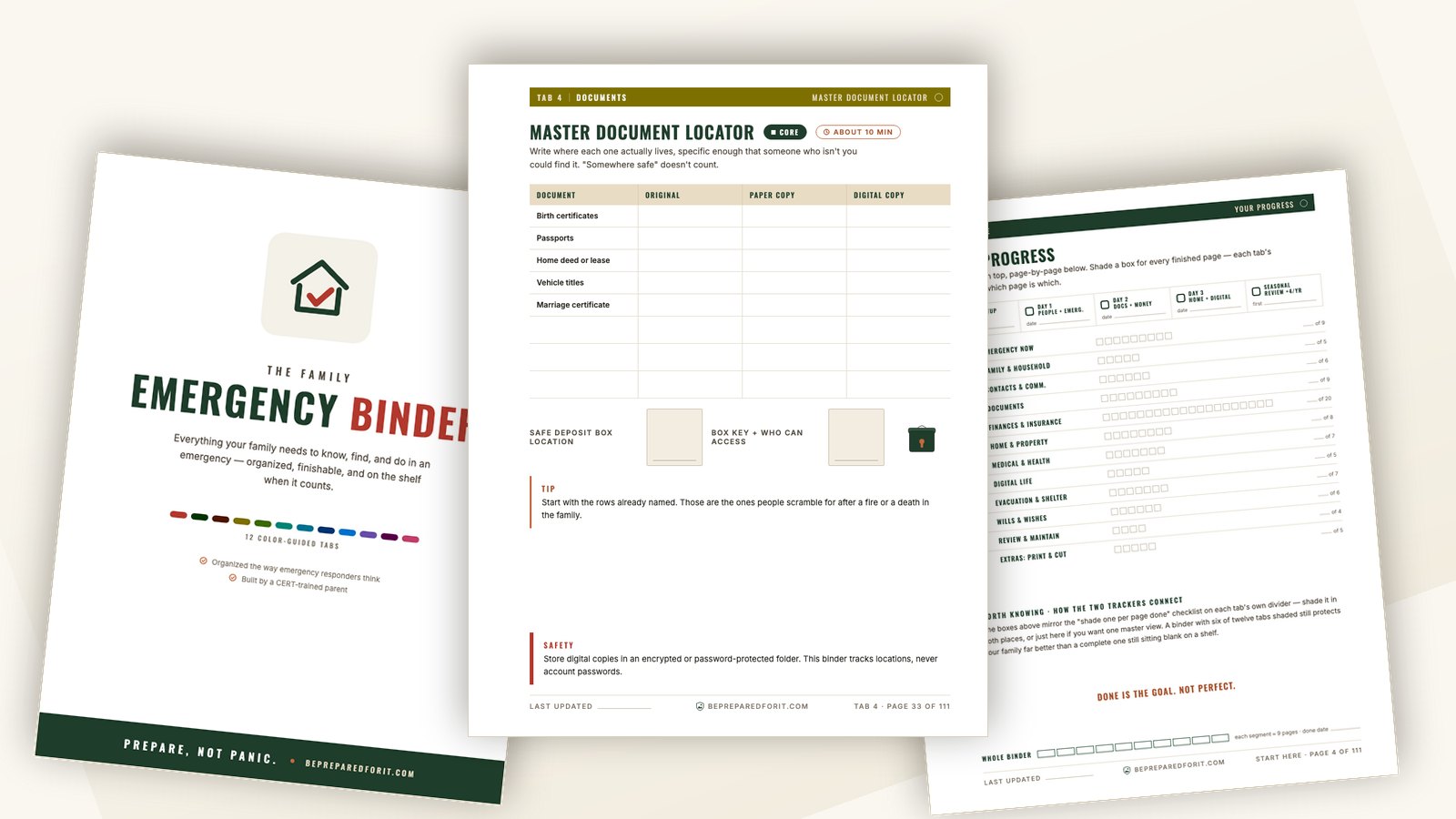
This is also the idea behind our family emergency binder: every category uses the same rule. Work through the locator habit here, one section at a time, and you’ll already understand how the finished product is built.
Contacts & Communication
Start with the people, not the paperwork. Gather these before anything else:
- Full names, phone numbers, and addresses for immediate family, plus one out-of-state contact everyone can call if local lines jam
- Pediatrician, family doctor, and any specialist your family sees regularly, with phone numbers
- Employer contact info for each working adult, including a direct line rather than just a switchboard number
- School and daycare main office numbers, plus who is authorized to pick up your kids if you can’t
- Insurance agent’s name and phone number for each policy (the policy details themselves belong in Finances & Insurance below)
If you haven’t built the rest of this around a real plan yet, setting up a family emergency communication plan takes about 30 minutes and covers meeting spots and backup contacts in more depth than a checklist can. Once you’ve got those names and numbers written down, a fillable household info sheet turns this exact list into one finished page tonight.
Documents
This is the category most people mean when they say “emergency documents binder.” Some of these are worth keeping as actual copies. One is worth handling differently, and it’s a good early lesson in why.
- Birth certificates for every family member; a photocopy in the binder is fine
- Social Security cards: skip the copy here and note where each original card is kept instead, since a copy shows the full number
- Passports and any immigration paperwork
- Marriage certificates, divorce decrees, or custody agreements that establish who can make decisions for whom
- Copies of your last three years of tax returns; the IRS’s general rule is to keep records for about three years after filing, longer if you underreported income or claimed a loss, so three years of copies covers most households
Finances & Insurance
This is the category where the locator habit matters most, because it’s the one most other checklists get wrong. FEMA’s EFFAK form asks for full account and routing numbers for exactly the items below. Don’t follow that example. A carrier name, an agent’s contact info, and a location tell you everything you need without creating a single page someone could use to move your money.
- Insurance policies: homeowner’s or renter’s, auto, life, and health, noting the carrier, the agent’s contact info, and where the physical policy is filed
- Bank and credit union names, with an account nickname (“checking,” “kids’ savings”) and where statements or online access is set up, not the account number
- Investment or retirement account custodians (a brokerage, a 401(k) provider) and where their statements arrive
- Mortgage or lease holder’s name and where the loan or lease paperwork is filed
Home & Property
- Note where the deed or mortgage paperwork for your home is filed
- Note where the title and current registration for each vehicle are kept
- A room-by-room photo or video inventory of your belongings, stored with the binder or backed up online, for insurance claims
- Warranty and manual locations for big-ticket items: HVAC, water heater, major appliances
- Landlord or HOA contact info, if either applies to your household
Medical & Health
- Current medication list for every family member: name, dose, and prescribing doctor
- Allergies, chronic conditions, and past surgeries for each person
- Immunization records, especially for kids enrolled in school
- Insurance carrier and group plan name for each person’s health coverage, plus where the physical card is kept
- A signed medical authorization form if a grandparent or babysitter might need to make care decisions for your kids
The American Red Cross recommends keeping copies of almost this exact list: a medication list, medical information, proof of address, and insurance policies, as part of ordinary preparedness, not just for a major disaster. An unplanned trip to urgent care counts too.
Evacuation & Shelter
- A paper map with two meeting spots marked, one near home, one farther out, in case phones or GPS are down
- A list of nearby shelters, hotels, or family you could stay with, with driving directions written out
- Pet evacuation info: vaccination records, a current photo of each pet, and where the carrier is stored
- A one-page note on who in the household needs help evacuating (mobility issues, medical equipment) and what they need
If you haven’t built the kit that goes with this list, a 72-hour emergency kit on a budget is the natural next step. The binder tells you where to go and what to bring; the kit is what you carry there.
Wills & Wishes
- Note where a signed will or trust document is kept, plus the attorney’s name and phone number if you used one
- Note where power of attorney and healthcare proxy paperwork are filed, so someone can act for you if you can’t
- Funeral or burial preferences, written down so your family isn’t guessing under pressure (our death binder guide covers what to write, plus the facts the funeral home will need for the death certificate)
- Named guardians for minor children, with a note confirming those people have actually agreed to it
- A note on where a password manager or its recovery instructions live, never the passwords themselves
- A letter of instruction, if you’ve written one: the informal letter that tells your family your wishes and where everything is (what to put in it)
Frequently asked questions
Is there a printable or PDF version of this checklist?
Not as a separate download. Everything above works straight from this page, and you don’t need to give an email address or download anything to use it. If you’d rather have it already built out as printable binder pages, with a matching page for every item here, that’s what our family emergency binder does (see the closing section below). For a binder cover page and the other free pieces on this site, see emergency binder printables.
Does this work as a family emergency binder checklist, or just for one person?
It’s built for a household. Several categories assume more than one person: each family member’s school, medications, and vehicle get their own line. A single adult or couple can use the same seven categories and just skip what doesn’t apply, like school pickup or guardianship notes.
Is this different from an “emergency preparedness binder checklist”?
Not really. “Emergency binder,” “family emergency binder,” and “emergency preparedness binder” all point at the same document. Whatever term brought you here, the categories above cover what most versions of that list include, in the order a finished binder actually uses.
Do I need to write down my account numbers?
No, and that’s deliberate. The FEMA checklist mentioned above asks for full account and routing numbers. This one asks for a carrier name and a location instead, which is just as useful in an emergency and can’t be used to move your money if the wrong person finds it.
You’ve built the list. Here’s what it doesn’t do.
This checklist tells you what to gather. Organizing a hundred pages so you can find the right one during an actual emergency is a separate job, and so is walking through the first ten minutes of a specific disaster. Both gaps are intentional. They’re worth solving on their own.
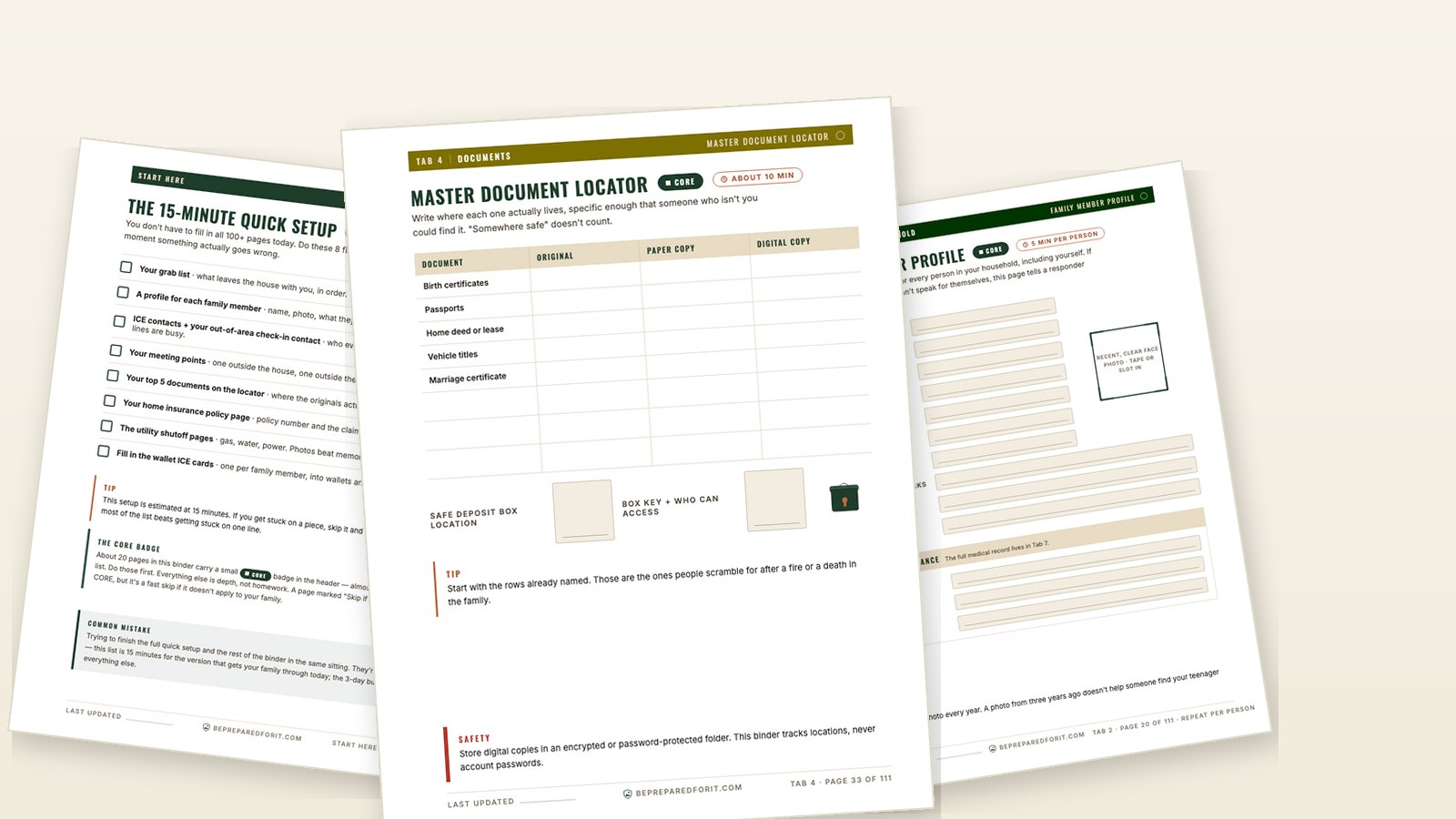
If you’ve worked through all seven categories above, you’ve done the hard part. You know what belongs in a binder, and just as important, how to write it down safely. Our family emergency binder takes this same list and turns it into a finished, tabbed system, with pre-built pages for every category here and a few more this checklist doesn’t cover. Think of what you just built as page one. The other hundred are already done.
Coming soon
The part of being prepared most families never finish
The Family Emergency Binder puts your family's contacts, documents, and plans in one place — a 15-minute quick start tonight, finished over a weekend. Join the list and we'll email you the moment it's ready, at the $19 launch price for a limited time.