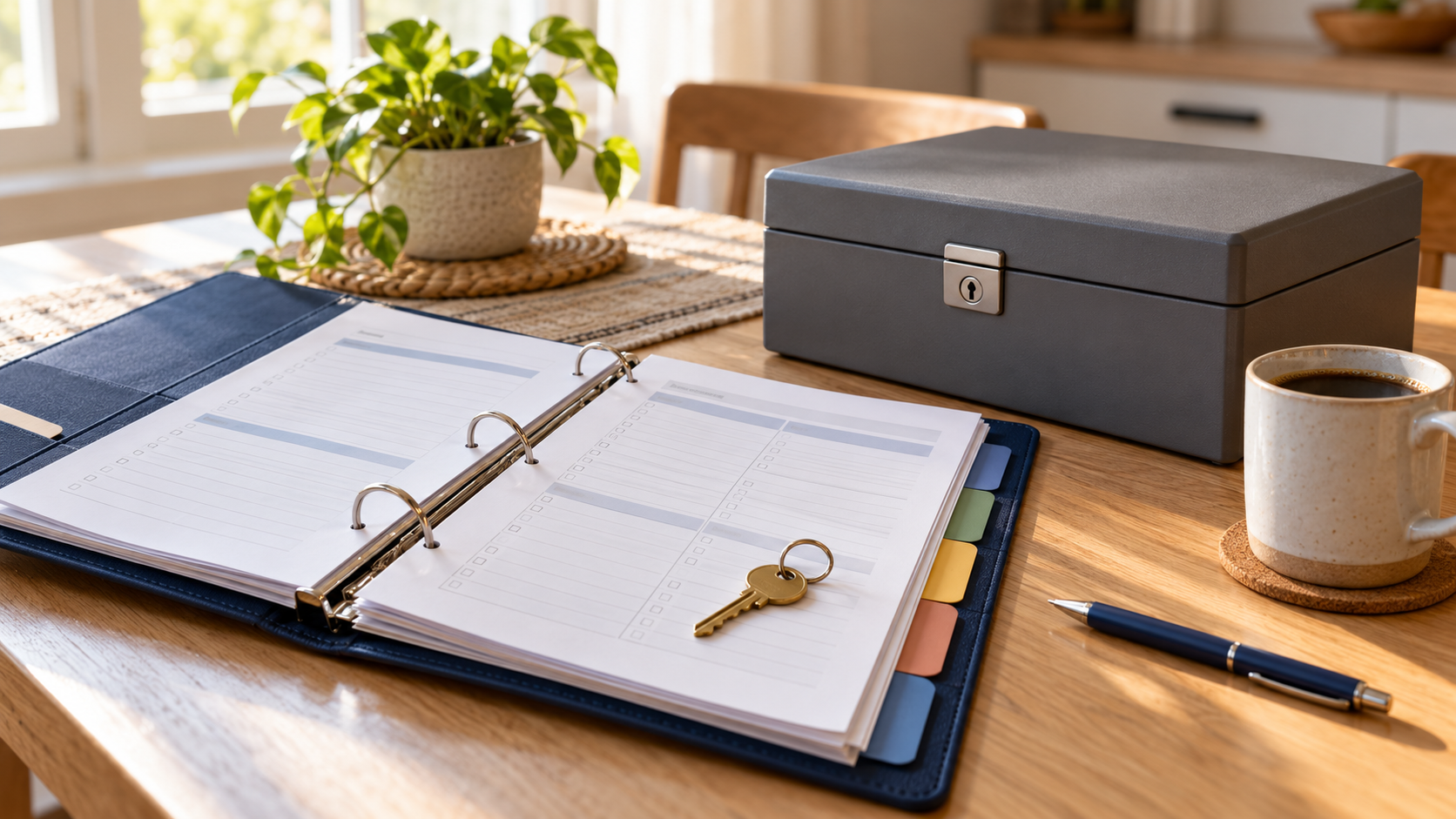
The Family Emergency Binder
A Free Emergency Binder Template You Can Fill Out Now
In this guide
Yes, a free emergency binder template exists on this page. It is the Household Info Sheet, one complete page you can fill out directly here or copy onto paper: your household’s names and address, three emergency contacts, allergies and medications, and insurance carrier names. No email address, no download, no waiting.
Most “free template” pages online are a teaser for something you have to hand over an email address to get. This one isn’t. Fill it out below, right now, and you’ll have a real, usable piece of an emergency binder finished before you finish reading this page.
The Household Info Sheet
This is the page nearly every version of a family emergency plan starts with, and for good reason: if someone else has to step in, whether that’s a babysitter, a neighbor, or a relative who flew in after a bad week, this is the one sheet that gets them oriented fastest. Ready.gov’s guidance on making a family emergency plan recommends exactly this shape: a plan that “includes important info such as household information, names and contacts of family members, meeting places and medical information” all in one place.
Copy the fields below onto paper, type them into a note on your phone, or print this page. Fill in a line for every person in your household.
Household information
- Household name / address: ______________________
- Home phone: ______________________
- Out-of-area contact (someone outside your immediate area everyone can call if local lines jam): ______________________
Emergency contacts (list three)
The American Red Cross recommends an emergency contact card for every family member, plus one out-of-area contact, and says plainly that “everyone should carry emergency contact information in writing.” Three names covers most households: someone local, someone a little farther away, and someone out of state.
- Name: ______________________ Relationship: ______________________ Phone: ______________________
- Name: ______________________ Relationship: ______________________ Phone: ______________________
- Name: ______________________ Relationship: ______________________ Phone: ______________________
Allergies and medications (one line per person)
- Person 1: Name ______________________ Allergies ______________________ Medications ______________________
- Person 2: Name ______________________ Allergies ______________________ Medications ______________________
- Person 3: Name ______________________ Allergies ______________________ Medications ______________________
- Person 4: Name ______________________ Allergies ______________________ Medications ______________________
Insurance (carrier name only, never a policy number)
- Homeowner’s or renter’s insurance carrier: ______________________
- Auto insurance carrier: ______________________
- Health insurance carrier: ______________________
Notice what’s missing from that last section on purpose. There’s no line asking for a policy number, an account number, or a member ID. Ready.gov’s own financial-preparedness guidance recommends gathering your insurance policies so you can re-establish your accounts later, but it never says to copy the numbers onto a page someone else might find. This template follows the same logic: the carrier’s name is enough for anyone helping you to know who to call. The number itself is worth protecting.
That’s it. That’s the whole sheet, and it’s useful the moment you finish it: tape it inside a kitchen cabinet, keep a copy in the car, or hand a copy to whoever watches your kids. Ready.gov’s own guidance on building a kit recommends keeping copies of key records in a waterproof, portable container for the same reason: a document only helps if it’s somewhere you can actually reach it.
A few tips make it hold up over time instead of going stale in a drawer:
- Write in pencil or leave room to update phone numbers and medications, since both change more often than people expect
- Make more than one copy. One on the fridge or in a kitchen drawer, one folded into a wallet or glove box, and one with whoever regularly watches your kids
- Skip the digital-only version if you can. A phone that’s dead, lost, or password-locked is exactly the situation this sheet is meant to cover
- If a household member has a condition that affects how they’d be cared for in an emergency (a wheelchair, a hearing aid, a severe allergy), say so in plain words rather than assuming whoever reads it already knows
What does the free template include, and what doesn’t it?
Yes, this page is completely free, and no, nothing above is a preview of a paywall. The Household Info Sheet you just filled out is one real page. It also covers one of the twelve tabs in the full Family Emergency Binder, so it’s worth being specific about the line between the two.
What the free template gives you: a complete household info sheet with your contacts, allergies, medications, and insurance carriers, following the same locator rule the full binder uses everywhere.
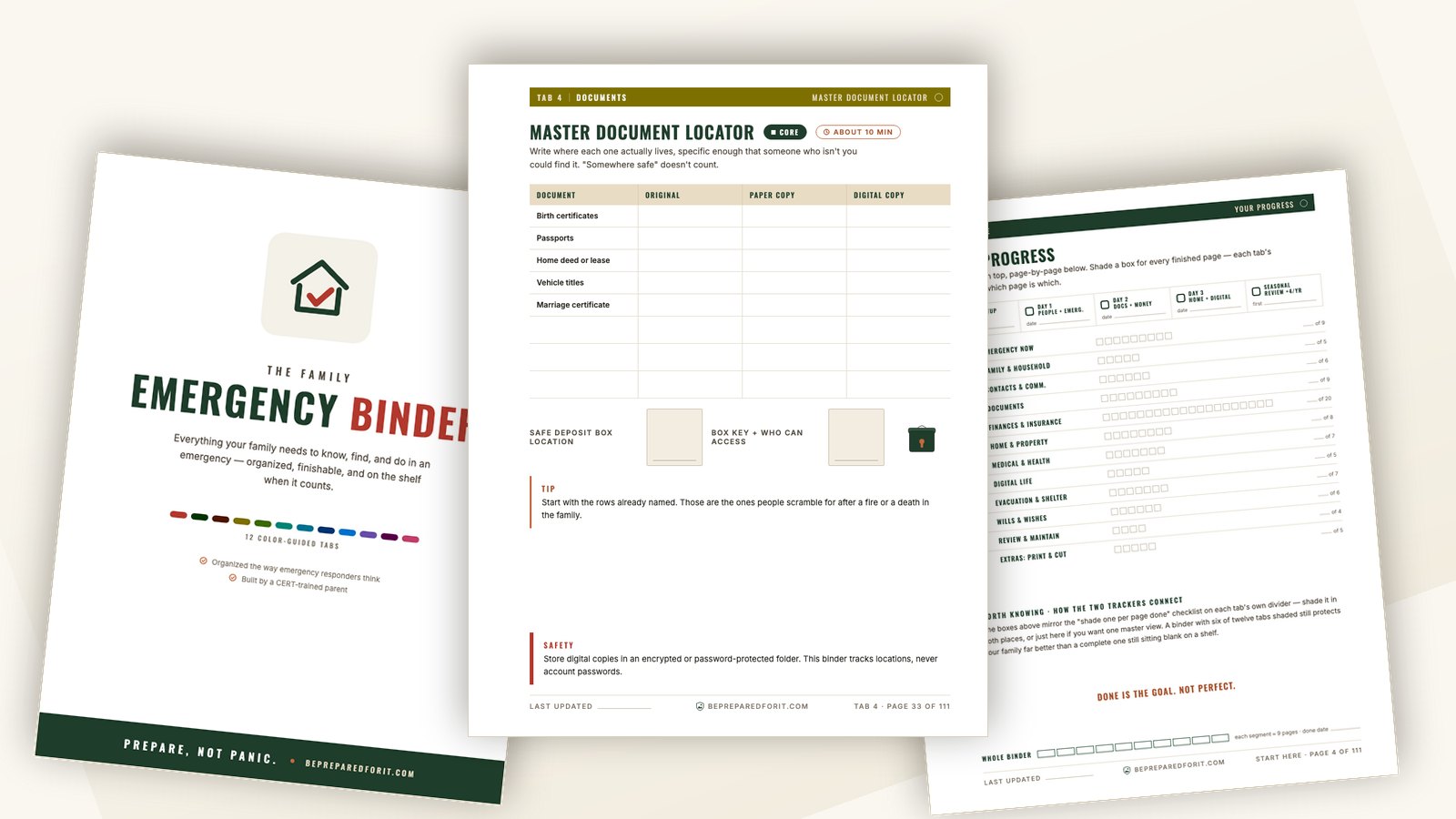
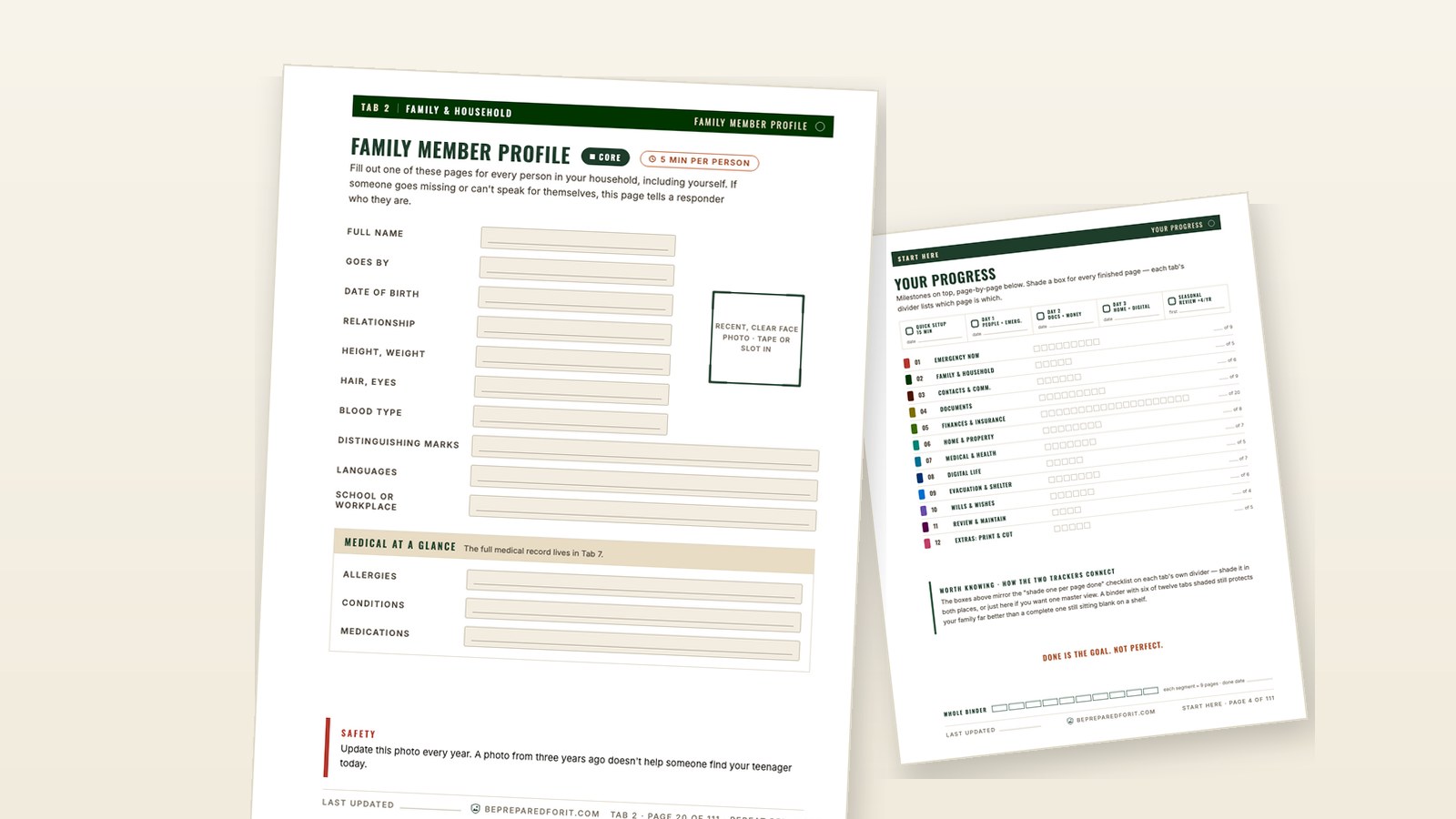
What it doesn’t include: the other eleven tabs (documents, finances beyond the carrier name, home and property, evacuation and shelter, wills and wishes, and more), the step-by-step first ten minutes of an actual emergency, fillable PDF forms you can print pre-formatted, and the twice-a-year review system that keeps a binder from going stale. None of that is hidden or “coming soon.” It’s just a different, larger product, and this page was never meant to replace it.
How does this free template compare to the full binder?
The free template covers one of the binder’s twelve tabs and none of its added tools. Here’s the full breakdown:
| This free template | The Family Emergency Binder | |
|---|---|---|
| Tabs covered | 1 (household info) | 12 |
| Emergency Now first-response steps | Not included | Included |
| Fillable PDF form fields | Not included | Included |
| Seasonal review system | Not included | Included |
| Cost | Free | One-time price, see the binder page |
Nothing in that table is meant to talk you out of using the free page on its own. A finished Household Info Sheet taped inside a cabinet is worth more than a binder you never start. It’s just not the same product, and you should know exactly where the line sits before you decide which one you need tonight.
The honest way to think about it: this page solves the “who do I call and what do they need to know about us” problem. The full binder also solves “what do I actually do in the first ten minutes of a fire, a flood, or a tornado warning,” “where is the actual paperwork, not just a note about who to call about it,” and “will this still be accurate a year from now, or did life change and nobody updated it.” Those are three separate, real problems. A free page can only ever solve the first one.
Where this fits with the checklist
If you haven’t already, the emergency binder checklist is the natural step before this one. It walks through all seven categories a full binder covers, contacts, documents, finances, property, medical, evacuation, and wills, so you know everything worth gathering before you commit anything to paper. This page picks up right where that list leaves off: it takes the first category, contacts and household info, and turns it into one finished, fillable page instead of just a list of what to gather.
If you’ve already worked through the checklist, you likely have most of what belongs on the Household Info Sheet sitting in front of you already. Filling it in should take a few minutes, not a few hours.
Frequently asked questions
Is there a free emergency binder template?
Yes. The Household Info Sheet on this page is a complete, free template you can fill out directly here or copy onto paper. It covers your household’s contacts, allergies, medications, and insurance carrier names, and it doesn’t require an email address or a download.
Is there a printable version?
Yes, in the sense that matters: print this page from your browser and you have a printable copy. There’s no separate PDF file. Printing directly from this page is how you get a paper copy today. A binder cover page and the checklist live on the free emergency binder printables page too.
What’s a family emergency binder pdf, and do you have one?
A “family emergency binder pdf” usually means a downloadable, pre-formatted file you print and fill in by hand. This page is the free version: fill it in on screen or print it. The full Family Emergency Binder is the PDF version, with a type-in edition and a print-blank edition in one download.
Is this different from a DIY emergency binder template?
Not really. “DIY emergency binder template,” “free emergency binder template,” and “printable emergency binder template” are all names for the same idea: something you build or fill out yourself rather than buy pre-made. This page is exactly that, one piece of it, done for you in advance so you don’t have to design the fields yourself.
You just built one real page. Here’s the rest.
The Household Info Sheet above is a genuine piece of an emergency binder, not a demo of one. Fold it in half, put it somewhere your family would think to look, and it’s already doing its job.
The full Family Emergency Binder is the other eleven tabs: the documents and finances sections beyond a carrier name, the property and evacuation pages, the wills and wishes tab, fillable PDF forms for every page instead of blanks you write into by hand, and the 10-minute seasonal review that keeps the whole thing current. Think of the page you just finished as page one. The other hundred are already built, in the order a family actually needs them under pressure.
Coming soon
The part of being prepared most families never finish
The Family Emergency Binder puts your family's contacts, documents, and plans in one place — a 15-minute quick start tonight, finished over a weekend. Join the list and we'll email you the moment it's ready, at the $19 launch price for a limited time.