The Family Emergency Binder
Medication List Template for the Whole Family (Free Printable)
In this guide
A medication list template is a written record of every medicine a person takes: the name and strength, the dose, how often it’s taken, what it’s for, who recommended it, and any allergies. Our free two-page printable puts the household’s pharmacy, doctor and emergency contact at the top, then gives each of up to four people their own block and medicine table. Get the free printable and fill it in from the bottles and boxes, one person at a time.
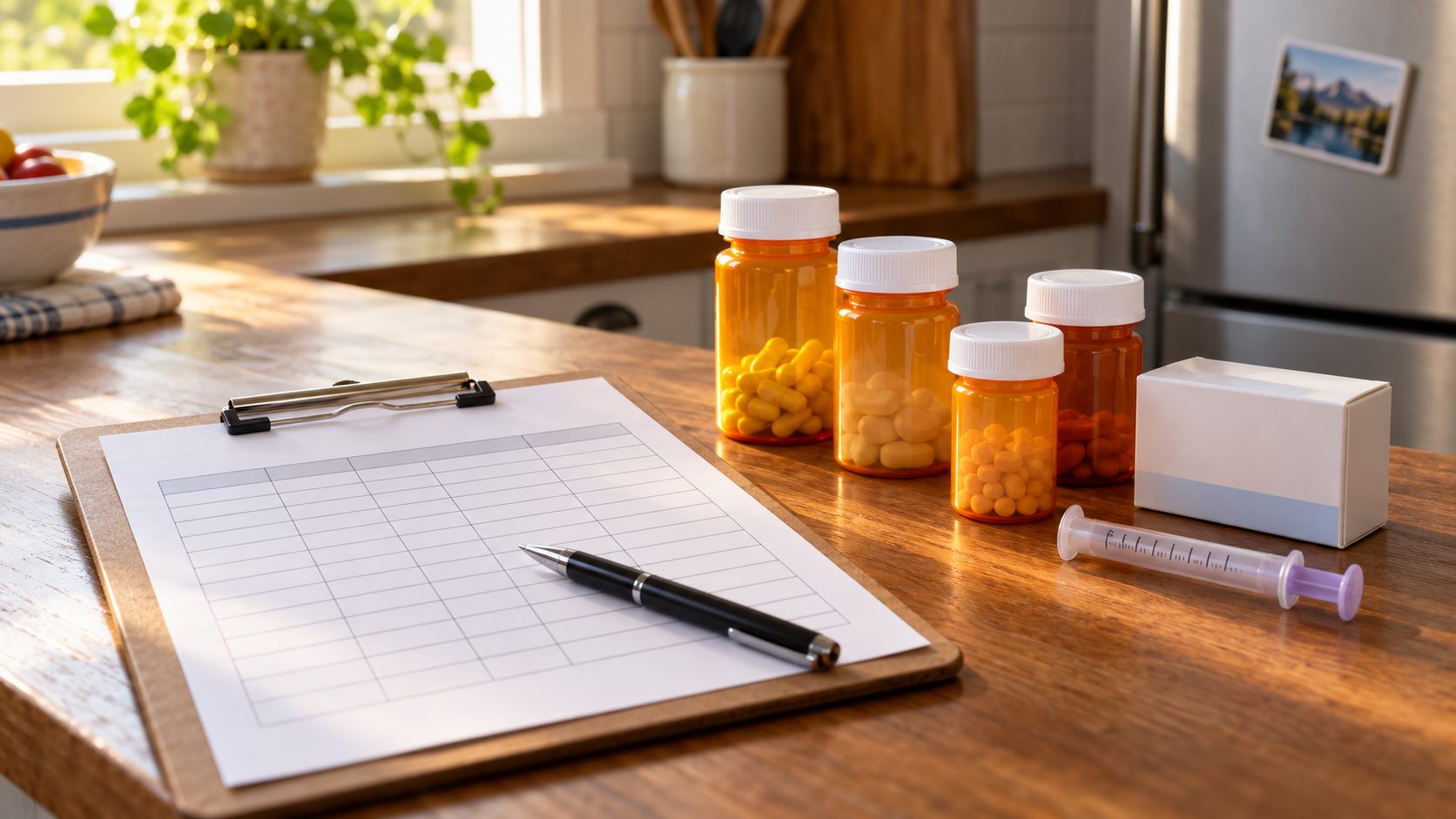
The image at the top is an illustration, not a photo of a real family’s medicines.
Writing it down matters because, in an ER, at urgent care, or during an evacuation, the person answering questions about medicines may not be the one who manages them. A spouse, grandparent, or sitter you’ve given a copy to should be able to hand it to the doctor or nurse and answer the basic questions from it.
This page is a record-keeping tool, not medical advice. Take every medicine as the label or your doctor or pharmacist directs.
What’s on the free printable, box by box
The printable is a two-page, US Letter PDF. Every tan box is a fillable field, so you can type into it in Acrobat, Preview or most browsers, or print it blank and use a pen. Here is what you’ll see, top to bottom, and what to put in each box.
Page 1, top: the household box
The first box is labeled Household and covers things everyone in the house shares. Fill it in once:
- Main pharmacy name and phone. The pharmacy that fills most of your prescriptions.
- Main doctor or clinic and phone. Your family doctor or the clinic you use most.
- Emergency contact and phone. The person a doctor or nurse should call if you can’t answer for yourself. If someone in the house needs a different contact, write it on that person’s Notes line.
- Health insurance carrier name, and where the cards are kept. The company name and a location like “kitchen drawer” or “Dad’s wallet.” Not the member number.
- Date this list was last updated. Fill this in every time you change anything. A doctor reading a list wants to know how old it is.
Each person’s block
Under the household box, page 1 has blocks for Person 1 and Person 2. Each block starts with three lines about the person:
- Name, date of birth, and weight (children, with unit). For a child, write the weight with its unit, such as “42 lb.” Leave it blank for adults.
- Allergies or bad reactions, and what happened. Medicines, foods, medical tape, anything. “Penicillin: hives” tells a nurse much more than “penicillin.”
- Conditions or diagnoses. “Type 2 diabetes,” “asthma,” “high blood pressure.” This is the diagnosis line Ready.gov asks for.
- Doctors and pharmacy, if different from the household’s. A child’s pediatrician, a parent’s cardiologist, a specialty pharmacy.
- Notes (supplies, cold storage, dosing device). A spacer or test strips, “insulin goes in the fridge,” “use the 5 mL syringe from the box.”
The medicine table
Below the person lines sits a six-column table. Persons 1 and 2 get five rows each; Persons 3 and 4 get three. One medicine per row, including vitamins, supplements and over-the-counter products:
| Column on the printable | What to write | Example |
|---|---|---|
| Medicine & strength | Name from the label, plus the strength; for over-the-counter products, the active ingredient too | Lisinopril 10 mg; Allergy relief (cetirizine 10 mg) |
| Dose | How much, with the unit | 1 tablet (10 mg); 5 mL |
| How often | Timing and any directions | Once daily, morning; as needed |
| What it’s for | The reason, in plain words | Blood pressure; spring allergies |
| Who recommended it (phone) | The prescriber, or “self” or “pharmacist” for over-the-counter items | Dr. Lee, 555-0100 |
| Start / stop | When it started, and when it ends if it’s a short course | Started 3/2024; 10-day course |
The examples are made up to show the format. Copy the real details from each label.
Page 2: two more people and the reminders
Page 2 holds the Person 3 and Person 4 blocks, laid out exactly like page 1 with three medicine rows each. If you have more than four people or one person outgrows their rows, print page 2 again and number the extra blocks yourself.
Under the last block is a line reminding you where copies go: the fridge, your wallet, your kit, and whoever watches your kids or parents. Below that sit three short boxes. “How to fill it out so it’s useful” is a short version of the fill-in tips further down this page, including the as-needed one: write “as needed” under How often with the label’s directions, and ask your pharmacist if they’re unclear. “Write where, not what” is the rule about ID numbers explained just below. “Record-keeping only” says the sheet isn’t medical advice and reminds you to update it the day a medicine starts, stops or changes.
If you’d rather not download anything, use the field list above as your guide: copy those labels onto paper or into a note on your phone, and fill them in the same way.
Why there’s no ID number anywhere
The sheet has no line for an insurance member ID, a policy number, or a Social Security number. That’s deliberate. A medication list gets taped inside cabinets and handed to sitters, so it holds the carrier’s name and where the card lives, not the number on it. The numbers stay on the cards in your wallet. Leave the date of birth off the copies you hand out if you’d rather. Every copy still holds diagnoses, so give copies only to people you’d trust with that and shred the old ones when you update.
How our printable compares with the FDA’s form
The FDA publishes its own free form, My Medicine Record (Form FDA 3664), a four-page PDF dated March 2011 and built for one person. It’s a good form, and if one person in your house takes many medicines, it’s worth printing for them. Our printable covers most of the same medicine fields in a shape built for a household. The table compares the main medicine-record fields.
| Field | FDA My Medicine Record | Our printable |
|---|---|---|
| Medicine name | Brand and generic name; active ingredients for over-the-counter medicines | Medicine & strength column; the tips on page 2 say to write the active ingredient next to over-the-counter names |
| Dose, use and timing | ”How Much” and “How to Use / When to Use” | Dose, and How often (add “with food” or similar directions there) |
| Why you take it | ”Why I’m Using / Notes” | What it’s for |
| Who recommended it | ”Who Told Me to Use / How to Contact” for each medicine | Who recommended it (phone) for each medicine, plus a household doctor and pharmacy and each person’s own if different |
| Start and stop dates | Start / Stop Dates | Start / stop |
| What the pill looks like | Color, shape, size and markings | No column; use the person’s Notes line if you want it |
| Allergies | Reactions to any medicine, supplement, food, skin cleaner or medical tape | Allergies or bad reactions, and what happened, per person |
| People covered | One person per form | Four person blocks, each with a child’s weight line |
How to fill it out so it’s actually useful
Work from the labels, not from memory.
Count vitamins, supplements, and over-the-counter medicines. The CDC’s medication safety guidance says to keep a list of your medicines, vitamins, and other supplements, and to make sure your doctor knows about all of them. The FDA’s form instructions go further: enter all over-the-counter medicines and dietary supplements, including vitamins, minerals and herbals, “whether you use them all the time or only some of the time.” A daily fish oil or an allergy pill you take every spring belongs on the list. For over-the-counter products, write the active ingredient next to the name, as the FDA form asks.
Write the dose with its unit. “10 mg” or “5 mL” is useful. “One pill” isn’t, because nobody reading the sheet knows which pill. Copy it from the label. When the dose differs from the pill size, the FDA’s example is to write it out, such as “40 mg; use two 20 mg pills.” If a label confuses you, the CDC’s advice is to ask your pharmacist or doctor before taking the medicine.
Use both the diagnosis line and the what-it’s-for column. Ready.gov’s medication tips for people with disabilities ask you to keep a list of your prescription medicines that includes your diagnosis, dosage, frequency, medical supply needs, and allergies. On the printable, the diagnosis goes on the person’s “Conditions or diagnoses” line, the reason for each medicine goes in “What it’s for,” and supply needs like a spacer or test strips go on the Notes line. A doctor who has never met you can then read the list fast.
Mark as-needed medicines. A rescue inhaler or an epinephrine auto-injector that rarely gets used still goes on the list. Write “as needed” in the How often column, along with the label’s directions, such as how long to wait between doses. If the directions aren’t clear, ask your pharmacist. (The FDA form handles the same thing in its start and stop dates field, using an occasional headache medicine as its example.)
Add the kids’ details. For a child, we’d fill in the weight line and note the dosing device that came with each liquid medicine. That’s our suggestion, not a CDC rule. What the CDC does say is to measure a child’s dose with the oral syringe or dosing cup that comes with the medicine, never a household spoon, and to check active ingredients so you don’t give a child two medicines with the same one.
Note anything about storage. If a medicine needs to stay cold, write it on the person’s Notes line. The FDA form asks for how and where to keep a medicine “if not at room temperature.” That note matters most when the power is out.
Where to keep copies
We’d make three or four copies:
- Inside a kitchen cabinet or on the fridge, where anyone in your house would look first.
- In each adult’s wallet, folded small. A glove-box copy is handy, but it leaves birth dates and diagnoses in a car you don’t always control, so skip it or leave the date of birth off that copy. The FDA’s form instructions say to keep a printed copy with you all the time and to give a copy to a friend or loved one.
- In your emergency kit, in a zip bag or waterproof pouch. The American Red Cross survival kit list includes copies of a “medication list and pertinent medical information” among the personal documents to pack. If you’re still putting a kit together, our guide to a 72-hour emergency kit on a budget walks through the rest.
- With the people who help care for your family and need it. Ready.gov’s guidance for older adults says to make sure at least one person in your support network knows where you keep emergency supplies and knows how to administer medicine. The same thinking works for a babysitter, a grandparent who watches the kids, or a neighbor with your spare key.
If you filled in the PDF on a computer, save that file as your master copy and print fresh copies from it after each change. A photo of the printed sheet on your phone is a good backup, and Ready.gov’s disability guidance also suggests adding pertinent medical information to your electronic devices and wearing a medical alert tag or bracelet. Don’t make the phone the only copy, though. A dead or locked phone can’t show anyone your list; paper still can.
If you want the rest of your household’s basics on one page too, the free Household Info Sheet covers contacts, allergies, and insurance carriers and sits nicely next to this list.
Pair the list with an emergency supply
Ready.gov’s Build a Kit page says about half of all Americans take a prescription medicine every day, and that an emergency can make it hard to refill a prescription or find an open pharmacy.
The Red Cross survival kit list includes a 7-day supply of medications. Ready.gov’s advice is to talk to your doctor or pharmacist about how to create an emergency supply. Your next refill is a good time to ask.
For medicines that need refrigeration, Ready.gov suggests keeping a cooler and chemical ice packs on hand. The cold-storage note on the person’s Notes line tells whoever is packing during an evacuation to grab it.
The CDC says adverse drug events cause more than one and a half million US emergency department visits each year, and its advice is to make sure your doctor knows about every medicine, vitamin and supplement you take. The FDA’s form instructions say to share your record with your doctors, pharmacists, or other health professionals at all your visits.
Keep it current
A medication list goes out of date the first time a dose changes. Do two things:
- Update it the day something changes. The FDA’s form says to review the record when you start or stop a medicine or supplement, change anything you use, or visit your doctor, pharmacist, or other health professional. Fix the master copy, change the “last updated” date in the household box, and swap out the other copies when you can.
- Do a full review once a year. Ready.gov’s kit guidance says to replace expired items as needed and to re-think your needs every year. Do the medication list at the same time, and check the over-the-counter medicines in your first aid kit for expiration dates.
If you haven’t started yet, the free printable has the household box, four person blocks, and the reminders on page 2 ready to fill in.
Frequently asked questions
What should be on a medication list?
For each person: the medicine name and strength, the dose, how often it’s taken, what it’s for, who prescribed or recommended it, when it was started (and when it should stop, if it’s a short course), and any allergies or bad reactions. Include over-the-counter medicines, vitamins, and supplements. Add the main pharmacy, doctor, and an emergency contact once for the household, and each person’s own doctor or pharmacy if theirs is different.
Should vitamins and supplements go on the list?
Yes. The CDC says to keep vitamins and other supplements on your list along with your medicines and to make sure your doctor knows about all of them. The FDA’s My Medicine Record also asks for vitamins, minerals, and herbals.
Do I need a separate medication list for each family member?
You can keep one document for the household with a separate block for each person, like our printable. If one person takes a lot of medicines or sees several specialists, give them their own page, such as the FDA’s one-person form.
Is there a free printable medication list?
Yes. Ours is a free two-page fillable PDF with a household box and blocks for four people; enter your email in the signup box on this page to get it. For a single person, the FDA’s My Medicine Record (Form FDA 3664) is a free PDF you can print or type into.
What’s the difference between a medication list and a medication chart?
A medication list records what each person takes and why, for doctors, sitters, and emergencies. A medication chart or schedule usually means a tracker you tick off as each dose is taken through the day. Many families use both, but the list is the one to keep in your wallet and your emergency kit.
Where should I keep my medication list in an emergency?
One in your emergency kit in a waterproof bag, one in your wallet, and one with whoever helps care for your family. The American Red Cross includes a medication list among the document copies for a survival kit.
Keep it with your other family records
When you’re ready to keep it with everything else, the Family Emergency Binder has a profile page for each person in its Family & Household tab, covering medications, allergies, and care notes, plus a Medical & Health tab for doctors, prescriptions, and vaccination records. A copy of this list fits in that Medical & Health tab, and the binder checklist shows what else goes in each section.
The binder
The part of being prepared most families never finish
The Family Emergency Binder puts your family's contacts, documents, and plans in one place: start with the essentials, then build on it a few sittings at a time. $19, instant download.
See what's inside