Emergencies & Disasters
Emergency Contact Card: What to Put on It (Free Printable)
In this guide
An emergency contact card should list your full name, two or three people to call (one of them out of town), your allergies, medical conditions and daily medications, your doctor and pharmacy, and your health insurance carrier’s name. We leave off Social Security, policy, account and passport numbers, because a lost card shows whatever is written on it. On a wallet card there’s only room for the short version: your name, one local and one out-of-town contact, allergies, conditions, the medicines you can’t miss and your insurer. The second local contact, doctor and pharmacy go on a household sheet at home. Our free printable has both: two fold-over wallet cards, a kids card, and a household contact sheet.
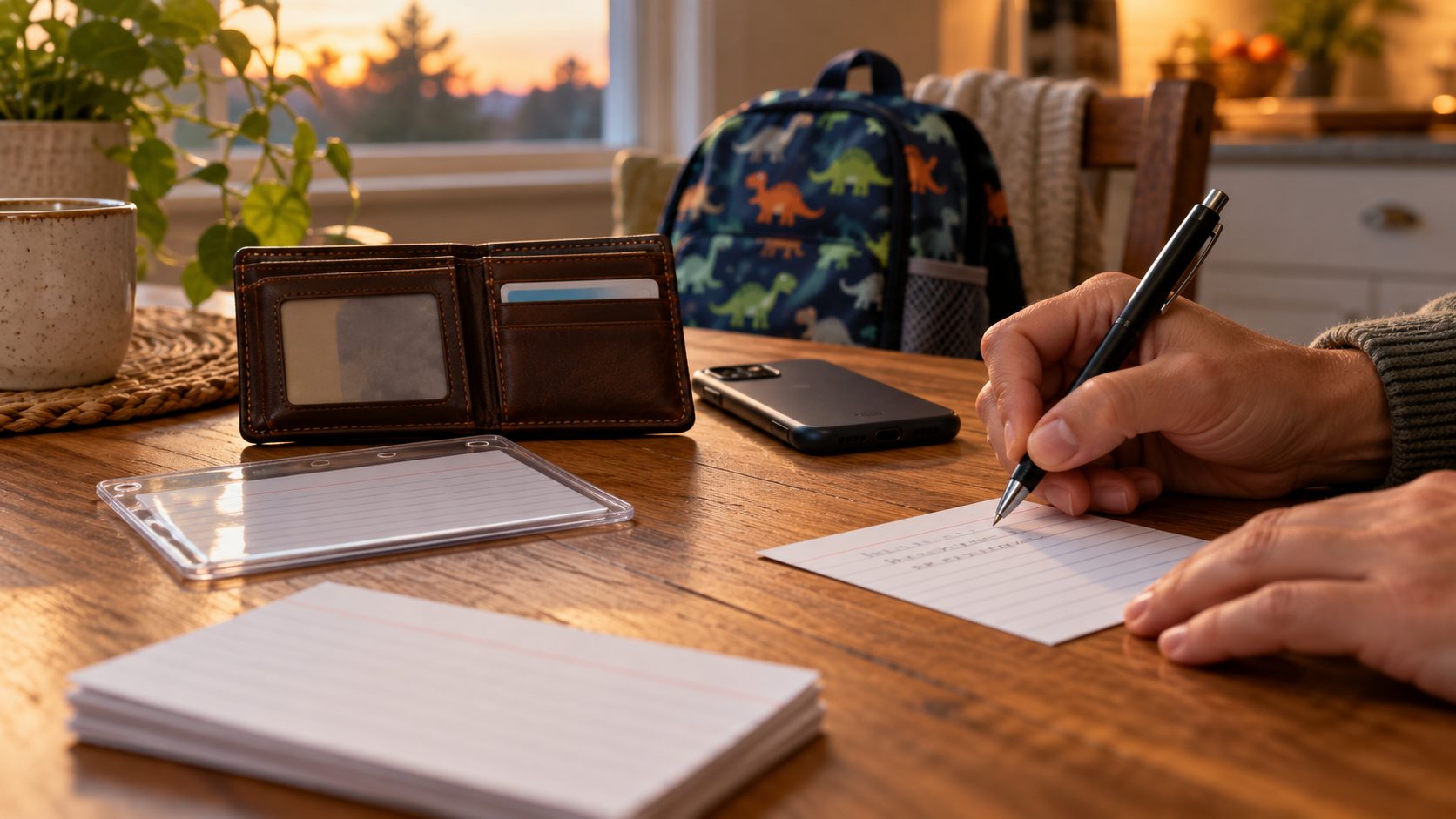
Make one for every person in your house, kids included. A lost card still shows your birth date and medical details, so keep it to what helps someone help you. If you’d rather not download anything, a plain index card and a pen work too, and the card layouts below are short enough to copy by hand.
What to put on an emergency contact card
Put on the card what a stranger would need if you couldn’t speak for yourself: who you are, who to call, and what could hurt you. The Connecticut Department of Public Health’s guide to emergency health information cards, adapted from American Red Cross and Independent Living Resource Center San Francisco material, frames it the same way: the card tells rescuers what they need to know if they find you unconscious or confused, or need to help you evacuate.
Here is the full list we’d use. The wallet card on our printable carries a short version of it, and the household sheet on page 2 holds the rest:
Who you are
- Full name, plus the name you actually answer to if it’s different
- Date of birth
- Primary language, if it isn’t English
Who to call
- Two local contacts: name, relationship, and mobile number
- One out-of-town contact: name, relationship, and mobile number
- Your family’s meeting place, if you have one
Medical basics
- Allergies, especially to medications, adhesive tape, foods, and insect stings
- Medical conditions a responder should know about (diabetes, epilepsy, a heart condition, and so on)
- Daily medications with the dose and times, marking any you can’t safely miss
- Blood type, if you know it
- Doctor’s name and phone, and your pharmacy’s name and phone
Where the rest is
- Health insurance carrier name and its member services phone number
- A line like “Full medication list at home in the family binder, hall closet” or “Allergies and contacts also in my phone’s Medical ID”
Don’t leave off the out-of-town contact. The American Red Cross recommends choosing an out-of-area emergency contact, because it may be easier to text or call long distance when local lines are overloaded or out of service. The same page says everyone should carry emergency contact information in writing and saved on their cell phones. If you haven’t picked that person yet, our guide to setting up a family emergency communication plan walks through choosing them and your meeting spots.
What to leave off an emergency contact card, and why
This part is our own privacy call, not an official rule. Some official templates ask for more: the Connecticut card has lines for a Social Security number and insurance ID numbers, and Ready.gov’s wallet card has a line for the insurance policy number. We leave those off a card you carry every day, because a wallet card gets lost, left in a rental car, or handed around a waiting room. Even without those numbers, a lost card shows your name, birth date, contacts and health details to whoever picks it up. That’s the trade for a card that can help you, so put on it only what a helper needs. If you decide a number belongs on yours, that’s a reasonable choice, as long as you know what the card would give away if you lost it.
| Item | Our call | Why |
|---|---|---|
| Social Security number | Leave off | A responder doesn’t need it to help you, and it’s the number you least want a stranger holding |
| Insurance policy or member ID number | Leave off, usually | If you carry an insurance card, the number is already in your wallet. The carrier name and member services phone tell a helper who to call. If you don’t carry the insurance card, you may want the number after all |
| Bank, credit card, or account numbers | Leave off | Nothing on this card needs them |
| Passport number | Leave off | Some travel cards include it. We’d rather keep a photocopy of the passport in a separate bag |
| Passwords or PINs | Never | Not on this card or any card someone might find |
| Home address | Kids and anyone who may not be able to say where they live: yes. Other adults: optional | A child may not be able to tell a helper where they live. If your ID already shows your address, the card doesn’t need to repeat it |
| Full medical history | Leave off | List what a helper needs right away: allergies, conditions, and medications you can’t miss. The full history belongs at home |
On that last row: keep the card to what a helper needs in the first hour, so it stays readable. If you want the full picture written down, put it on a household sheet at home, like the one in our free binder template, and let the card point to it.
The free printable, page by page
The free printable is a two-page US Letter PDF. Page 1 has two fold-over wallet cards and a kids card. Page 2 is a household contact sheet for the fridge, your kit or the car. It holds more than a wallet card does: birth dates and health details for everyone in the house. Our suggestion is to keep it where only people you’d trust with that will see it, such as inside a cabinet door rather than on the front of the fridge if guests or workers come through, and out of sight in the car. The lines are fillable fields, so you can type into them in a PDF reader that supports form fields, or print the pages blank and use a pen. Print at 100% (actual size) so the wallet cards come out the right size.
Page 1: two fold-over wallet cards
Each wallet card is printed as a front and a back side by side, with crop marks at the corners and a dashed line down the middle. Cut around the outside, then fold on the dashed line with the writing facing out, or cut the two halves apart and tape or glue them back to back. Folded, each card is about credit-card size, 3 3/8 by 2 1/8 inches, so it slides in behind your driver’s license. There are two, labeled Person 1 and Person 2, so two adults can each carry one from a single sheet.
The front is headed “ICE, In case of emergency” and has six lines:
- Name
- Born
- Call
- Phone
- Out of town
- Phone
The back is headed “Health basics”:
- Allergies (printed in red for visibility)
- Conditions
- Must-take meds
- Insurer and phone
- More info (for example, “kit” or “phone Medical ID”)
- Updated
The labels are short on purpose, and each name and phone number gets its own line so the numbers have room. On the “must-take meds” line, write the medicine, the dose and the times, in that order. Use a fine-point pen and a few words per answer. If you take more than one must-take medicine, or you can’t write it legibly at that size, skip the wallet card and write your own name, contacts, allergies and each must-take medicine with its dose and times on a larger piece of paper folded into a pocket you always have on you. The household sheet on page 2 has a full “daily medications, dose and times” column for the same details. Keep the household sheet, with everyone’s details, at home and in the kit. A bag alone can end up in another room or another car. The second local contact, the doctor and the pharmacy go on the page 2 sheet, not the wallet card.
Page 1: the kids card
Below the wallet cards is a larger, single-sided kids card, also with crop marks. It’s headed “ICE, In case of emergency, Kids” and has these lines:
- Name
- Parent, with a mobile number
- Second adult, with a mobile number
- Out-of-town contact, with a mobile number
- Home address
- Allergies (in red)
- Medical conditions
- Medications, dose and times
- School or daycare
- Last updated
Next to it, a box headed “Make one for every person” repeats three tips from this article: where kids can carry the card, the medicine-dose-times order for must-take meds, and “laminate last,” meaning double-check every number before you seal it.
Page 2: the household contact sheet
Page 2 opens with a red “In case of emergency” banner and the note “For the fridge, your kit or the car.” It’s a household summary on one page: one shared care-team section and a row for each of up to five people. If someone sees a different doctor, write the name and phone on a note kept with the sheet, labeled with that person’s name.
- Who to call. A three-row table: call first, call second, and out-of-town contact, each with name, relationship and mobile. Under it are boxes for the family meeting place and the date the sheet was last updated.
- Care team. Doctor, pharmacy and health insurance carrier, each with a name, a phone number (member services, for the insurer) and a notes column.
- Each person. Five rows with columns for name or the name they go by, birth date, allergies, conditions, daily medications with dose and times, and “Other.” The header says to mark any medication that can’t be missed. The cells are small, so if a person’s medications won’t fit, write the ones they can’t miss and keep the full list at home. A line at the bottom of the page lists what fits in “Other”: blood type, language, and help or equipment someone relies on.
- Before you call it done. The four checks from the end of this article, as tick boxes.
- Leave these off. Social Security, policy, account and passport numbers, and never passwords or PINs.
If you’d rather not download anything, the wallet and kids card lists above are short enough to copy onto an index card cut to size. Write in black ink, print clearly, and skip abbreviations a stranger might misread.
Make one for each person in your family
Every person in the house needs their own card, written for them. The Red Cross suggests making cards for the whole family in case you’re separated, and making sure the places your children spend time, like school or daycare, have your contact numbers too.
Kids
Keep it short and put it where they’ll have it: a backpack pocket, a lunchbox lid, a jacket. Use the kids card on page 1 of the printable, and include the home address if they’re too young to say it reliably. If a child’s medicines, doses and times won’t fit legibly on the card’s one line, write them on a larger folded sheet that stays in the same backpack pocket. Then check that the school office or daycare has the same contact numbers on file. For allergies and medications, ask the office which form they use.
An older parent or anyone who needs extra help
For an older parent or anyone who needs extra help, the back of the card matters most. The Connecticut guide suggests listing help someone may need (walking, standing, eating, getting dressed), equipment they rely on, like oxygen or a wheelchair, and how they communicate. It even suggests writing out plain sentences in the person’s own voice, such as: “I may have some difficulty understanding what you are telling me, please speak slowly and use simple language.” If a medication can’t be interrupted without serious consequences, the Connecticut guide says to state that clearly, and its card has room for that medicine’s dose and the times it’s taken.
Your phone can help too, but keep the paper card
Your phone can show emergency details even while it’s locked. Before you turn that on, know the trade: whatever you put there can be read by anyone holding your phone. Apple says Medical ID appears on the Lock Screen, and Google says the same of Android’s emergency info. So list what helps a responder and nothing more. The phone doesn’t replace the card, either, because it can be dead, broken, or not on you.
- On an iPhone, open the Health app, tap your picture, then Medical ID. Tap Get Started or Edit, enter your allergies, conditions and emergency contacts, and tap Done. Then tap Edit, scroll to the bottom, and turn on Show When Locked. Apple says a first responder can open it from the passcode screen by tapping Emergency, then Medical ID. If you also turn on Emergency Call, your iPhone can share it automatically during an emergency call in the U.S. or Canada.
- On Android, it depends on your phone. Google says the Personal Safety app is only on some Android devices, and some steps work only on Android 12 and up. If your phone has the Safety app, add your medical information and emergency contacts there, then tap Emergency info access and turn on Show when locked.
The older habit of saving a contact as “ICE” (In Case of Emergency) in your phone book doesn’t help much on a locked phone, because a stranger can’t open your contacts without your passcode. Medical ID and Android’s lock screen info fill that gap, and the paper card covers you when the battery is dead. Use both, and keep them saying the same thing.
Where to keep your emergency contact card
Keep the main card behind your driver’s license or ID, a spot the Connecticut guide suggests and one a helper looking for your identification is likely to check, and put copies in a few other places. The Connecticut guide recommends multiple copies: your emergency kit, your car, your workplace, a wallet or purse, and a wheelchair pack if someone in your family uses one.
Some advice says the card must be on your body, never in a bag, and that’s fair for a solo run or a bike ride. For daily life, do both: one card where you’ll actually have it, and copies where you spend time. Tuck one into your 72-hour emergency kit while you’re at it.
A clear plastic sleeve or lamination helps a card survive rain, sweat, and the occasional trip through the wash. Laminate after you’ve double-checked every number, not before.
Before you call it done: four quick checks
These four are also tick boxes on page 2 of the printable.
- Your contacts know they’re on it. Call or text each person. Make sure they’ll pick up a call from a number they don’t know, and that the out-of-town person knows what role they play.
- A stranger can read it in a minute. Hand the card to someone who hasn’t seen it, give them one minute, and ask two questions: who would you call first, and what could hurt me? If they hesitate on either one, rewrite those lines bigger or plainer.
- It has a date. Write “last updated” and the date on every card. When a phone number, medication, or doctor changes, replace every copy, not just the one in your wallet.
- The next check is on the calendar. Pair it with something you already do twice a year, like a family plan review or the daylight saving time change. Pick the two dates and put them on the household calendar.
Frequently asked questions
What does ICE mean on an emergency contact card?
ICE stands for “In Case of Emergency.” It began as a suggestion to save an emergency contact in your phone under that name, and the label now shows up on paper cards too. Spelling it out in full is clearer for anyone who hasn’t heard the abbreviation.
Does listing someone on the card let them make medical decisions for me?
No. An emergency contact card tells people who to call. The document that names someone to make health care decisions for you is a durable power of attorney for health care, which the National Institute on Aging describes as a legal document that names your health care proxy. If you have no advance directive and can’t make decisions yourself, the NIA says the laws of your state decide who may make medical decisions on your behalf. If that matters to you, look up your state’s form.
What should I add to an emergency contact card for travel abroad?
Add your citizenship, your travel insurer’s name and 24-hour phone number, and the phone number for your country’s embassy or consulate at your destination. Some travel cards also include the passport number. We’d leave it off and carry a photocopy of the passport in a separate bag instead.
Should I put my blood type on the card?
If you know it, add it. The Connecticut card includes blood type on the front. If you don’t know it, leave the line blank rather than guessing.
Is there a free printable emergency contact card?
Yes. Ours is a free two-page PDF with fillable fields: two fold-over wallet cards and a kids card on page 1, and a household contact sheet on page 2. Enter your email in the signup box on this page to get it. Ready.gov also offers a free Family Communication Plan fillable card on its Make a Plan page.
Start with your own card
Start with your own card. After that, the next step is a family emergency plan that says where you’ll meet and who calls whom. If you haven’t printed the cards yet, the free printable has the wallet cards, the kids card and the household sheet ready to fill in. If you want every contact, allergy and medication in one organized place at home, that is what the family emergency binder is for.
The binder
The part of being prepared most families never finish
The Family Emergency Binder puts your family's contacts, documents, and plans in one place: start with the essentials, then build on it a few sittings at a time. $19, instant download.
See what's inside