Gear & Supplies
Fireproof Document Bag vs Home Safe: Which One Actually Protects Your Papers?
General information only, not professional advice. In an emergency, call 911 and follow local officials. How we use sources
We may earn a commission if you buy through our links, at no extra cost to you. We don't test every product ourselves. We read and weigh real buyer reviews to give a fair, balanced picture. Specs shown are the maker's claims. We have not tested any safety or fire rating. How we research.
In this guide
A fireproof document bag is a cheap, portable pouch built for brief heat; the maker of one popular bag says no document bag survives a significant structure fire. A UL-classified home fire safe has passed a lab fire test for a set time and temperature, such as the 1 hour at 1700°F listed for the two safes we compare. For originals, choose the safe and keep the bag inside it, then use the free printable to sort which papers go in the bag and record where the rest live.
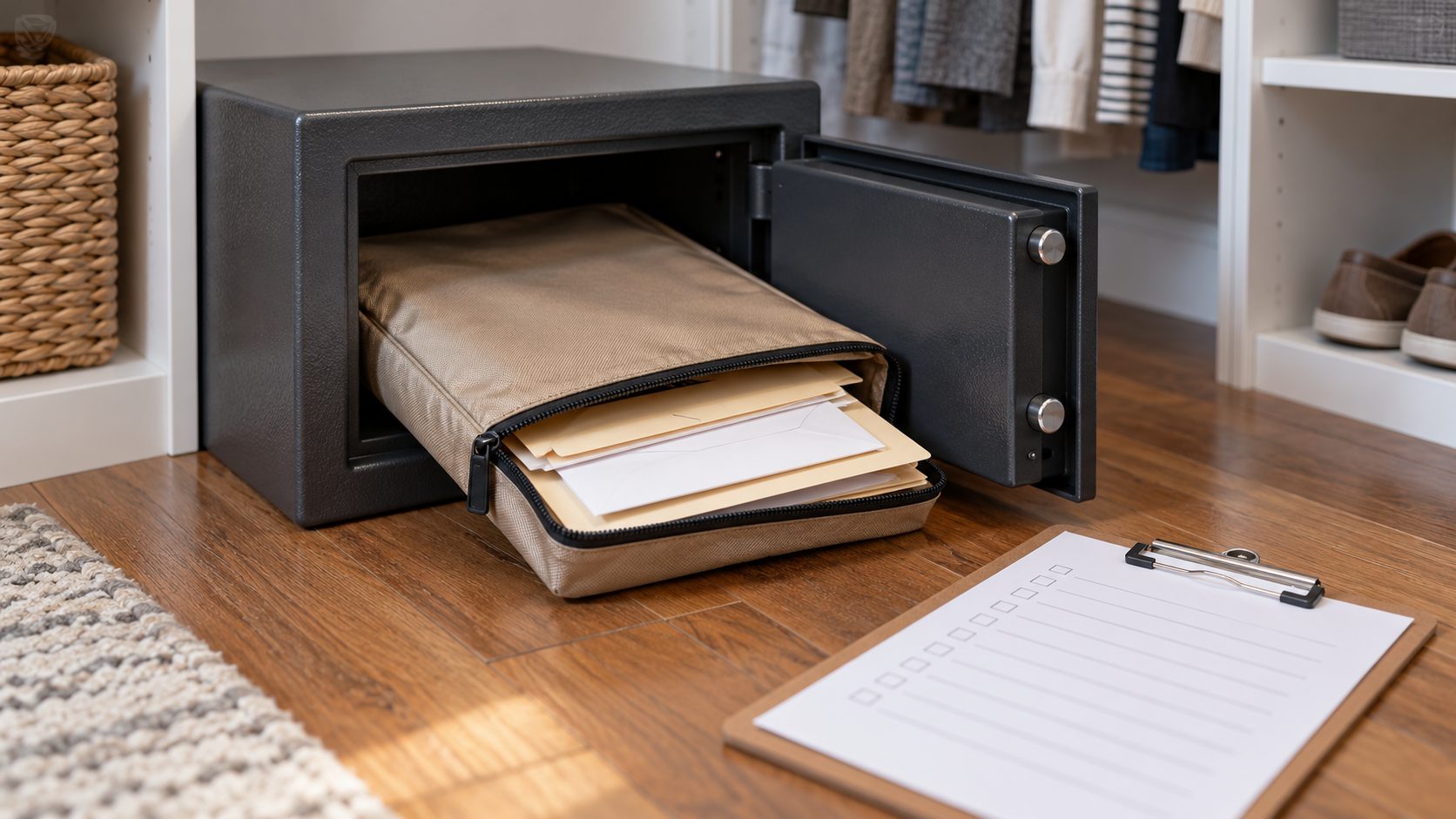
The image at the top is an illustration, not a photo of a real product.
Neither one is a backup, though. A bag carries only its maker’s brief-exposure claim, and a classified safe is rated only to its stated test limits. Either way it holds one copy. If that copy is your only one and the fire or flood is worse than the container can handle, you lose it. We cover that after the comparison, because it changes what “protected” means.
Fireproof document bag vs home safe at a glance
| Fireproof document bag | UL-classified home fire safe | |
|---|---|---|
| Example we used | SentrySafe FBWLZ0 fire bag | SentrySafe SFW123GTC and SFW205GPC |
| Price (SentrySafe, Oct 2026) | $20 to $50 | $200 to $400 (1.23 cu ft); $400 to $600 (2 cu ft) |
| Fire rating | None listed; “brief fire exposure” | UL Classified, 1 hour at up to 1700°F |
| Water | Water resistant, not waterproof | ETL Verified, up to 8 inches of water for up to 24 hours |
| Theft | Zipper and snaps; walks out the door with anyone | Steel, locking bolts, about 86 to 125 lb; can be bolted down |
| Portability | Grab it and go | Stays where it is |
| Capacity | About 0.1 cu ft (a stack of papers) | 1.23 to 2 cu ft |
| Best for | Evacuations, renters, tight budgets | Originals that are hard to replace |
| Main limit | Short heat protection, no theft protection | Cost, weight, can’t leave with you |
Specs and prices come from SentrySafe’s product pages for the SFW123GTC and SFW205GPC safes and the FBWLZ0 bag, as shown in October 2026. Other brands and sizes will differ, so check the label on whatever you buy.
What does “fireproof” mean on a bag vs a safe?
On a safe, “fireproof” should mean a rating with a time and a temperature attached, checked by an outside lab. On a bag, Bob Vila’s guide says no federal regulations cover the testing, so check what the listing actually backs the word with.
SentrySafe’s buying guide lists the UL fire tests its safes are classified under: half an hour at 1550°F, 1 hour at 1700°F, or 2 hours at 1850°F. Master Lock, SentrySafe’s sister brand, explains that items like paper go inside during the test, and that to earn the highest UL rating the interior can’t go above 350°F for the length of the test. Both are a manufacturer describing the standard, not UL itself, but the shape of it is the useful part: a time, an outside temperature, and a ceiling on how hot the inside gets.
Some safes also carry UL explosion and impact ratings, the second for a safe that falls through a burning floor. Master Lock says the 15-foot drop it describes applies to SentrySafe’s 2-hour fire safes. The two safes in our table list only their fire and water ratings, so check the label if that matters to you.
A bag is a different story. Bob Vila’s buying guide notes there are no federal regulations for testing fireproof document bags, and that the heat claims on bags typically run 1,000 to 2,000°F. That’s a single temperature. Unless the listing also gives a time and an outside lab, you have no way to compare it with a safe’s rating.
Bags aren’t useless. In Bob Vila’s tested roundup, the testers put six bags in front of a 68,000 BTU propane heater for 10 minutes each, and the paper inside every one came out intact. The bags themselves took a beating: zippers, hook-and-loop flaps and a lock melted or failed, and in one bag the paper took some burn damage while staying whole. That’s a real result from one reviewer’s test. It’s also 10 minutes of heat, not a house fire, and the same guide says none of the bags are designed to withstand actual flames and most are meant to be kept inside a safe.
SentrySafe is just as plain about its own bag. Its FBWLZ0 fire bag page says the bag is tested to endure brief fire exposure and that no document bag will survive a significant structure fire.
Our rule: if the box doesn’t name an outside lab and a time, read “fireproof” as “fire resistant for a little while.”
The 5-point label check before you buy
The difference between a bag and a safe shows up on the label, so read the label before the product name. These five checks come from the ratings above.
| Check | What to look for | Why it matters |
|---|---|---|
| 1. An outside lab for fire | ”UL Classified” fire protection | Without a named lab, the listing doesn’t show that anyone outside the maker checked the claim |
| 2. A time, not just a temperature | ”1 hour at 1700°F,” not “2,000°F” alone | Heat for 10 minutes and heat for an hour are different jobs |
| 3. A verified water rating with numbers | ”ETL Verified,” with depth and hours, such as 8 inches for 24 hours | Floods, sprinklers and fire hoses can all leave water in a house; the rating tells you what depth and time the safe was tested for |
| 4. A digital media rating, if you store drives | Wording that the safe is verified for digital media | A paper rating is about paper |
| 5. Weight and bolt-down | Bolt-down hardware or a kit for that model | A light safe or a bag can be carried off |
If a product passes checks 1 and 2 together, an outside lab’s fire classification with a time on it, it has a real fire rating. If it only lists a temperature, treat its fire protection as unverified, whatever the name says.
Which one protects documents from water?
The safe, if it carries a verified water rating.
SentrySafe says its FBWLZ0 fire bag is not waterproof, though it resists sprinkler water. Other bags make their own water claims, so check each one rather than assuming. The two SentrySafe safes in our table carry an ETL Verified rating for up to 8 inches of water for up to 24 hours. Per Master Lock, ETL Verified means the testing company Intertek verified the maker’s own water test, used where no standard water test exists. Not every fire safe has a water rating, so look for it on the label. Master Lock also says some makers rate water protection with their own internal tests, and those claims should generally be avoided.
Water matters even if you don’t live near a river. Master Lock points out that a house fire can bring significant water from sprinklers or fire hoses, which can damage what’s inside a safe that isn’t rated for water. The rating measures depth and time under water, not a hose spray.
Where you put the safe matters too, and the advice pulls in two directions. Master Lock suggests a basement so a safe can’t fall through floors in a fire. FEMA’s Safeguard Critical Documents and Valuables guide suggests moving valuables out of a basement to a higher spot in waterproof containers. If your area floods, keep the safe off the basement floor. If it doesn’t, a basement or a ground-floor closet both work.
Which one is better against theft?
The safe, by a wide margin. A bag closes with a zipper and snaps and weighs about a pound, so anyone who finds it can carry it off as easily as you can.
The SentrySafe safes in our table weigh about 86 and 125 pounds and have locking bolts and a pry-resistant hinge bar. The larger one comes with bolt-down hardware, and SentrySafe sells a bolt-down kit for the smaller one. Bolting a safe down makes it much harder for someone to carry it away.
One practical point that has nothing to do with steel: decide who else knows the combination or where the key is. If you’re the only one who can open it, the papers inside don’t help your family when they need them. That belongs in your family emergency plan.
When is a fireproof document bag the better choice?
When you might have to leave, when you rent, or when $200 or more isn’t in the budget this month.
A safe stays put and keeps protecting what’s inside, within its rating, while you’re gone. A bag protects a smaller set of papers for a short time, but it leaves with you. If a hurricane or wildfire could mean a fast evacuation where you live, a bag with your passports, birth certificates and insurance details is easy to grab on the way to the car, if you can reach it safely. Never delay leaving to get it. SentrySafe pitches its bag as a go-bag for that reason. Our hurricane prep guide covers the rest of what goes with you.
A bag holds a stack of papers, not a filing cabinet; the SentrySafe bag is 13 by 9 inches inside and 1.5 inches deep. If a bag is all you can do right now, we’d still use one. Its maker says it’s tested for brief fire exposure, and it keeps the papers together and ready to grab.
If you’re shopping, look at fire resistant document bags closely, because zippers, flaps and locks were what melted in Bob Vila’s heat test. Bob Vila’s guide also warns that bags can trap moisture, so make sure papers are dry before they go in.
What goes in the bag, and what stays in the safe
FEMA’s critical documents guide asks you to think about what you’d take with you if you had to evacuate suddenly. Here’s how we’d sort the main papers on its checklist. It’s our suggestion, not FEMA’s; adjust it for your family.
| Paper | Bag (goes with you) | Safe (stays home) |
|---|---|---|
| Passports, birth certificates, marriage certificates | Yes | When you’re home, the bag lives in the safe |
| Insurance policies (homeowners, renters, auto, flood) | A copy, for filing a claim | The original |
| List of medications, allergies and doctors | Yes | No need |
| Deed, vehicle titles | No | Yes |
| Will, trust, power of attorney | A copy | The original, unless your attorney holds it |
| Social Security cards | No | Yes |
| Tax returns | No | Yes, or a secure digital copy |
Our important documents guide goes deeper on which papers need the original and which only need a copy.
Why the best setup is often both
SentrySafe’s own advice for its bag is to use it inside a UL classified fire safe for the most protection. We think that’s the right answer for most homeowners.
Each covers the other’s gap. The safes we compare carry a 1-hour fire rating and, bolted down, are much harder to carry off. The bag keeps your most important originals together in one pouch, so if you need to leave, you open the safe, take the bag and go. If you don’t, the papers stay in the rated safe.
Neither one is your backup
A fire safe protects one copy. A bag protects one copy. If that copy is the only one, a single fire or flood can still take it.
FEMA’s guide suggests keeping paper copies of important documents in a fireproof and waterproof box or safe at home, in a bank safe deposit box, or with a trusted friend or relative. It also suggests password-protected electronic copies on a flash drive or external drive kept in the safe, or in a secure cloud service. If the drive lives in the safe, check whether the safe is verified for digital media; Master Lock says that takes its own testing, separate from the paper rating. Ready.gov’s financial preparedness page gives a similar short list: a safe deposit box, an external drive, or the cloud. If you use a safe deposit box, FEMA suggests asking your bank, or checking state law, about who can open it if the account holder dies or can’t act.
Wherever the originals end up, someone in your family needs to know where each one is. That’s where a binder helps. The Family Emergency Binder records where each original is kept (the bag, the safe, the bank, a relative’s house) without asking for account numbers, Social Security numbers or passwords. So whoever needs the papers knows exactly where to look.
Which should you buy?
It depends on your house and your risks more than on the product. Here’s how we’d decide.
- If you rent or money is tight, get a fireproof document bag and keep copies somewhere else. Upgrade to a safe when you can.
- If you own your home and keep originals that are hard to replace (deed, will, titles, birth certificates), get a UL classified fire safe with a 1-hour rating, bolted down, with a bag inside for the papers you’d grab first.
- If your area floods, choose a safe with an ETL-verified water rating and keep it off the basement floor.
- If you live in hurricane or wildfire country and evacuating is a real possibility, get both: the safe for what stays, the bag for what goes.
- If theft is your main worry, get the safe and bolt it down. A bag offers no theft protection.
The free printable: what goes in the bag, and where the rest lives
The printable turns this guide into two letter-size pages you fill in once and keep with the papers. The boxes are fillable, so you can type into them in a PDF reader, or print the pages and use a pen.
Page 1: what goes in the bag
The top half is the bag-or-safe table from this guide, with two columns added: a “Done” tick box on the left and “Where the original is now” on the right. The seven rows are the same papers: passports and certificates, insurance policies, the medication list, deed and vehicle titles, will and power of attorney, Social Security cards, and tax returns. Three blank rows at the bottom are for papers your family has that aren’t on the list.
Work down it with the papers in front of you. In the last column, write a place, like “the safe,” “the bag,” “deposit box at our bank,” or “Mom’s house,” then tick “Done” once the paper is actually there. The “Where, not what” box spells out the rule: no account numbers, Social Security numbers or passwords on the page.
Under the table, “Where things live” has four blanks:
| Blank | What to write |
|---|---|
| The bag lives at, when I’m home | Where the bag sits day to day, ideally inside the safe |
| The safe is at | The room and spot, like “basement, under the stairs” |
| Who else knows where the key or combination is | A name. Write who, never the combination. |
| Safe deposit box: which bank, and who can open it if I can’t | The bank, and the answer you got when you asked, as FEMA suggests |
Two boxes close the page. “Before you pack” repeats Bob Vila’s moisture warning and SentrySafe’s advice to keep the bag inside a UL-classified safe. “Never delay leaving” says to take the bag only if you can reach it safely, because its maker says no document bag survives a significant structure fire.
Page 2: backups and the label check
The left column, “Neither one is your backup,” lists the four storage options FEMA names for documents: a fireproof and waterproof box or safe at home, a bank safe deposit box, a trusted friend or relative, and a password-protected electronic copy on a drive or in a secure cloud service. The deposit box and the friend or relative keep a copy away from your house, and so does a cloud copy; a drive kept in the home safe doesn’t. Tick the ones you’ve set up and fill in the blank beside each. If none of your ticks is away from the house, add one, because one fire or flood can still take every copy kept at home.
The right column is the 5-point label check as tick boxes: an outside lab for fire, a time and not just a temperature, a verified water rating with numbers, a digital media rating if you store drives, and weight or bolt-down hardware. Keep it next to you while you shop, and tick a box only when the label or listing actually says it. The note under the boxes is the rule from this guide: if a product lists only a temperature, treat its fire protection as unverified. It adds Bob Vila’s point that no federal regulations cover bag testing, so check what the listing backs the word with.
Below both columns, “Which setup fits your house?” repeats the five-line buying list. Find your line, then use the notes box for the model you picked and where you’ll put it. The last box on the page is the same reminder as above: decide who else knows where the key is, and write down who, never the combination.
Frequently asked questions
Do fireproof document bags really work?
In one short test, yes. In Bob Vila’s 10-minute heater test, the paper in all six bags it tried stayed intact. That’s six bags under one heater setup, not a house fire, and it can’t tell you how any bag holds up longer or hotter. They aren’t fireproof in the way a rated safe is, though. Bags are fire resistant for brief exposure, and SentrySafe says no document bag survives a significant structure fire. For originals that would be hard to replace, pair a bag with a UL-rated safe or keep copies somewhere else, ideally both.
Can I keep a fire safe in the basement?
Yes, if your area doesn’t flood. Master Lock likes the basement because a safe there can’t fall through floors in a fire. FEMA suggests moving valuables out of a basement to a higher spot if water is the risk. If you do flood, put the safe on a higher floor, or at least raise it off the basement floor.
Is a safe deposit box better than a home safe?
They do different jobs. A home safe keeps papers close and reachable any time; a safe deposit box keeps papers, originals or copies, away from your house. FEMA lists both as options, and suggests asking your bank, or checking state law, about who can open the box if you die or can’t act.
Where to start
Start with the papers, not the container. Gather your birth certificates, passports, deed, titles, will and insurance details using our important documents guide, and you’ll know how much space you need. Then pick a setup from the list above, and make one copy that lives somewhere other than your house. Page 2 of the free printable gives you a place to write down where that copy is.