Buying Guides
Best Emergency Water Filters and Purification Tablets
General information only, not professional advice. In an emergency, call 911 and follow local officials. How we use sources
We may earn a commission if you buy through our links, at no extra cost to you. We don't test products ourselves. We choose picks from the maker's own specs, the retailer listing and, where a safety rule applies, official government guidance. Specs shown are the maker's or seller's claims, and we have not tested any safety or fire rating. How we choose.
In this guide
For most families, the best emergency water setup is a small hollow-fiber filter, like the Sawyer Mini, plus a box of chlorine dioxide tablets. The filter removes bacteria and parasites. The tablets kill viruses. Boiling is still the CDC’s first choice, so treat both as the backup for when you cannot boil.
Water treatment is a safety topic, so the rules below are the CDC’s and EPA’s, quoted word for word. The product picks are ours, and the specs come from each maker’s own page. Follow your local emergency officials, call 911 in an emergency, and when in doubt, don’t drink the water.
Should you boil first?
Yes, if you can. The CDC puts it plainly:
Use bottled, boiled, or treated water to avoid getting sick.
Boiling is the best way to kill germs in water.
Source: CDC, How to Make Water Safe in an Emergency, accessed November 2026.
Our boil water notice guide covers what that looks like at home. A filter or tablet earns its place when you have no power or no fuel, when you are away from home, or when you want a second layer in your kit.
What do filters and tablets actually remove?
They do different jobs, and neither does all of them. This is the part most “best of” lists skip.
On filters, the CDC says:
Portable water filters do not remove all types of germs from water.
Will not remove viruses
Must have an absolute pore (hole) size of 0.3 micron or smaller to remove bacteria
Must have an absolute pore size of 1 micron or smaller to remove parasites (such as Giardia or Cryptosporidium)
Source: CDC, How to Make Water Safe in an Emergency, accessed November 2026.
On tablets, the CDC says:
Chemical disinfectants kill viruses and bacteria, but may not kill parasites.
Iodine, tablets with iodine (tetraglycine hydroperiodide), or chlorine tablets kill most germs, but will not kill Cryptosporidium germs. Chlorine dioxide tablets will kill Cryptosporidium as long as you follow the instructions correctly.
Source: CDC, How to Make Water Safe in an Emergency, accessed November 2026.
Read together, the gap is clear. A filter misses viruses. A chlorine or iodine tablet misses Cryptosporidium. The CDC’s answer is to use both in order: after filtering, it says to add a chemical disinfectant (it names iodine, chlorine or chlorine dioxide) to the filtered water.
Follow the instructions for the water filter you are using.
The disinfectant will kill any viruses and bacteria.
Source: CDC, How to Make Water Safe in an Emergency, accessed November 2026.
There is one limit that applies to everything on this page:
You cannot make water containing fuel, toxic chemicals, or radioactive materials safe by boiling or disinfecting it.
Source: CDC, How to Make Water Safe in an Emergency, accessed November 2026.
If your local officials say the water is chemically contaminated, use bottled water or a different source. Our water storage guide for small spaces and bottled water guide cover that supply.
How do the four picks compare?
This table uses each maker’s own page. Every figure is the maker’s claim, not our test. Prices change often, so check the listing.
| Pick | Type | What the maker says it removes or kills | Size and life (per maker) | Main limit |
|---|---|---|---|---|
| Sawyer Mini | Hollow-fiber filter, 0.1 micron | 99.99999% of bacteria, 99.9999% of protozoa | About 2 oz, rated up to 100,000 gallons | Does not remove viruses (CDC) and must not freeze |
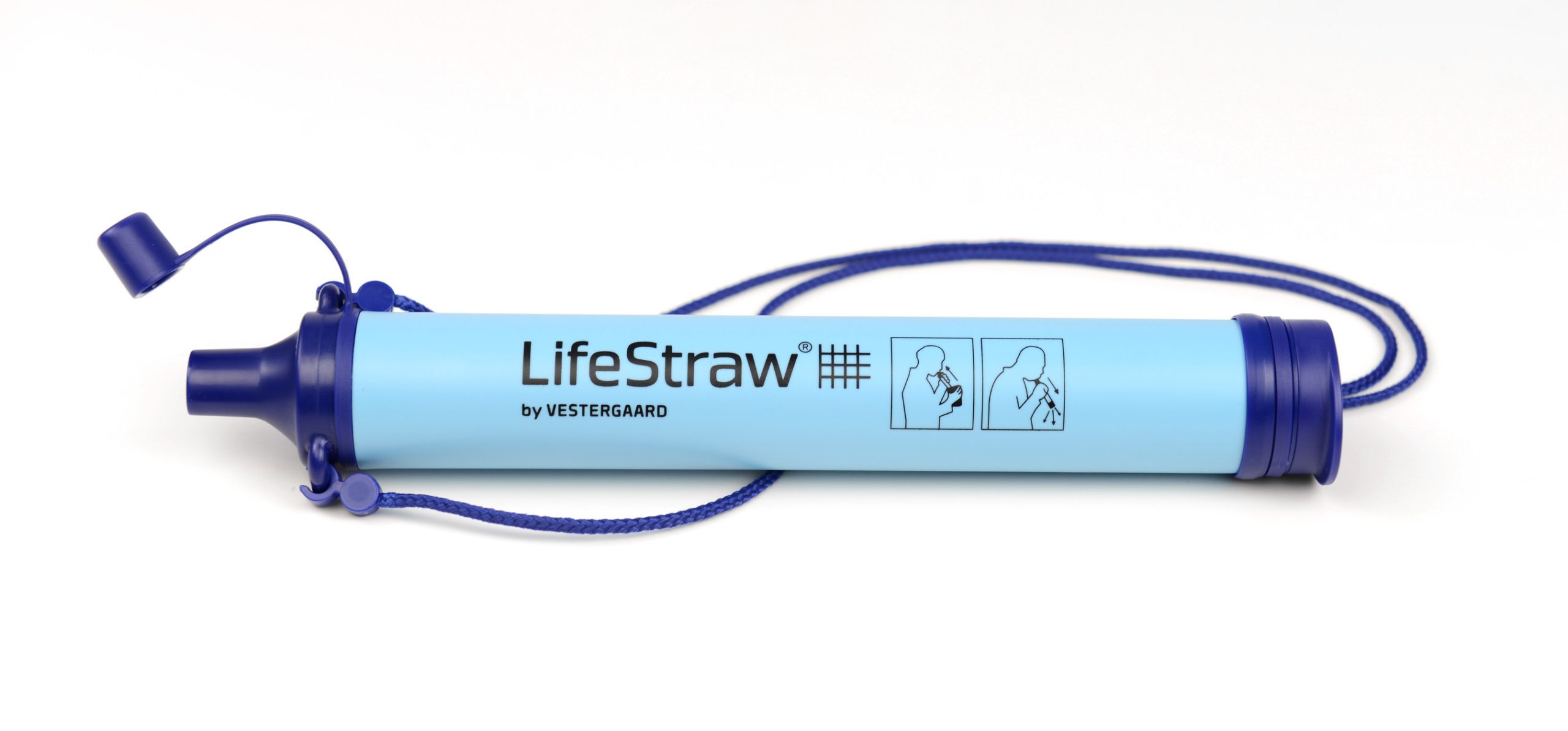
| LifeStraw Peak Series Straw | Hollow-fiber filter, 0.2 micron | 99.999999% of bacteria, 99.999% of parasites | 2.3 oz, up to 4,000 L (1,000 gallons) | Does not remove chemicals or heavy metals, and no viruses (CDC) |
| Aquatabs | Chlorine tablet | 99.9999% of bacteria, 99.99% of viruses, 99.9% of Giardia cysts | Treats in 30 minutes; 5-year shelf life in strip packs, 3 in tubs | Chlorine tablets will not kill Cryptosporidium (CDC) |
| Katadyn Micropur MP1 | Tablet sold as chlorine dioxide (maker’s page does not name the ingredient) | Bacteria, protozoa, cysts and viruses | 1 tablet per liter of clear water, 4-hour exposure time, 5-year shelf life from manufacture | The 4-hour wait. Confirm “chlorine dioxide” on the box |
For the Aquatabs row, the maker’s page cites a US EPA water purifier challenge test. The CDC’s line about Cryptosporidium is why we pair them with a filter.
Sawyer Mini: best filter for most kits
Sawyer describes the Mini as a 0.1 micron absolute hollow-fiber filter that weighs about 2 ounces and attaches to the included pouch, a standard disposable bottle or a hydration pack. It is the one we would put in a family kit first. It is cheap, it is small, and the pore size is well under the CDC’s 0.3 micron line for bacteria and 1 micron line for parasites.
Two things from Sawyer’s own FAQ matter at home. Do not attach the filter directly to a faucet, because the filters handle up to 20 psi. And freezing can damage the fibers without any way to tell: Sawyer says to replace a filter you suspect was frozen, and there is no warranty on it. That makes a garage shelf in a northern winter a poor place to keep one. Check the Sawyer Mini on Amazon.
LifeStraw Peak Series Straw: best for one person on the move
The Peak Series Straw uses a 0.2 micron membrane. LifeStraw lists it at 2.3 ounces and up to 4,000 liters, and it says plainly that the straw does not remove chemicals or heavy metals. It is a good pick for a personal kit or a car, since you can drink from a container or straight from the source. Like every filter here, the CDC’s note applies: it will not remove viruses. We compare it to tablets in more depth in our LifeStraw vs. purification tablets guide. Check the LifeStraw Peak Series Straw on Amazon.
Aquatabs: best chlorine tablet for the price
Aquatabs says its tablets disinfect water within 30 minutes and treat volumes from 1 liter up. The tablets are NaDCC, a form of chlorine, and the FAQ gives a five-year shelf life in strip packs and three years in tubs, with protection from heat and humidity. The strip packs are easier to tuck into several kits. These are chlorine tablets, so per the CDC they will not kill Cryptosporidium. Pair them with a filter. Our do water purification tablets expire guide goes deeper on storage. Check Aquatabs on Amazon.
Katadyn Micropur MP1: the chlorine dioxide tablet
The CDC singles out chlorine dioxide tablets as the type that kills Cryptosporidium when used correctly, which is why we pair a box with the filter. Katadyn’s Micropur MP1 is sold as one. Katadyn’s own page does not name the active ingredient, so check that the box says chlorine dioxide. The maker says one tablet treats 1 liter of clear water, the exposure time is 4 hours, the shelf life is 5 years from manufacture, and the tablets are effective against bacteria, protozoa, cysts and viruses. Four hours is a long wait, so treat a batch ahead of time and follow the label. Check the Katadyn Micropur MP1 on Amazon.
We may earn a commission if you buy through these links, at no extra cost to you. We have not tested these products ourselves. The specs above are the makers’ claims.
What about iodine tablets and bleach?
The EPA and CDC both list iodine tablets, with a caution from the CDC:
If you are pregnant, have thyroid problems, or have a hypersensitivity to iodine, avoid drinking water disinfected with iodine. Additionally, no one should drink water disinfected with iodine for more than a few weeks at a time.
Source: CDC, How to Make Water Safe in an Emergency, accessed November 2026.
That is why we skip iodine. You should also know that federal pages do not fully agree on tablets. Ready.gov’s water page, last updated in February 2021, says:
Other chemicals, such as iodine or water treatment products sold in camping or surplus stores that do not contain 5.25 or 6.0 percent sodium hypochlorite as the only active ingredient are not recommended and should not be used.
Source: FEMA, Ready.gov: Water, accessed November 2026.
Read literally, that covers more than iodine. It would also rule out the chlorine dioxide and NaDCC tablets on this page, since neither is plain sodium hypochlorite. The CDC and EPA pages quoted here list chlorine, iodine and chlorine dioxide tablets as emergency options. We are not in a position to settle that. When the agencies differ, follow what your local health department tells you. For tablets in general, the EPA says:
You can disinfect water with tablets that contain chlorine, iodine, chlorine dioxide, or other disinfecting agents. These tablets are available online or at pharmacies and sporting goods stores. Follow the instructions on the product label as each product may have a different strength.
Source: EPA, Emergency Disinfection of Drinking Water, accessed November 2026.
The EPA also reminds readers that treatment has limits:
However, boiling or disinfection will not destroy other contaminants, such as heavy metals, salts, and most other chemicals.
Source: EPA, Emergency Disinfection of Drinking Water, accessed November 2026.
How do you put it together?
- Store water first. A filter needs a source. Our small-space water storage guide covers the stored supply, and the filter is for after it runs out.
- Put one filter and one box of chlorine dioxide tablets in the kit. Keep them dry and out of a freezing garage, and check the label for a date.
- Pre-filter cloudy water. A coffee filter or clean cloth first, as the CDC says, then the filter or tablet.
- Practice once. Run a liter of tap water through the filter before you need it, so the first time is not during an outage.
- Write down where it all lives. The Home & Property section of our Family Emergency Binder checklist is built for noting where the water shutoff, water heater and supplies are kept, so anyone in the house can find them.
Frequently asked questions
Does a LifeStraw remove viruses?
The CDC says portable filters will not remove viruses, and LifeStraw’s page for the Peak Series Straw claims bacteria, parasites and microplastics, not viruses. If viruses are a concern, add a disinfectant after filtering, as the CDC advises.
Are water purification tablets safe to drink?
When used as the label directs, the CDC and EPA both list them as an emergency option, though Ready.gov’s water page advises against camping-store treatment products (see above). The CDC warns that some people should avoid iodine. Follow the label, and use bottled water if you are unsure.
Filter or tablets: which should I buy first?
If you must pick one, buy the filter, because it needs no waiting time and no dosing. But the two cover different germs, so a filter plus a box of chlorine dioxide tablets is the better pair.
Can I use either one on water from a flood?
Not on water you know or suspect contains fuel, toxic chemicals or radioactive material. The CDC says boiling or disinfecting will not make it safe. Follow your local officials, who will say which water to avoid.
Final thoughts
Pick one small filter and one box of chlorine dioxide tablets, store them dry, and run a test liter this week. Keep your stored water as the main plan, with the filter and tablets as the backup. If officials tell you the water is unsafe, follow them, call 911 in an emergency, and when in doubt, don’t drink it.