Emergencies & Disasters
What to Do When the Power Goes Out: The First Hour
General information only, not professional advice. In an emergency, call 911 and follow local officials. How we use sources
We may earn a commission if you buy through our links, at no extra cost to you. We don't test products ourselves. We choose picks from the maker's own specs, the retailer listing and, where a safety rule applies, official government guidance. Specs shown are the maker's or seller's claims, and we have not tested any safety or fire rating. How we choose.
In this guide
When the lights go out, keep the refrigerator and freezer doors shut, get a battery flashlight in hand, and find out whether the outage is just your house or the whole area. Ready.gov says: “Keep freezers and refrigerators closed. The refrigerator will keep food cold for about four hours.” Everything else on this page builds from those first moves.
This is a first-hour checklist, the order I would work through it with my own family. The safety guidance comes from federal agencies and is quoted as they wrote it. Where I add something that is common sense and not an agency instruction, I say so. Follow the instructions of your local emergency officials over anything here, call 911 in an emergency, and when in doubt, don’t.
1. Get light, and skip the candles
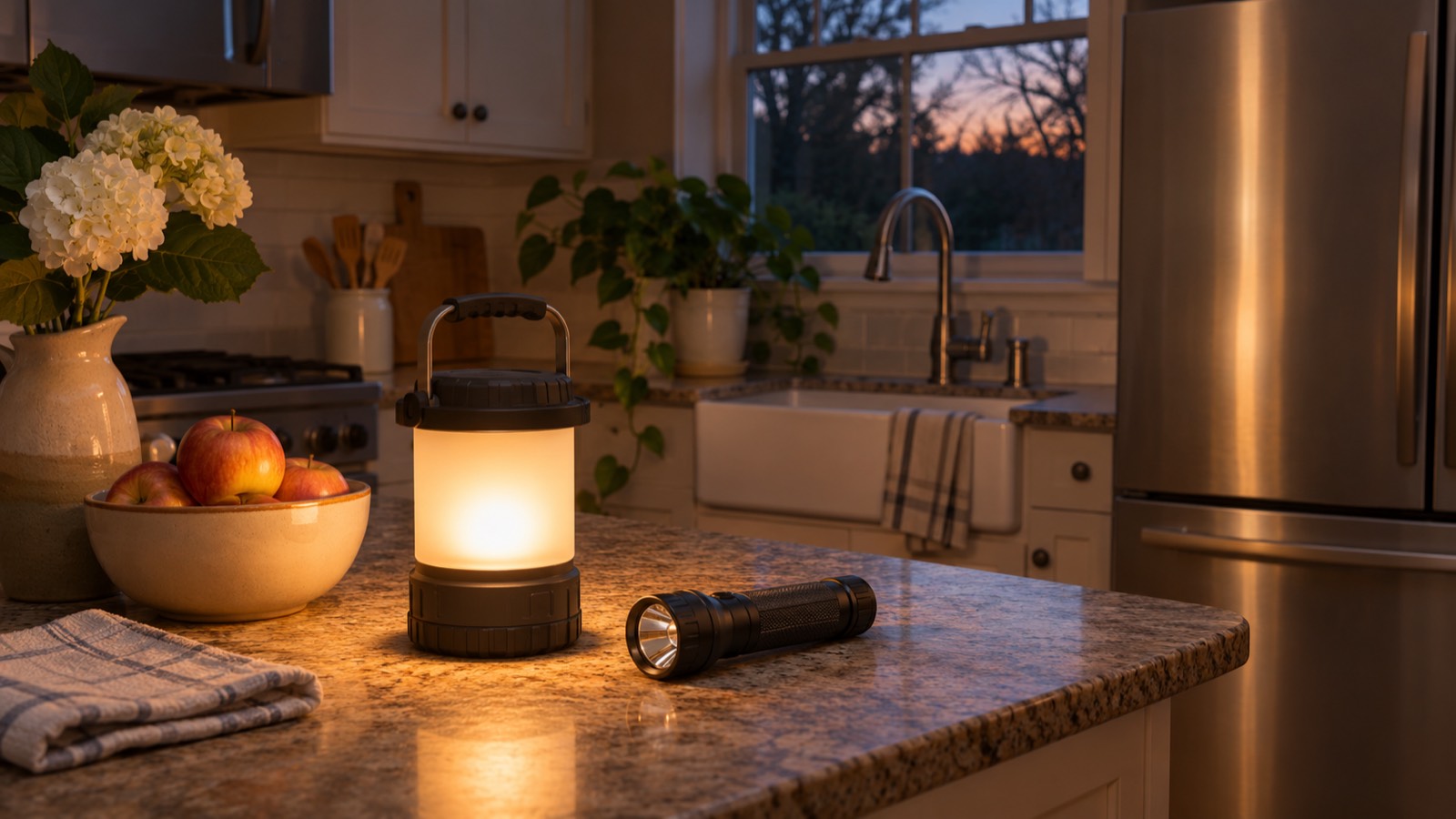
Grab a flashlight or battery lantern before you do anything else. If you can’t find one, use your phone’s flashlight for the moment, then put the phone down so the battery lasts.
The CDC is direct about candles: “Use battery-powered flashlights and lanterns, rather than candles, gas lanterns, or torches to minimize the risk of fire.” It adds: “If you have to use candles, keep them away from anything that can catch fire. Always stay near lit candles.” (Source: CDC, “What to Do to Protect Yourself During a Power Outage” (cdc.gov), accessed November 2026.)
If you want help choosing lights worth keeping in a drawer, see our guide to battery-free flashlights. For a candle-heavy household, emergency candles 101 covers how to burn them more safely if you decide to. A battery LED lantern lights a whole room with no flame, which is why it is the first thing I would put in an outage bin.
2. Find out how wide the outage is
This step is common sense, not agency guidance. Look out a window. If the neighbors’ lights and the streetlights are on, the problem may be inside your house, and a tripped breaker in your electrical panel is the usual first thing to check. If the whole street is dark, it is a utility problem.
Either way, report it. Most utilities have an outage page or phone number, and many show a map with an estimated restoration time. Keep a paper copy of that number somewhere you can find without power, since the website may be the first thing you cannot load. Writing it on a card for your wallet or your emergency binder helps at exactly this moment. Our emergency binder is built for that kind of thing.
If you see a downed line, the CDC’s advice is short: “Never touch a fallen power line.” It also says: “Do not drive through standing water if downed power lines are in the water.” (Source: CDC, “What to Do to Protect Yourself During a Power Outage” (cdc.gov), accessed November 2026.) Stay back, keep other people back, and call 911 and your utility.
3. Keep the fridge and freezer shut
This is the step people undo without noticing. Every time a door opens, cold air leaves and the clock runs faster.
Ready.gov says: “Have enough nonperishable food and water. Keep freezers and refrigerators closed. The refrigerator will keep food cold for about four hours. A full freezer will keep the temperature for about 48 hours. Use coolers with ice if necessary. Monitor temperatures with a thermometer. Throw out food if the temperature is 40 degrees or higher.” (Source: Ready.gov, “Power Outages” (ready.gov), accessed November 2026.)
The CDC gives the same numbers and adds the half-full case: “A full freezer will keep food safe for 48 hours (24 hours if half-full) without power if you don’t open the door.” (Source: CDC, “What to Do to Protect Yourself During a Power Outage” (cdc.gov), accessed November 2026.)
A cheap appliance thermometer lets you read the inside temperature without guessing. Put it in before you need it. Note the time the lights went out, because that is the number every hold time counts from.
For the full list of what to keep and what to throw away, see how long food lasts in the fridge without power. If the outage is heading toward a day or more, read how to keep food cold during a long outage before the four hours are up.
4. Switch off what could surge when power returns
Ready.gov lists this under protecting yourself: “Disconnect appliances and electronics to avoid damage from electrical surges.” Its longer version says: “Turn off or disconnect appliances, equipment, or electronics. Power may return with momentary surges or spikes that can cause damage.” (Source: Ready.gov, “Power Outages” (ready.gov), accessed November 2026.)
A practical way to do this: unplug the TV, computer and other electronics you care about, and turn off stove burners and space heaters so nothing starts up on its own. Leave one lamp switched on so you can see when the power is back. That last part is my habit, not an agency rule.
5. Carbon monoxide comes first
More people are hurt by the response to an outage than by the outage itself, and carbon monoxide is the main reason. The CDC says: “Carbon monoxide (CO) is an odorless, colorless gas that can cause sudden illness and death if inhaled.” It also says: “Never use a generator, pressure washer, or any gasoline-powered engine inside your home, basement, or garage or less than 20 feet from any window, door, or vent.” (Source: CDC, “What to Do to Protect Yourself During a Power Outage” (cdc.gov), accessed November 2026.)
A few more lines from the same CDC page apply to the first hour:
- “Never use a charcoal grill, hibachi, lantern, or portable camping stove inside a home, tent, or camper.”
- “Never use a gas range or oven to heat a home.”
- “Never leave the motor running in a vehicle parked in an enclosed or partially enclosed space, such as a garage.”
Ready.gov agrees: “Install carbon monoxide detectors with battery backup in central locations on every level of your home.” (Source: Ready.gov, “Power Outages” (ready.gov), accessed November 2026.) If your detector only plugs into the wall, it needs a battery to work in an outage. A battery-backup carbon monoxide alarm is cheap compared with the risk.
The CDC lists the symptoms: “The most common symptoms of CO poisoning are headache, dizziness, weakness, nausea, vomiting, chest pain, and confusion.” It warns that “People who are sleeping or who have been drinking alcohol can die from CO poisoning before ever having symptoms.” If you or anyone else shows signs, the CDC says to call 911 or Poison Control at 1-800-222-1222. Get everyone into fresh air first. (Source: CDC, “What to Do to Protect Yourself During a Power Outage” (cdc.gov), accessed November 2026.)
If you own a generator, our page on how far a generator should be from the house goes through placement in detail.
6. Think about medicines and medical devices
If anyone in the house depends on a powered device or a refrigerated medicine, decide in the first hour whether you need to move them to a place with power. Ready.gov says: “Have alternate plans for refrigerating medicines or using power-dependent medical devices.” It also says: “Check with local officials about heating and cooling locations open near you.” (Source: Ready.gov, “Power Outages” (ready.gov), accessed November 2026.)
On refrigerated drugs, the CDC says: “When the power is out for a day or more, throw away any medication that should be refrigerated, unless the drug’s label says otherwise.” It continues: “If a life depends on the refrigerated drug, but the medications have been at room temperature, use them only until a new supply is available.” Call your doctor or pharmacist about anything critical. (Source: CDC, “What to Do to Protect Yourself During a Power Outage” (cdc.gov), accessed November 2026.)
7. Stay in touch without burning the phone battery
Tell the people who would worry that you are fine and the power is out. Then drop the screen brightness, close the apps you aren’t using, and keep the phone for what matters. Text messages tend to use less battery than a long call, though I could not find an agency page that says so, so treat that as a tip and not a rule.
If you haven’t agreed on how your family reaches each other when phones are limited, the family communication plan walks through it. A charged power bank keeps a phone alive for a good part of a day. Ready.gov recommends planning ahead: “Plan for batteries and other alternative power sources to meet your needs when the power goes out, such as a portable charger or power bank. Have flashlights for every household member.” (Source: Ready.gov, “Power Outages” (ready.gov), accessed November 2026.) A NOAA weather radio is the better way to follow storm warnings if cell service drops.
8. Plan for the cold or the heat
If the weather is extreme, an outage becomes a health question quickly. The CDC says: “If conditions are too hot or too cold, seek shelter with friends or at a community shelter.” Ready.gov says to “Go to a community location with power if heat or cold is extreme.” (Sources: CDC, “What to Do to Protect Yourself During a Power Outage” (cdc.gov), and Ready.gov, “Power Outages” (ready.gov), accessed November 2026.)
For a cold house, the CDC lists these heat sources: “Extra blankets, sleeping bags, and warm winter coats,” a fireplace that is up to code, or portable heaters, and cautions: “If you plan to use a wood stove, fireplace, or space heater, be extremely careful. Follow the manufacturer’s instructions.” Our page on how to stay warm without power covers the non-electric options, and the winter storm guide covers the longer view.
For a hot house, the CDC suggests: “Spend some time at a shopping mall or public library- even a few hours spent in air conditioning can help,” and “Take cool showers or baths.” It also says: “Don’t rely solely on fans to keep you cool.” (Source: CDC, “What to Do to Protect Yourself During a Power Outage” (cdc.gov), accessed November 2026.)
9. Water and the toilet
The CDC notes that “When power goes out, water purification systems may not be functioning fully,” and that safe water means “bottled, boiled, or treated water.” Your state, local or tribal health department can give specifics for your area. (Source: CDC, “What to Do to Protect Yourself During a Power Outage” (cdc.gov), accessed November 2026.) If you are on a well, your pump will stop with the power, and our page on flushing the toilet during an outage explains what to do.
What to do after the first hour
If it is night, our nighttime outage page picks up from here. If the outage is still going after the first hour, the next decisions are food, heat and communication, and the links above cover each one. When the power returns, Ready.gov’s rule for food is: “When in doubt, throw it out! Throw away any food that has been exposed to temperatures 40 degrees or higher for two hours or more, or that has an unusual odor, color or texture.” (Source: Ready.gov, “Power Outages” (ready.gov), accessed November 2026.)
What to keep in one place
This is our own suggestion, not an agency list, but it makes the first hour much easier. Keep these in one bin you can find in the dark:
- A flashlight or lantern for every person, with fresh batteries (our page on whether batteries expire explains storage).
- A battery-backed carbon monoxide alarm that you tested this month.
- An appliance thermometer for the fridge and freezer.
- A power bank, charging cables, and a paper list of phone numbers.
- Your medicine list and your utility’s outage number.
The 72-hour kit guide covers the larger supplies, and the emergency binder holds the paperwork in one place.
Questions people ask
Should I unplug everything?
Ready.gov says to disconnect appliances and electronics to avoid damage from surges when power returns. Unplug what you want to protect, and leave one lamp on so you know when it comes back.
Can I use my gas stove to heat the house?
No. Ready.gov says: “Do not use a gas stove or oven to heat your home. It increases your risk of carbon monoxide poisoning.” (Source: Ready.gov, “Power Outages” (ready.gov), accessed November 2026.)
Can I run a generator in the garage with the door open?
No. The CDC says never to run one inside a garage, “even if the doors or windows are open, unless the equipment is professionally installed and vented.” Keep it outside and at least 20 feet from windows, doors and vents.
How long is the food safe?
Ready.gov and the CDC both say about four hours for a closed refrigerator and about 48 hours for a full freezer, 24 if it is half full. Use a thermometer and follow the 40 degree line.
A note on sources
Quotes on this page come from Ready.gov and the CDC pages named in each credit line, which I read in November 2026. I did not test any of the products linked here. Links to Amazon are affiliate links; see our affiliate disclosure. Local conditions and rules differ, so follow your local emergency officials, call 911 in an emergency, and when in doubt, don’t.