We may earn a commission if you buy through our links, at no extra cost to you. We don't test every product ourselves. We read and weigh real buyer reviews to give a fair, balanced picture. How we research.
In this guide
A generator needs to be at least 20 feet from every window, door, vent, and attached garage, with the exhaust pointed away from the house. Never run one indoors, and never in a garage even with the door open. Put battery-backed carbon monoxide alarms on every level of the house before you start it.
Carbon monoxide is why that number exists. It has no smell and no color, so you get no warning before it does damage. The CPSC reports that more than 200 people a year die from accidental, non-fire carbon monoxide poisoning tied to consumer products in the US, and more than 100 of those deaths are linked to portable generators specifically. Distance, exhaust direction, and a working alarm are the three things that keep you off that list.
The 20-foot rule, and what it actually measures
The 20 feet isn’t measured to the nearest wall. It’s measured to the nearest opening, meaning any window, door, or vent the exhaust could reach. Ready.gov puts the minimum at 20 feet from windows, doors, and attached garages, and says fuel should be stored outdoors at that same distance, not just the generator itself. The CPSC adds the other half of the rule: the exhaust has to face away from the home, not just sit 20 feet from it.
Exhaust direction does as much work as distance. A generator 20 feet away but blowing exhaust straight at a window is worse than one at 15 feet pointed at open yard. Before you settle on a spot, walk the perimeter and check for every opening people forget:
- the dryer vent
- a crawl-space or foundation vent
- a bathroom exhaust vent
- a neighbor’s window, if you’re close to a property line
- an attached garage door, even one you plan to keep shut
Never run a generator indoors, and never in a garage, even with the door open. A garage with the door up is still an enclosed space, and carbon monoxide from a generator inside it can reach dangerous levels in minutes.
What if your yard can’t give you 20 feet?
Get every foot of distance the yard allows, then manage the rest with exhaust direction, closed windows, and a working alarm. There’s no published figure for how many homes actually have a full 20 feet of clearance in every direction, and plenty of standard suburban lots don’t. That gap is a real one: a thread asking exactly this question outranks most safety sites for this search, because “just move it 20 feet” isn’t an answer for everyone.
The decision method: put the generator as far from the house as the space allows. Point the exhaust away from every window and door on that side of the house, and close those windows while it’s running. Where you can, avoid a spot directly downhill or downwind of the house; carbon monoxide is heavier than air, and a low spot near the foundation lets it pool and drift upward toward the building even at a distance that would otherwise be fine. Then treat the CO alarm as non-negotiable rather than a backup plan.
Say it plainly: less than 20 feet is a compromise, not a safe distance. You’re trading a hard number for a set of habits, done every single time, that lower the risk as much as your yard allows.
Can you run a generator in the rain?
Not bare, no. An uncovered generator running in rain or standing water is a shock hazard, and draping a tarp over a running unit traps the exhaust instead of letting it vent, which undoes the entire reason you’re running it outdoors.
The standard fix is a purpose-built, open-sided generator canopy or tent, made to shed rain while leaving every side open for airflow. Set it up on dry, level ground, still at your full available distance from the house, still with the exhaust pointed away. A porch, carport, or garage roof is never a substitute no matter how bad the weather gets; those spaces trap exhaust the same way a tarp does.
If you want one ready before the next storm, a generator tent or canopy built for open-air use is the category to look for. Buy it because it solves the rain problem, not as a stand-in for distance or exhaust direction.
Where the carbon monoxide alarms go
Every level of the house, outside sleeping areas, and battery-operated or with battery backup, since a power outage is exactly when you can’t count on a plug-in unit. Ready.gov and the CPSC both name this as a baseline safety step, not an optional upgrade, alongside the placement rule above.
Know the symptoms so you can act fast: headache, dizziness, weakness, nausea, vomiting, sleepiness, or confusion. If you or anyone in the house notices these while a generator is running, get outside to fresh air immediately and call 911. Don’t wait to see if it passes.
A battery-backup CO alarm for each level of the house is one of the cheapest, most important purchases you can make before the next outage. If the outage lands at night, our guide to what to do during a power outage at night covers what changes when you’re doing all of this in the dark.
Refueling and cords
Turn the generator off and let it cool before you refuel it. A hot engine and spilled gasoline are a common way a generator fire starts, and it’s an easy step to skip when you’re in a hurry to get the lights back on. Store fuel away from the house in an approved container, the same distance rule that applies to the generator itself; our guide to storing fuel for emergencies covers containers, quantities, and where to keep them.
Run a heavy-duty, outdoor-rated extension cord from the generator to whatever you’re powering, through a window or door you can close snugly around the cord, not through a gap you leave open overnight. Check the cord for cuts, cracked insulation, or missing prongs before you use it.
Never plug a generator into a wall outlet to power the house. That’s called backfeeding, and it can send electricity back down the line toward utility workers who believe the power is off. NFPA’s guidance says home wiring should never be tied directly into a house’s electrical panel, and that a properly installed transfer switch, put in by a licensed electrician, is the safe way to power your house from a generator if that’s what you want to do.
Related questions you’ll hit next
Two questions come up right after placement. Will a generator hurt your electronics? Usually not the way people fear, and our guide on whether a generator can damage electronic devices covers what actually causes problems. Does propane hold up as well as gas in the cold? Mostly yes, with a few adjustments, covered in our guide to running a propane generator in cold weather.
Frequently asked questions
Can you run a generator in the garage with the door open?
No. A garage with the door open is still an enclosed space, and carbon monoxide can build up inside it and drift into the house faster than it would in open air. Run the generator outside, never in the garage.
Is 10 feet from the house far enough?
No. Ten feet is half the 20-foot minimum that ready.gov and the CPSC both set, and it puts the generator well within range of a window or door pulling in exhaust. Twenty feet is the floor, not a suggestion, and more is better when you have the room.
How far should a generator be from a neighbor’s house?
The same rule applies. Point the exhaust away from your house and away from your neighbor’s, and keep it at least 20 feet from any structure with windows, doors, or vents, including one you don’t own.
Do I need a carbon monoxide detector if the generator is outside?
Yes. Even a generator placed correctly outdoors can send some CO toward the house under the wrong wind conditions, and an alarm is your backup if placement, wind, or a closed window don’t go the way you planned.
Can I cover a generator with a tarp while it runs?
No. A tarp draped over a running generator traps exhaust instead of letting it vent, which recreates the exact risk you’re trying to avoid by running it outside. Use an open-sided generator canopy made for this instead.
Two things kill people with generators: running one indoors or in a garage, and skipping the CO alarm. Get the distance right, point the exhaust away from the house, and put a working alarm on every level before you start it. Everything else here is detail on top of that.
Coming soon
The part of being prepared most families never finish
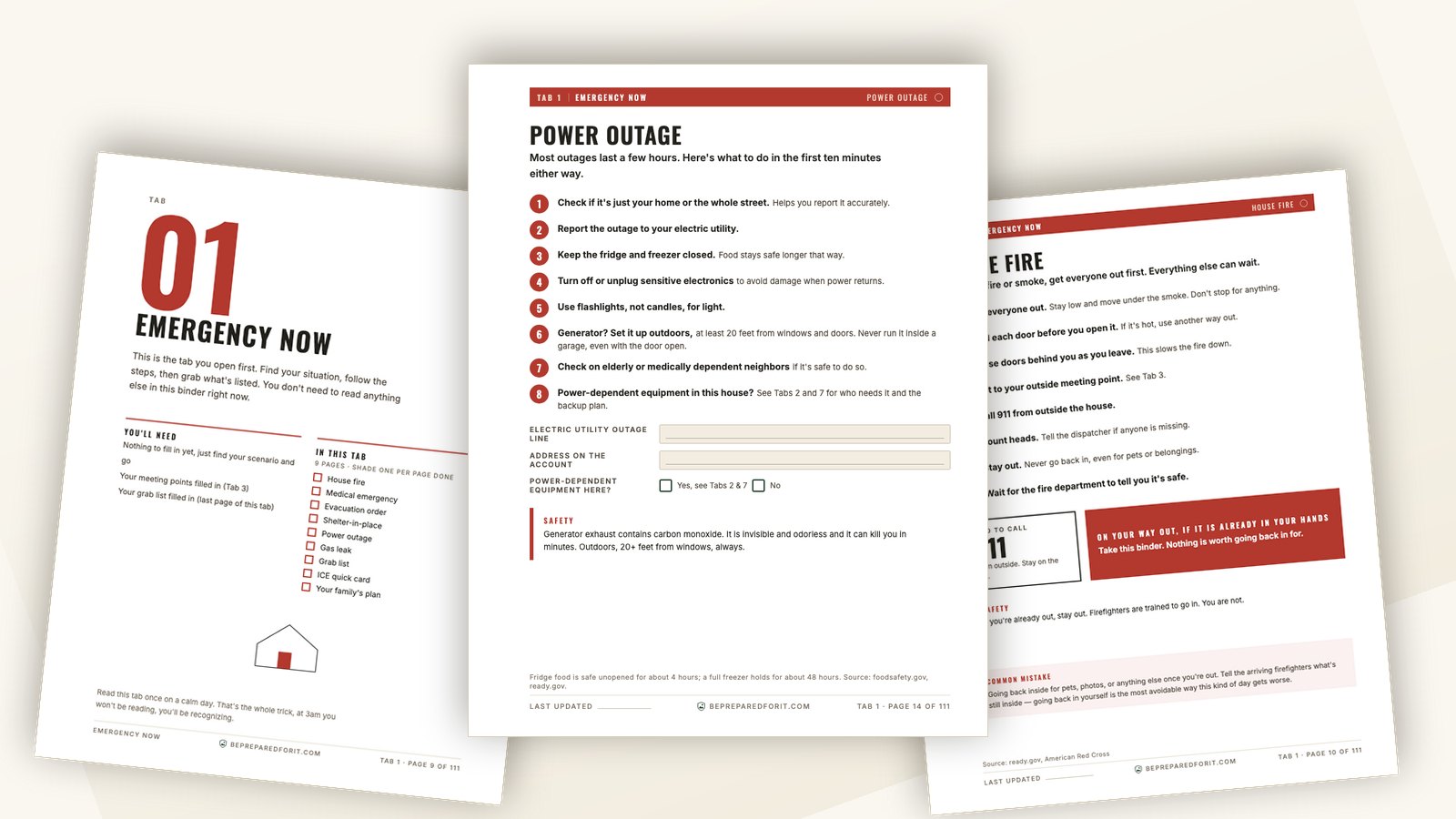
The Family Emergency Binder puts your family's contacts, documents, and plans in one place — a 15-minute quick start tonight, finished over a weekend. Join the list and we'll email you the moment it's ready, at the $19 launch price for a limited time.