Gear & Supplies
Power Outage Kit: What to Put in One 5-Gallon Bucket
General information only, not professional advice. In an emergency, call 911 and follow local officials. How we use sources
We may earn a commission if you buy through our links, at no extra cost to you. We don't test products ourselves. We choose picks from the maker's own specs, the retailer listing and, where a safety rule applies, official government guidance. Specs shown are the maker's or seller's claims, and we have not tested any safety or fire rating. How we choose.
In this guide
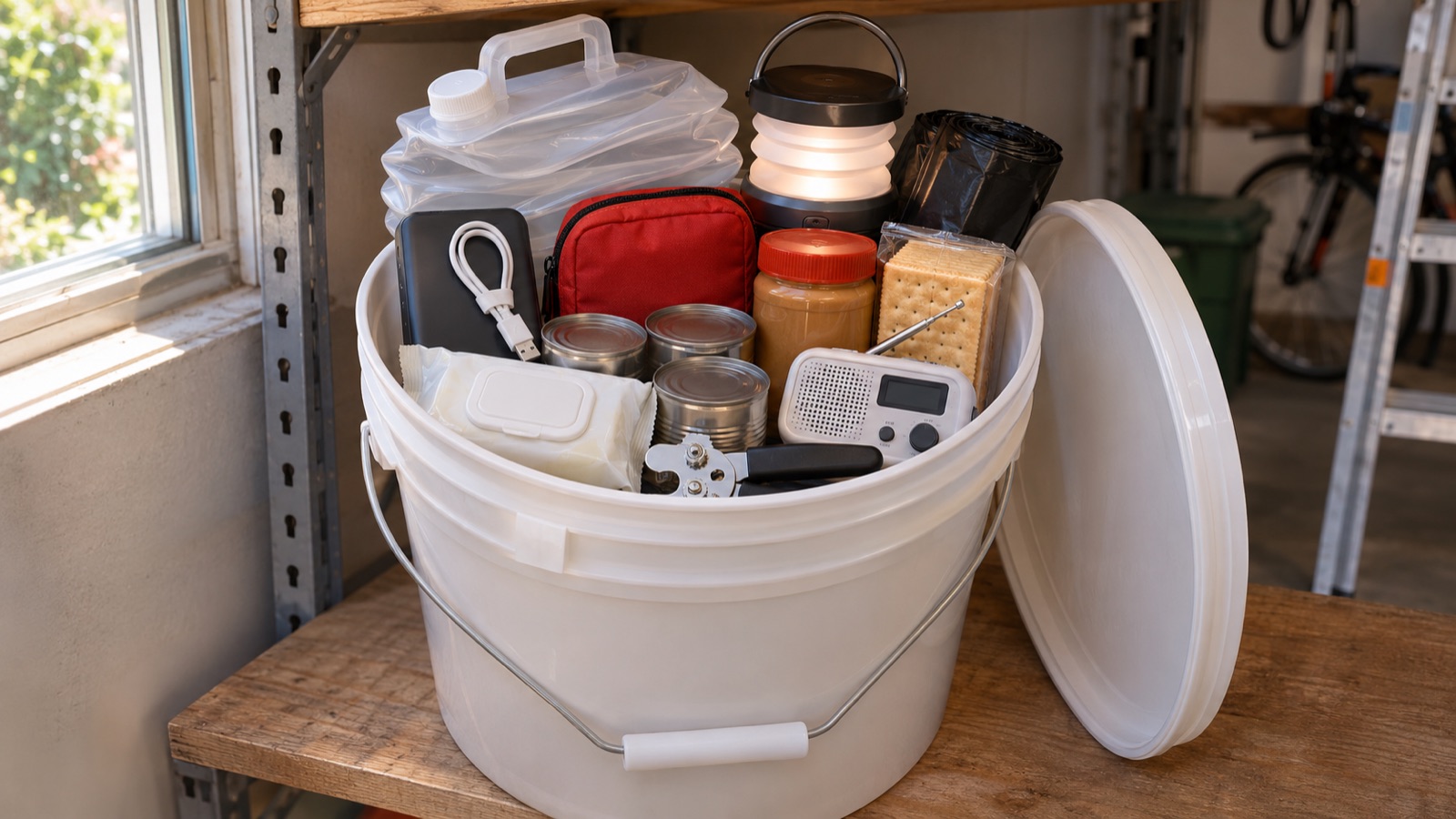
A power outage kit is one labeled bucket, kept where you can grab it in the dark, with the things a household needs to get through an outage at home: water and a way to treat more, food that needs no cooking, light, a way to charge a phone, a weather radio, first aid and basic sanitation. A 5-gallon bucket with a lid holds most of it.
This is the short version of how to prepare for a power outage when you want something simple and a shelf to keep it on. It is not a full emergency kit. For that, see our 72-hour emergency kit guide, which covers documents and the rest. This page stays on the outage.
We have not built or tested this kit. The items and safety rules come from Ready.gov, FEMA, the National Weather Service, FoodSafety.gov, the USDA, the EPA and the CDC, and the product cards are search links for the type of item, not endorsements of one model. Follow your local emergency officials, call 911 in an emergency, and when in doubt, don’t.
Why a bucket?
Ready.gov suggests keeping a kit in “one or two easy-to-carry containers such as plastic bins or a duffel bag.” A 5-gallon bucket fits that description. The lid keeps dust and moisture out, the handle makes it easy to carry, and a bucket with a tight lid also shows up on FEMA’s older sanitation checklist, covered below. Write the date you packed it and a list of what is inside on the lid with a marker, so you know when to check it.
Source: Ready.gov, “Build A Kit” (ready.gov), accessed November 2026.
Ready.gov’s list is longer than one bucket. Ours picks the part that matters when the lights go out and you are staying put.
The container
5-gallon bucket with a gasket lid
Look for a food-grade bucket with a snap-on or screw-top lid, so it can hold the kit and keep dust and moisture out.
Water: how much, and how to treat more
Start with the number. Ready.gov says:
“Store at least one gallon of water per person per day for several days, for drinking and sanitation.”
Source: Ready.gov, “Water” (ready.gov), accessed November 2026.
Do the math for your own household: gallons per person per day, times the people in your home, times the days you want to cover. We are not going to tell you what that adds up to, because it depends on who lives with you. Ready.gov adds that children, nursing mothers and sick people may need more, and that if you live in a warm weather climate, more water may be necessary. It also says:
“In very hot temperatures, water needs can double.”
Source: Ready.gov, “Water” (ready.gov), accessed November 2026.
A collapsible container packs flat, so it rides inside the bucket empty and gets filled when an outage is forecast. Fill it from the tap while the water still runs.
Water
Collapsible water container
A folding 5-gallon jug packs flat inside the bucket. Reliance makes a well-known version.
Unscented bleach and a dropper
If your stored water runs out and you must use water of uncertain quality, the EPA and CDC both describe disinfecting it with household bleach. The details matter, so here is what they say. On the type of bleach, the EPA writes:
“Only use regular, unscented chlorine bleach products that are suitable for disinfection and sanitization as indicated on the label. The label may say that the active ingredient contains 6 or 8.25% of sodium hypochlorite. Do not use scented, color safe, or bleaches with added cleaners.”
Source: EPA, “Emergency Disinfection of Drinking Water” (epa.gov), accessed November 2026.
On cloudy water, the CDC says:
“If the water is cloudy, first filter it through a clean cloth, paper towel, or coffee filter. Another option is to let it settle. Then, draw off the clear water and follow the steps below.”
Source: CDC, “Making Water Safe in an Emergency” (cdc.gov), accessed November 2026.
On how much to add, the CDC gives a table by concentration. For bleach with 5% to 9% sodium hypochlorite, its table says to add 8 drops of bleach to 1 gallon of water with a dropper, and 40 drops to 5 gallons. The same page says:
“If the water is cloudy, murky, colored, or very cold, add double the amount of bleach listed below.”
Source: CDC, “Making Water Safe in an Emergency” (cdc.gov), accessed November 2026.
And on the wait, the CDC says: “Let the water stand for at least 30 minutes before you drink it.” The EPA adds that the water should have a slight chlorine odor, and that if it does not, you repeat the dose and let it stand again. The EPA also says to use fresh bleach, “stored at room temperatures for less than one year.”
Two cautions from the same pages. Different agencies print slightly different tables because bleach strength varies, so read the percentage on your bottle and use the matching row. And the EPA states plainly that “boiling or disinfection will not destroy other contaminants, such as heavy metals, salts, and most other chemicals.” If your local officials tell you not to drink the water, or you suspect fuel or chemicals in it, use bottled water or another source. The CDC calls boiling “the best way to kill germs in water,” so boil when you can. Our boil water notice guide covers that.
Water treatment
Unscented household bleach and a dropper
Check the label for unscented and for the sodium hypochlorite percentage. A plain glass or plastic dropper does the measuring.
Food that needs no cooking
Ready.gov’s power outage page says to “have enough nonperishable food and water,” and the kit list asks for “at least a several-day supply of non-perishable food.” What fits a bucket is food you can eat straight from the package, with no stove, no fridge and no water to add.
A spread, something to put it on, and a few cans cover that. Peanut butter needs no cooking, and FoodSafety.gov’s power outage chart lists it among the foods to keep when a refrigerator has been at 40°F or above for more than 2 hours. If anyone in your home has a nut allergy, sunflower seed butter is a common swap, and you should check every label yourself. Crackers go with it. For canned food, pick things you would be willing to eat cold, since you may not be able to heat them.
Heat is a separate question. Ready.gov says “never use a gas stovetop or oven to heat your home,” and the CDC’s carbon monoxide rules below apply to any cooking you try indoors. We keep the bucket to food that needs none.
Food
Peanut butter or sunflower seed butter
A jar that needs no cooking or refrigeration. Sunflower seed butter is the usual nut-free swap. Add a sleeve of saltines or other sealed crackers from your pantry.
Food
Canned food with a pull tab or one you can open by hand
Ready-to-eat items like chili, beans or tuna that you would eat cold if you had to.
A manual can opener
The Ready.gov kit list includes a “manual can opener (for food).” An electric one will not run in an outage. A P-38 style opener is a small folding tool that fits inside the bucket without taking space from anything else, and it is small enough that keeping a spare with the kit is easy.
Food tools
P-38 style can opener
A small folding opener that lives on a keychain or in the bucket. Buy a pair so one stays with the kit.
The fridge, the freezer and a thermometer
Most of what you will do about food in an outage is keep the appliance doors shut. Ready.gov says:
“Keep freezers and refrigerators closed.”
Source: Ready.gov, “Power Outages” (ready.gov), accessed November 2026.
The same page gives rough hold times and a temperature line:
“The refrigerator will keep food cold for about four hours. A full freezer will keep the temperature for about 48 hours. Use coolers with ice if necessary. Monitor temperatures with a thermometer. Throw out food if the temperature is 40 degrees or higher.”
Source: Ready.gov, “Power Outages” (ready.gov), accessed November 2026.
FoodSafety.gov, the federal food safety site, sets its refrigerator rule by hours without power. It says:
“Keep the door closed as much as possible.”
Source: FoodSafety.gov, “Food Safety During Power Outage” (foodsafety.gov), accessed November 2026.
The same page says a refrigerator will keep food safe for up to 4 hours during a power outage, and that after 4 hours without power you should discard refrigerated perishable food such as meat, poultry, fish, eggs and leftovers. For the freezer:
“A full freezer will hold a safe temperature for approximately 48 hours (24 hours if it is half full and the door remains closed).”
Source: FoodSafety.gov, “Food Safety During Power Outage” (foodsafety.gov), accessed November 2026.
Read each agency’s rule in its own words. Ready.gov’s sentence ends on a temperature reading, and FoodSafety.gov’s refrigerator rule counts hours without power. We are not merging them into a rule of our own. FoodSafety.gov is also blunt about one shortcut:
“After a power outage never taste food to determine its safety.”
Source: FoodSafety.gov, “Food Safety During Power Outage” (foodsafety.gov), accessed November 2026.
The same passage closes with: “When in Doubt, Throw it Out!”
Using that temperature line takes a thermometer that is already inside, because you cannot check a closed fridge without opening it. The USDA’s Food Safety and Inspection Service says:
“An appliance thermometer can be kept in the refrigerator and freezer to monitor the temperature at all times. This can be critical in the event of a power outage. When the power goes back on, if the refrigerator is still 40 F and the freezer is 0 F or below, the food is safe.”
Source: USDA Food Safety and Inspection Service, “Appliance Thermometers” (fsis.usda.gov), accessed November 2026.
That FSIS page is older than the others here, so we quote only those sentences. If a reading leaves you unsure, FoodSafety.gov’s line above still applies. The thermometer lives in the fridge and freezer, not in the bucket, but it belongs on your list. Our guide to how long food lasts in the fridge without power goes into the foods and timing in more detail.
Food safety
Refrigerator and freezer appliance thermometer
An appliance thermometer stays inside the fridge or freezer. Get one for each, and put them in before an outage starts.
Light and a way to charge your phone
Ready.gov’s kit list includes a flashlight and extra batteries, and the National Weather Service’s supply kit page lists a “flashlight with extra batteries.” Ready.gov’s outage page says to take an inventory of what relies on electricity and to “plan for batteries and other alternative power sources to meet your needs when the power goes out, such as a portable charger or power bank. Have flashlights for every household member.”
For the bucket, that means a spare flashlight with fresh batteries, one light that lights a room, and one source of power. A collapsible, USB-rechargeable lantern lights a room without burning anything, and it packs flat. A power bank charges the phone and can top up the lantern. Charge both before you seal the lid. Check the maker’s listing for runtime and charging time on any model you buy. If you are unsure how long spare batteries stay good, our guide on whether batteries expire explains it.
Light
Collapsible rechargeable lantern
A flat-folding USB lantern such as the Goal Zero Crush Light gives room light. Read the maker listing for runtime.
Phone charging
Power bank
Choose one with the cable your phone uses, and recharge it on a schedule you will remember.
A weather radio
Ready.gov’s kit list includes a “battery-powered or hand crank radio and a NOAA Weather Radio with tone alert.” On what the NOAA network does, Ready.gov says:
“National Oceanic and Atmospheric Administration (NOAA) Weather Radio All Hazards (NWR) is a nationwide network of radio stations that broadcast continuous weather information from the nearest National Weather Service office based on your physical location.”
Source: Ready.gov, “Emergency Alerts” (ready.gov), accessed November 2026.
When the internet is down and the phone battery is precious, a radio that does not depend on either is worth a spot. Look for one you can run on batteries or a crank, and check that it lists NOAA weather channels. Our guide to NOAA weather radios goes through what to look for.
Information
Battery or hand crank NOAA weather radio
Look for "NOAA Weather Radio" and "tone alert" on the listing, plus a charging method that does not depend on the wall.
First aid, medications and medical devices
The kit list includes a first aid kit, and a compact one fits in a bucket. Check what is in it and replace anything that has expired. A small kit handles small problems. For anything serious, call 911.
Medicines are a different matter, and they do not belong in the bucket. Ready.gov lists prescription medications among its additional supplies, and notes that an emergency can make it difficult to refill a prescription or find an open pharmacy. It also lists prescription eyeglasses and contact lens solution. Keep these where you use them every day, and make sure the person who would grab the bucket knows where they are. If you want one page that lists every medicine in your household, our medication list template is a printable you can fill in.
For anything that runs on electricity or needs a cold fridge, Ready.gov’s outage page says:
“Have alternate plans for refrigerating medicines or using power-dependent medical devices.”
Source: Ready.gov, “Power Outages” (ready.gov), accessed November 2026.
“Talk to your medical provider about a power outage plan for medical devices powered by electricity and refrigerated medicines.”
Source: Ready.gov, “Power Outages” (ready.gov), accessed November 2026.
We cannot tell you how long a particular medicine keeps without refrigeration. Ask your provider or pharmacist, and ask before an outage rather than during one.
First aid
Compact first aid kit
A small travel kit covers minor cuts. Johnson & Johnson is one familiar maker.
Sanitation
Ready.gov lists “moist towelettes, garbage bags and plastic ties (for personal sanitation)” in its basic kit. FEMA’s older “Are You Ready?” guide has a sanitation and hygiene section that lists this:
“Medium-sized plastic bucket with tight lid”
It lists “disinfectant and household chlorine bleach” in the same section.
Source: FEMA, “Are You Ready? Appendix B: Disaster Supplies Checklists” (fema.gov), accessed November 2026.
Neither page gives step-by-step toilet instructions, and we did not find a federal page that does, so we are not going to write our own. This page sticks to the supplies those lists name: the bucket with a tight lid, garbage bags and ties, moist towelettes, and disinfectant and bleach. If your toilet cannot be used, ask your local officials how they want human waste handled where you live.
Most toilets still flush in an outage. Our guide on flushing the toilet when the power is out explains how to flush by pouring a bucket of water into the bowl when the tank will not refill, and which homes are exceptions.
Sanitation
Heavy-duty trash bags
Contractor-style bags hold up better than thin kitchen bags. Ready.gov lists garbage bags and plastic ties for personal sanitation.
Hygiene
Unscented hand wipes
For hands and basic cleanup when water is better spent on drinking.
One more thing: carbon monoxide
The CDC says carbon monoxide is in the fumes any time you burn fuel, including in small engines, stoves, lanterns and grills. Two of its rules apply directly to an outage:
“Never use a generator inside your home or garage, even if doors and windows are open.”
Source: CDC, “Carbon Monoxide (CO) Poisoning Basics” (cdc.gov), accessed November 2026.
“Never use a portable gas camp stove indoors.”
Source: CDC, “Carbon Monoxide (CO) Poisoning Basics” (cdc.gov), accessed November 2026.
A battery-backup CO alarm is the other half of that advice, and it does not fit in the bucket. Ready.gov and the CDC word the placement a little differently. Ready.gov says:
“Install carbon monoxide detectors with battery backup in central locations on every level of your home.”
Source: Ready.gov, “Power Outages” (ready.gov), accessed November 2026.
The CDC says:
“Install battery-operated or battery back-up CO detectors near every sleeping area in your home.”
Source: CDC, “Carbon Monoxide (CO) Poisoning Basics” (cdc.gov), accessed November 2026.
For where to put yours, follow the alarm maker’s instructions, and see our carbon monoxide detector guide for what to look for.
What lives outside the bucket
A few things from the federal lists belong somewhere other than a sealed bucket. Some you use every day, and one has to be installed rather than packed.
- Cash. Ready.gov’s additional supplies list includes “Cash or traveler’s checks,” and the National Weather Service’s kit page lists cash too.
- Medications and eyeglasses. Covered above. Keep them where you use them, with a medication list nearby.
- Pet food and water. Ready.gov’s list includes “Pet food and extra water for your pet.” Add this to your household plan if you have animals.
- The carbon monoxide alarm. It needs to be installed and working before the outage, not packed.
Keeping it current
Ready.gov’s maintenance list for a kit is short:
“Replace expired items as needed.”
“Re-think your needs every year and update your kit as your family’s needs change.”
Source: Ready.gov, “Build A Kit” (ready.gov), accessed November 2026.
Our own suggestion, not a federal rule: when you do that yearly re-think, open the bucket, check the dates on the food and first aid items, and recharge the lantern and power bank before you close the lid again.
Keep the bucket somewhere you can reach in the dark, like a hall closet or the bottom of the pantry, and tell everyone in your home where it is. For the first hours of an outage, step by step, see what to do when the power goes out.
We may earn a commission if you buy through the Amazon links on this page, at no extra cost to you. We have not tested any of these items. The cards link to Amazon searches for each type of item, so read the listings and the maker’s instructions before you buy.