Start Here
Babysitter Information Sheet: What to Put On It and How to Walk Your Sitter Through It (Free Printable)
General information only, not professional advice. In an emergency, call 911 and follow local officials. How we use sources
In this guide
A good babysitter information sheet is one page on the fridge. It lists who to call, the home address, each child’s allergies and medicines, the routines and house rules, where things are in the house, and what to do if something goes wrong, plus a sleep line if there is a baby. The popular templates handle contacts and routines well. Two of the three we read leave off the home address, only one mentions a fire escape route, and none covers a gas smell or a power outage, which are the lines you want on the fridge if the evening goes badly.
There is a free printable on this page: the emergency contact card printable includes a household contact sheet for the fridge, which works as a starting layout. Filling it in is half the job. The other half is the walk-through before you leave, which Safe Sitter, a sitter training nonprofit, tells sitters to expect to take about 10 minutes with a family they have worked for before and about 30 with a new one.
We gathered this from Ready.gov, NIH Safe to Sleep, America’s Poison Centers, Safe Sitter, Chica and Jo and Sittercity. Federal quotes are word for word; the rest is reworded and credited. Follow your local emergency officials, call 911 in an emergency, and when in doubt, don’t.
What goes on the sheet
The table combines what the popular templates share with the safety lines they mostly leave out.
| Block | What to write | Why it is there |
|---|---|---|
| Contacts | Both parents’ cell numbers, where you will be and when you expect to be home, a nearby adult, the doctor, Poison Help | A second person to reach if you do not pick up |
| Home address | Street address and nearest cross street | A sitter, especially a teen, may not know the address by heart |
| Allergies and medicines | Allergies, health conditions, any medicine to be given with name, dose and time | A sitter cannot guess these |
| Routines | Bedtime, meals and snacks, screens | Keeps the evening normal for the kids |
| House rules | Off-limit rooms, visitors, pets, forbidden foods | Saves the sitter from guessing |
| Where things are | Exits, meeting place, first aid kit, flashlight, shutoffs | Hard to find in a hurry otherwise |
| If something goes wrong | Short steps for fire, gas smell, power outage | Needed most when you cannot answer |
| Baby sleep line | How and where the baby sleeps, feeding and diaper times | Only if there is a baby in the house |
The contact sheet in the emergency contact card printable is built for the fridge, and the rest of this page covers what to add to it. To keep it where a sitter will see it, our resources page lists a magnetic sheet holder for the fridge.
Contacts and the address line
Safe Sitter’s help sheet tells sitters to note the parent’s name, the address, a cell phone and an alternate number, a back-up adult, 9-1-1 and the Poison Center number. Chica and Jo adds where you will be that evening and when you plan to be home, plus a trusted neighbor. Sittercity suggests the contacts who live closest to the house, the doctor and the hospital you prefer.
Put your address on the sheet even though it feels obvious. Ready.gov’s home fire page, in its steps for someone who cannot get out, tells them to say where they are:
If you can’t get out, close the door and cover vents and cracks around doors with cloth or tape to keep smoke out. Call 9-1-1 or your fire department. Say where you are and signal for help at the window with a light-colored cloth or a flashlight.
Source: Ready.gov, Home Fires (ready.gov), accessed November 2026.
That is easy in your own home and harder in someone else’s. A teen sitter who has been in the house a couple of times may not know the street number, so put the address and nearest cross street near the top.
America’s Poison Centers runs the Poison Help line, 1-800-222-1222, which it describes as free and confidential, with a live poison expert on the phone. Safe Sitter prints the same number, and details are at poisonhelp.org. Write it on the sheet next to 911.
If you already keep a family emergency plan, borrow its out-of-town contact. Ready.gov’s kids’ planning page explains the idea and adds a note about phones:
Pick the same person for each family member to contact.
Text, don’t talk. In an emergency, phone lines may be tied up. It may be easier to text and this leaves phone lines open for emergency workers.
Source: Ready.gov, Make a Plan (ready.gov), accessed November 2026.
That page is written for disasters, but the habit carries over, so write down who should get a text if the lines are busy.
Allergies, medicines and health
Write down every allergy and health condition a sitter should know about, and what a reaction looks like in your child if you know. Chica and Jo’s guide lists allergies and current medications, and Safe Sitter tells sitters to ask about allergies and medicine before the parents leave. Ready.gov’s household planning page has a matching prompt:
Medical needs including prescriptions and equipment
Source: Ready.gov, Make A Plan (ready.gov), accessed November 2026.
If a medicine is to be given while you are out, write the name, dose and time, every time. “The usual one” means nothing to someone who has never watched you give it.
Also decide what the sitter should do about medicine when nothing is written down, and put that on the sheet. You might want a call first, or nothing given unless it is listed. This is our suggestion, not an agency rule; we did not find one in the sources we gathered, so it is a decision for you and your child’s doctor. If you are unsure, ask your pediatrician.
Chica and Jo’s list also includes insurance information and a medical treatment release. Ask your pediatrician or hospital whether they have a form; we are not giving legal advice here.
If your child takes regular medicine, our medication list template keeps names, doses and timing in one place to copy from.
Show the sitter around
Safe Sitter’s help sheet includes a house tour checklist, which covers the fire escape route and where to meet outside, where the phones are, the locks and any alarm system, the children’s rooms and any off-limit rooms, and where the first aid supplies, flashlight and diapering supplies are kept. Walk the sitter to each spot rather than describing it from the kitchen.
Ready.gov’s Safety Skills page names a few more things everyone in a household should know about. A sitter is not a household member, but the same stops belong on the tour. The first is the fire extinguisher:
Have at least one up-to-date fire extinguisher and let everyone in your household know where it’s kept and how to use it.
Source: Ready.gov, Safety Skills (ready.gov), accessed November 2026.
Showing the sitter where it is does not mean asking them to fight a fire; the fire steps further down are about getting everyone out. The same page covers the water main:
Find the shut-off valve for the main water line that enters your house and tag it for easy identification. Make sure everyone in your household knows where it is.
Source: Ready.gov, Safety Skills (ready.gov), accessed November 2026.
If a pipe bursts, a sitter who has seen the valve knows where to go. Our page on how to shut off the water main shows what you are looking for. The same Ready.gov page also says to teach the responsible members of a household how to shut off the electricity. Whether a teen sitter counts is your call, but at least show them where the electric panel is.
Check your first aid kit against our guide on whether first aid kits expire, and check that the flashlight works.
If something goes wrong
This is the block most templates leave out. Keep it short enough to read standing up, in plain sentences that come from an agency.
Fire. Ready.gov’s home fire guidance gives these steps:
Find two ways to get out of each room in the event the primary way is blocked by fire or smoke.
Before opening a door, feel the doorknob and door. If either is hot, or if there is smoke coming around the door, leave the door closed and use your second way out.
Drop down to the floor and crawl low, under any smoke to your exit.
Teach children not to hide from firefighters.
Source: Ready.gov, Home Fires (ready.gov), accessed November 2026.
For the sheet, that means naming the two ways out of each child’s bedroom and the outside meeting place. The last line is for your children ahead of time, and the sitter should hear it too. If you have filled in our home fire escape plan template, copy its routes and meeting place onto the sheet.
Gas smell. Ready.gov’s safety skills page says:
If you smell gas or hear a blowing or hissing noise, open a window and get everyone out quickly. Turn off the gas using the outside main valve if you can and call the gas company from a neighbor’s home.
Source: Ready.gov, Safety Skills (ready.gov), accessed November 2026.
On the sheet, name the neighbor whose home the sitter should go to and write down the gas company’s number. A teen sitter probably does not know where the outside valve is unless you have shown them, and if you would rather they left it alone, say so. Either way, the first step is getting everyone out.
Power outage. Ready.gov’s power outage page says:
Have flashlights for every household member.
Keep freezers and refrigerators closed.
Do not use a gas stove or oven to heat your home.
Source: Ready.gov, Power Outages (ready.gov), accessed November 2026.
A sitter should know where the flashlights are before the lights go out, and should not warm the house with the stove. Our page on what to do when the power goes out has the longer version.
Resist adding steps to this block that no agency or doctor has given you. End it with one line that covers everything else: in an emergency, call 911 first, then call us. When in doubt, don’t.
If there is a baby in the house
A household with an infant needs one more line, stated plainly. NIH’s Safe to Sleep campaign gives the main rule:
The most effective action that parents and caregivers can take to reduce baby’s risk of Sudden Infant Death Syndrome (SIDS) and other sleep-related death is to always place baby on their back to sleep, for naps and at night.
Source: NIH Safe to Sleep, About Back Sleeping (safetosleep.nichd.nih.gov), accessed November 2026.
The same campaign lists what a safe sleep environment for baby looks like. Its first item, and one more line from that page, apply directly to a sitter:
Firm (returns to its original shape quickly if pressed on)
Babies should never sleep on an adult bed, couch, or armchair by themselves, with others, or with pets.
Source: NIH Safe to Sleep, Safe Sleep Environment for Baby (safetosleep.nichd.nih.gov), accessed November 2026.
Write the sleep line in your own words, for example “Baby sleeps on their back in the crib,” and show the sitter where the crib is. Feeding and diaper times go with the other routines; Safe Sitter groups routines under BEST (bedtime, entertainment, snacks and meals, toileting), and those times fit under the last two.
Routines and house rules
The popular templates do this part well. Between them, Chica and Jo, Sittercity and Safe Sitter cover bedtime and its routine, meals and snacks, rules for screens and electronics, forbidden foods or behaviors, discipline, outside play and pet duties. Add anything else particular to your house, such as whether visitors are allowed.
Where you will be and when you will be home change every time. Chica and Jo suggests filling in the standard information, laminating the sheet and using a dry-erase marker for the fields that change, so you rewrite a couple of lines instead of the whole page.
Walk through it before you leave
Safe Sitter frames the 10 or 30 minutes as time for the sitter to learn how to care for the children and the rules of the house, and the sheet gives it a running order.
Go through the house with the sheet in hand and point to each item as you reach it, including the exits, the outside meeting place, the first aid kit, the flashlight, the water main and the electric panel. Then ask the sitter to say back the home address and what to do in a fire, and go over either again if the answer is shaky. Ready.gov’s planning advice to households fits here too:
Practice your plan with your household.
Source: Ready.gov, Make A Plan (ready.gov), accessed November 2026.
Update the sheet when anything changes, such as a new phone number, a new medicine or a baby who has moved rooms. The free printable is easy to reprint, so skip crossing things out on an old copy.
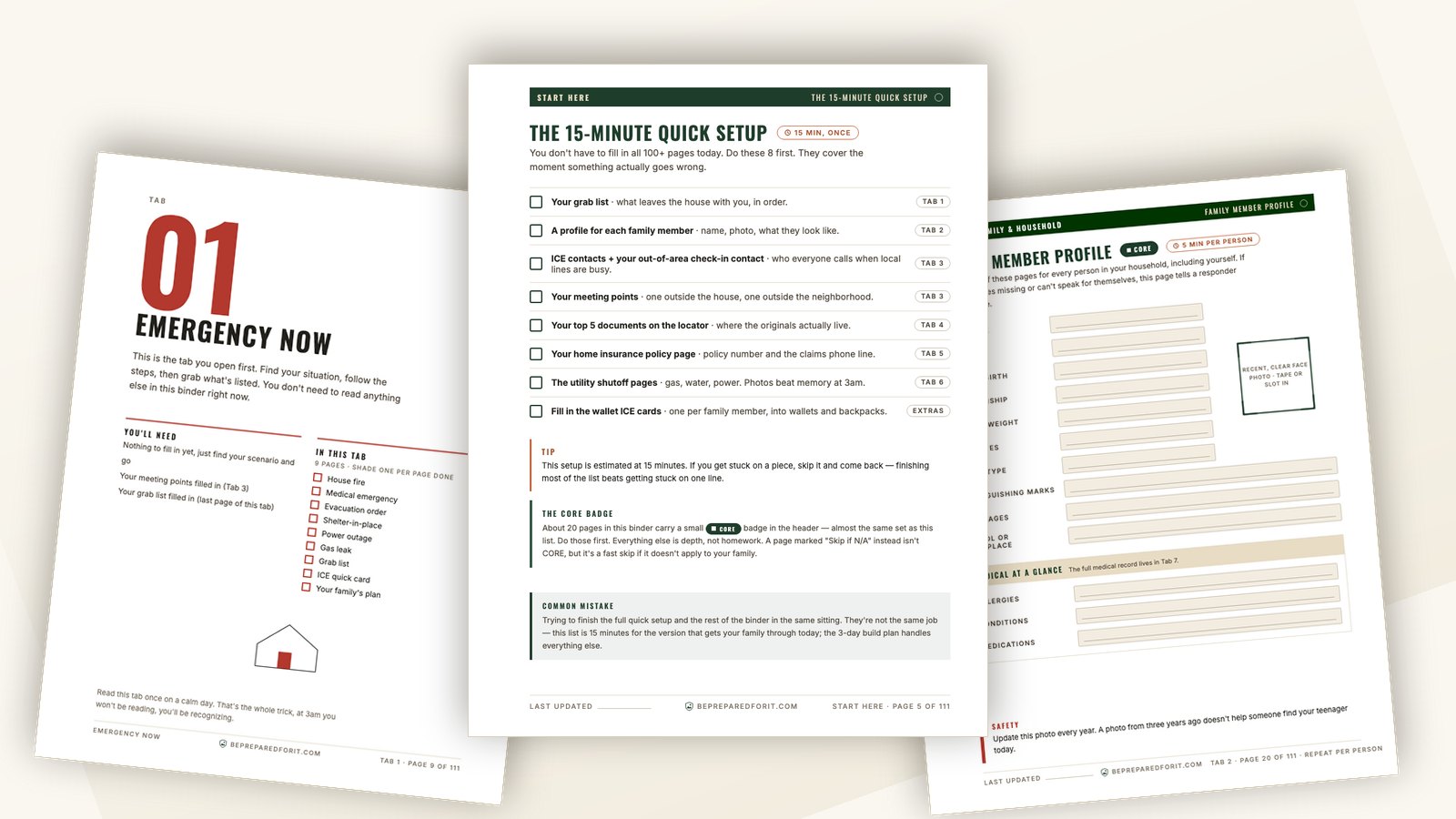
Once the sheet is up and the sitter has walked the house, you have done your part. If you want a ready-made version, the family emergency binder includes a Babysitter / Caregiver One-Pager and a Fridge Sheet with 911 and your address, both written for a sitter or guest to read.