In this guide
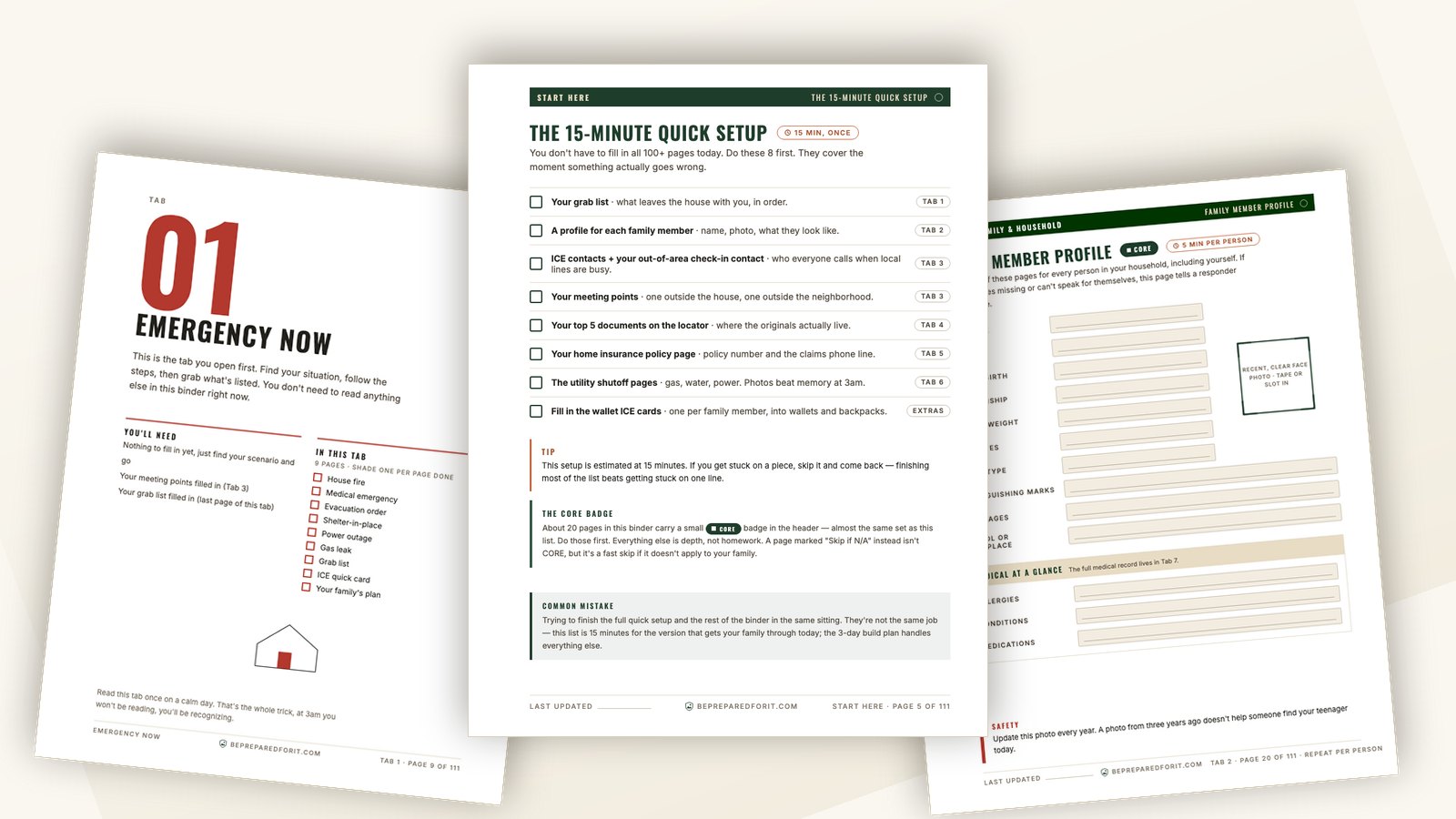
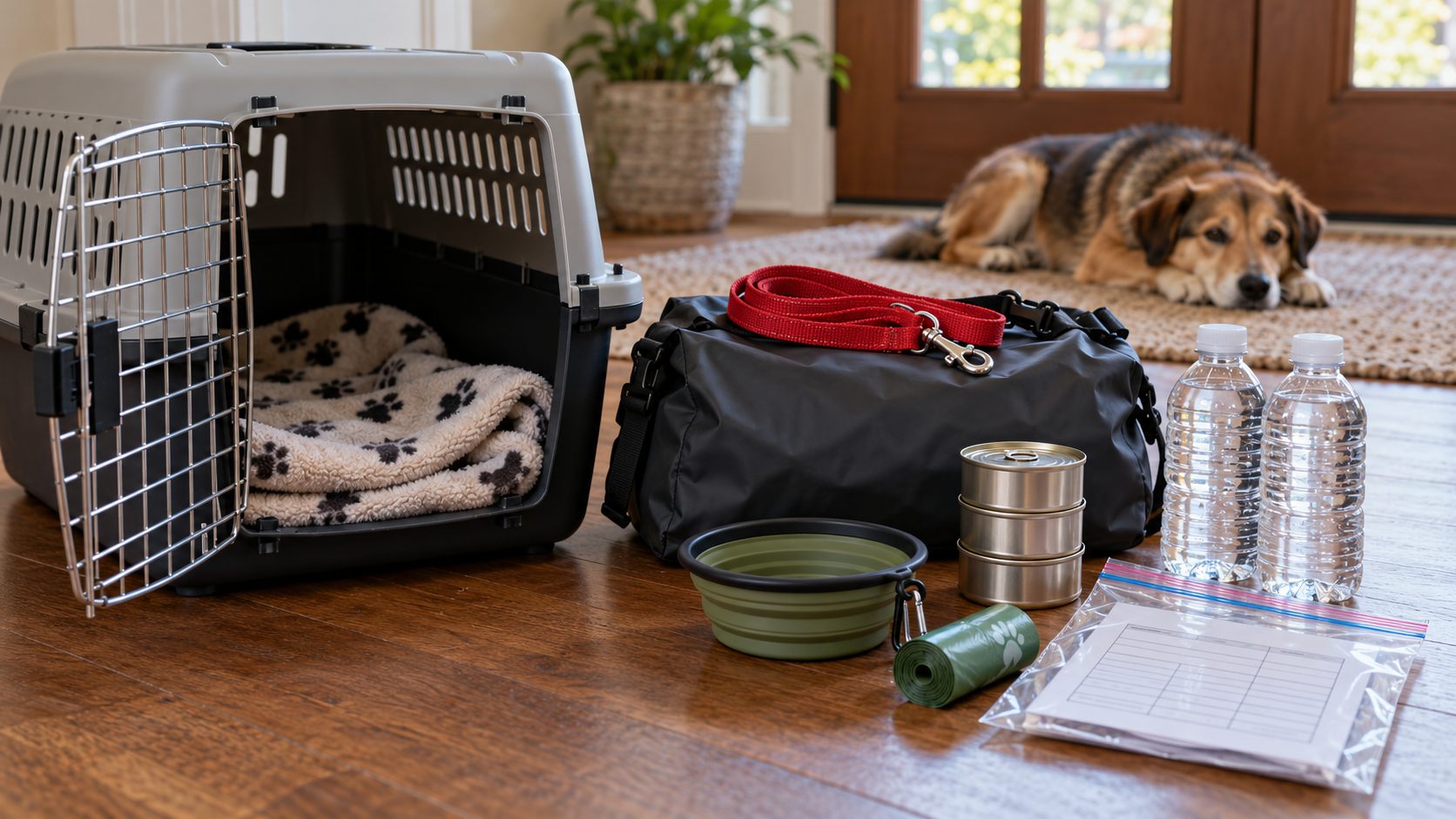
A pet emergency kit holds food, water, medications, a leash and spare collar with ID tag, a carrier, sanitation supplies, a first aid kit, and copies of your pet’s records in a waterproof bag. Add a one-page pet info sheet that lists feeding, medical needs, microchip number, and your vet, so anyone caring for your pet can find the basics fast. Our free printable has the whole kit checklist on page 1 and that info sheet, ready to fill in, on page 2.
The image above is an AI illustration, not a picture of our own kit.
What goes in a pet emergency kit
This checklist for a dog or cat combines Ready.gov’s pet preparedness guidance, the CDC, the ASPCA, the American Red Cross, and Best Friends Animal Society. The CDC says to ask your veterinarian for help putting the kit together, so have your vet look over the first aid and medication lines.
Food and water
- Food in an airtight, waterproof container (canned food should be pop-top, or pack a manual can opener)
- Bottled water
- Food and water bowls (the CDC lists non-spill dishes)
- Written feeding instructions for each pet
Medications and first aid
- Two weeks of any medication your pet takes, in a waterproof container, with dosing instructions
- A month of flea, tick, and heartworm preventive
- A pet first aid kit and a first aid guide (Ready.gov and the ASPCA both say to ask your vet what belongs in it)
Gear
- A sturdy carrier or crate for each pet. Best Friends says it should give the pet room to stand and turn around, and to label it with the pet’s name and your phone number
- A spare leash, a spare collar or harness, and a spare ID tag
- A flashlight and a blanket
Sanitation
- Litter and a litter box for cats (disposable aluminum roasting pans work well)
- Poop bags, paper towels, and trash bags
- Dish soap and a disinfectant, or household chlorine bleach
Records and comfort
- Copies of vet records and proof of ownership in a waterproof bag, plus a digital copy
- A recent photo of you with your pet
- A favorite toy, treats, and bedding. Ready.gov says familiar items can help reduce stress for your pet
A few species extras from the ASPCA list: a pillowcase and scoopable litter for cats, and chew toys plus a week of cage liner for dogs. If you have birds, reptiles, small animals, or horses, the ASPCA’s disaster preparedness page has sections for them, and Ready.gov has tips for large animals such as horses, goats, and pigs.
How much food and water should you pack?
Plan toward two weeks of food, water, and medication for each pet stored at home, and treat one week as the minimum for what you keep on hand. The carry-out bag can hold less if you can’t carry a week, but no less than Ready.gov’s several days. That is our rule, not an official one. The major sources don’t agree, so here is how they compare.
| Source | Food | Water | Medication |
|---|---|---|---|
| Ready.gov | Several days | Several days | An extra supply |
| ASPCA | 7 to 10 days | At least 7 days per person and pet | Two weeks |
| CDC | Two weeks | Two weeks | Two weeks |
We went with the bigger number because of a line in the ASPCA’s own evacuation advice: even if you think you may be gone for only a day, assume you may not be allowed to return for several weeks. The CDC’s pet disaster kit list lands on two weeks of food, water, and medicine too. Ready.gov’s several days is a shorter planning horizon; the ASPCA’s warning about weeks away is why we plan longer.
If two weeks of food won’t fit in one bag, that’s what the second kit is for.
Why you need two kits, not one
Ready.gov recommends two kits: a larger one for sheltering at home and a lightweight one you can carry if you have to evacuate.
- Stay-home kit: the rest of the two weeks of food and water, extra litter, and the cleaning supplies. Keep it somewhere cool and dry, such as a closet; the ASPCA says to store bottled water in a cool, dry place.
- Carry-out bag: the two weeks of medication, leash, spare ID, records, the info sheet, and a week of food and water if you can carry it. If you can’t, pack no less than Ready.gov’s several days. It goes next to the carrier, near a door.
The ASPCA says to keep the kit and leashes as close to an exit as you can, clearly labeled, with everyone in the house knowing where they are. The stay-home kit tops the bag up to two weeks. If you leave by car, our advice is to load the stay-home food and water too, so the full supply travels with you. If you can only take the bag, call ahead and ask your destination (the friend, kennel, or hotel on your list below) whether it can supply food and water for the rest, and buy more of your pet’s usual food on the way if stores are open. Ready.gov gives that advice for large animals, telling owners to ensure destinations have food, water, and veterinary care, and it is a sensible check for a dog or cat too. The bag fits right alongside a 72-hour emergency kit for the people in your house.
What’s on page 1 of the free printable
The free printable is a two-page US Letter PDF. Every tick box and tan line is a fillable field, so you can type into it in Acrobat, Preview or most browsers, or print it and use a pen. Page 1 is the kit, laid out so you can tick it off while you pack:
- The top line. For a dog or cat; ask your vet to look over the first aid and medication lines; many public shelters and hotels don’t allow pets, so pick the place before you need it.
- Five checklist groups. Food and water, Medications and first aid, Gear, Sanitation, and Records and comfort, each item with its own tick box. They match the checklist above line for line, with the short source notes in gray (non-spill bowls, room to stand and turn around in the carrier, ask your vet what goes in the first aid kit). Records and comfort adds two lines of its own: the pet info sheet on the next page, and ordering the free rescue alert sticker, with the 6 to 8 weeks for delivery.
- How much to pack. A box with the two-weeks rule and the one-week floor, labeled as our rule, and the two-kit split: what goes in the stay-home kit and what goes in the carry-out bag. The bag line says to take as much food and water as you can carry, and no less than several days’ worth, which is Ready.gov’s number. Aim for a week in the bag if you can carry it.
- Where will pets go? Five lines to fill in before you need them: a pet-friendly hotel or motel outside your area, a friend or relative outside your area who would take your pet, a boarding kennel your vet recommends, your local animal shelter if it offers emergency shelter or foster care, and a buddy who can care for or evacuate your pets if you can’t get home, with a tick box for “has a set of keys.” The section below explains where each suggestion comes from.
- Every two months. Four tick boxes for the swap: feed the kit food and replace it, swap the water, check medication and preventive dates, and update the info sheet.
- Notes. Three lines for anything else, like a second pet’s needs or where the carrier lives.
Fill in the “Where will pets go?” lines before the info sheet, because the info sheet’s “pet-friendly places” line copies from them.
Page 2: the one-page pet info sheet
Page 2 of the printable is the pet info sheet: a single page with the key facts a stranger would need to care for your pet. The Red Cross kit list includes information on feeding schedules, medical conditions, behavior problems, and your vet’s name and number in case you have to foster or board your pet. The CDC lists vaccination records, a written description, photos, and microchip details, and it offers a one-page Pet Boarding Instructions form (pet details, owner contact, food and medications, vet, vaccine dates, medical conditions, behavior). That form is built for a kennel stay. Our sheet adapts it: it uses the CDC form’s fields and adds the ones an evacuation needs: hiding spots, preventives, the chip company’s phone, an out-of-area contact, a backup caregiver who holds a key, pet-friendly places to go, and where the insurance card is kept.
That page matters most at the moment someone else takes over: a shelter volunteer, a boarding kennel, a neighbor, or a relative. They don’t know your cat hides under the bed or that your dog gets a pill with dinner.
On the printable, each field is a labeled writing line, top to bottom in the order of the table below, with two dashed photo frames at the bottom: “Recent photo of your pet” and “Photo of you with your pet.” Tape or glue prints into them. A note beside the frames says to make one sheet for each pet and keep two copies: one in the carry-out bag and one in the binder or on the fridge.
The fields run in five groups, which is also the easiest order to fill them in:
- Who the pet is: name, species and breed, sex, color and weight, and the markings that tell this pet apart from a similar one.
- Chip and vaccines: the microchip number and the chip company’s phone, the rabies vaccine date and certificate number, other vaccine dates, and the last heartworm test (dogs) or FeLV/FIV test (cats). Copy these from your vet records. The Red Cross notes that many pet shelters require proof of current vaccinations.
- Daily care: medications, dose and schedule; flea, tick and heartworm preventive; food brand, wet or dry, amount and feeding times; medical conditions and allergies; and behavior notes such as fear of other dogs, hiding spots, and how the pet handles a carrier.
- People: vet name and phone, owner names and contact details, an out-of-area emergency contact, and a backup caregiver, with their phone and whether they hold a house key.
- Places and insurance: pet-friendly places you can go, with names and phones (copy them from page 1), and the pet insurance carrier with where the card is kept. The form itself says “the carrier, not a policy number.”
Keep answers short so each field fits on its line. If you’d rather not download anything, the table below has the same 19 fields: copy it into a document or spreadsheet, leave room to write in each row, and print it. Then add the two photos and keep two copies, one in the carry-out bag and one in the binder or on the fridge. If you only need the kennel part, the CDC’s Pet Boarding Instructions form is a free one-page PDF linked from its pet disaster kit page.
Pet info sheet
| Field | Fill in |
|---|---|
| Pet name | |
| Species and breed | |
| Sex, color, and weight | |
| Markings or features that tell this pet apart | |
| Microchip number and chip company phone | |
| Rabies vaccine date and rabies certificate number | |
| Other vaccine dates (for dogs, bordetella and distemper/parvo) | |
| Last heartworm test (dogs) or FeLV/FIV test (cats): date and result | |
| Medications, dose, and schedule | |
| Flea, tick, and heartworm preventive | |
| Food brand, wet or dry, amount, and feeding times | |
| Medical conditions and allergies | |
| Behavior notes (fear of other dogs, hiding spots, how they handle a carrier) | |
| Vet name and phone | |
| Owner names, address, phone numbers, and email | |
| Out-of-area emergency contact | |
| Backup caregiver, their phone, and whether they hold a house key | |
| Pet-friendly places we can go (name and phone) | |
| Pet insurance carrier and where the card is kept |
Attach a recent photo of the pet and one of you with the pet. Ready.gov notes that a picture of you and your pet together helps you prove ownership if you get separated. The CDC also lists proof of ownership or adoption records, so a copy of those belongs in the same waterproof bag.
On the insurance line, we suggest writing the carrier’s name and where the card lives, not a policy number. The sheet goes in a bag that strangers may handle, so keep it to what a caregiver needs.
The sheet is also one page of a bigger record. Our emergency binder checklist already has a line for pet evacuation info in its evacuation section, and the sheet slots in right there.
Where will your pet go in an emergency?
Decide where your pet goes before you need to. Ready.gov points out that many public shelters and hotels do not allow pets.
The Red Cross says its shelters try to accommodate household pets, but depending on the situation pets may need to be housed in a different location with help from animal welfare groups. Service animals that assist people with disabilities are always welcome in Red Cross shelters. The Red Cross also notes that many pet shelters require proof of current vaccinations to reduce the spread of disease, which is one more reason the vaccine dates go on the sheet.
The ASPCA notes that not all shelters accept pets and suggests deciding ahead of time where your pets will go. Build a short list from its suggestions and put the phone numbers on the sheet:
- Hotels or motels outside your immediate area that accept pets (the Red Cross adds: ask if no-pet policies could be waived in an emergency)
- Friends or relatives outside your immediate area who would take your pet
- Boarding kennels and facilities your vet recommends
- Your local animal shelter, if it provides emergency shelter or foster care for pets
Ready.gov also suggests a buddy system: a neighbor, friend, or relative who can care for or evacuate your pets if you can’t get home. The ASPCA adds that a nearby caregiver should have a set of keys, and that neighbors who have pets of their own can swap the job. If you have more than one animal, the Red Cross says to be prepared to house them separately.
Your pet plan belongs inside your family emergency plan, which already asks who is responsible for the pets. The out-of-area contact on your sheet can be the same person from your family communication plan.
The rescue alert sticker
The ASPCA offers a free rescue alert sticker for your front door that tells rescue workers how many pets are inside, what kind, and your vet’s name and number. If you evacuate with your pets and have time, write “EVACUATED” across it. The Red Cross says that keeps rescue workers from wasting time looking for your pets. Order it now: the ASPCA says to allow 6 to 8 weeks for delivery.
How to get your pet ready before you need the kit
Get your pet used to the carrier, check the ID, and keep the microchip record current now. Ready.gov points out that you may need to put your cat or dog into a carrier when you evacuate, so practice matters.
- Make the carrier a normal part of the room. Ready.gov suggests leaving the carrier out where your pet spends time, with the door open, a favorite blanket inside, and treats near or in it.
- Ready.gov also says to make note of where your pets hide, so you can find them quickly if you have to leave. Add those spots to the info sheet.
- The Red Cross suggests including pets in evacuation drills so they get used to entering and traveling in their carriers calmly.
- Check the ID tag. The ASPCA recommends a tag with your pet’s name, your phone number, and any urgent medical needs. Best Friends adds a test: if the collar slips over your pet’s head when you pull, it is too loose.
- Keep the microchip record current. The ASPCA says a microchip can be read by a scanner at most animal shelters, and Ready.gov says to keep your address and phone up to date and include an emergency contact outside your immediate area.
- Bring pets in early. Ready.gov and the ASPCA both say to bring pets indoors at the first sign or warning of a storm or disaster.
How to keep your pet emergency kit current
Set one calendar reminder every two months and swap what spoils. The ASPCA says to rotate the food and replace the stored water every two months, and that food and medications need to be rotated out of the kit or they may go bad. Ready.gov says to review your kits regularly so food and medicines stay fresh.
When the reminder goes off:
- Feed the kit food to your pet and replace it with a fresh bag or cans.
- Swap the bottled water.
- Check medication and preventive dates against the bottles.
- Update the info sheet if weight, food, meds, or phone numbers changed.
- Check the first aid kit too. Our guide to whether first aid kits expire covers what to look at.
If space is tight for the water, our small-space water storage guide has ideas.
Frequently asked questions
Should I buy a pre-made pet emergency kit?
That’s your call. A pre-made kit can cover some of the gear. It can’t supply your pet’s usual food, prescription medications, records, or a filled-in info sheet for your pet. If you buy one, treat it as a starting bag and add the rest from the checklist.
What should I do with my pet after a disaster?
Keep your pet close and under your direct control. The Red Cross warns that pets may act differently after a disaster, even aggressive or defensive, and fences and gates may be damaged. It also says to watch for hazards at nose and paw level, like debris and spilled chemicals, and to consult your vet if behavior problems persist.
Can I leave my pet at home if I evacuate?
No. Ready.gov says that if local officials ask you to evacuate, your pet should evacuate too. Pets left behind may end up lost, injured, or worse.
Is there a free printable pet emergency kit checklist?
Yes. Ours is a free two-page fillable PDF: the kit checklist, how much to pack, a where-pets-go list and a two-month swap list on page 1, and a 19-field pet info sheet with photo frames on page 2. Enter your email in the signup box on this page to get it. The CDC also offers a free one-page Pet Boarding Instructions form for kennel stays.
Do I need a separate kit for each pet?
Ready.gov and the ASPCA both say ideally one carrier for each pet, and the CDC gives its food and water amounts per animal. In our view, the cleaning supplies and first aid kit can be shared. Fill in a separate info sheet for each animal.
Final thoughts
Start with the carry-out bag and the info sheet, then stock the stay-home kit. If you haven’t printed them yet, the free printable has the checklist, the where-pets-go list and the info sheet on two pages. Put the bag by the door with the leash, order the rescue sticker, and set the two-month reminder for food, water, and medication dates.
Then file a copy of the sheet with the rest of your family’s records. If you’re building that record from scratch, the emergency binder gives the pet page a home next to everything else your family would need in a hurry.
Sources checked October 21, 2026: Ready.gov Pets (last updated March 20, 2026), the CDC’s pet disaster kit page and Pet Boarding Instructions form, the ASPCA’s disaster preparedness page, the American Red Cross pet disaster preparedness page, and Best Friends Animal Society’s pet emergency kit checklist. This is general preparedness information, not veterinary advice.