Emergencies & Disasters
How to Prepare for a Winter Storm (Free Printable Checklist)
In this guide
To prepare for a winter storm, work in three windows. Before winter, build at least two weeks of water, food, and medicine, seal drafts, protect your pipes, and test your carbon monoxide alarms and backup heat; at the watch, top up supplies, fuel, and cash, and charge everything; at the warning, top off those charges, fill the tub, and run the laundry and dishes while you still have power and water. Those steps are on the free printable, a two-page winter storm checklist you can tick off on paper.
When an ice storm in January 2010 left one homestead family without power for 68.5 hours, the journal they kept noted that propane canisters were already gone from store shelves two days before the storm hit. By the weekend, the hardware store had propane heaters but no propane, and no candles, D batteries, or lamp oil. They were already well stocked, so they didn’t need any of it.
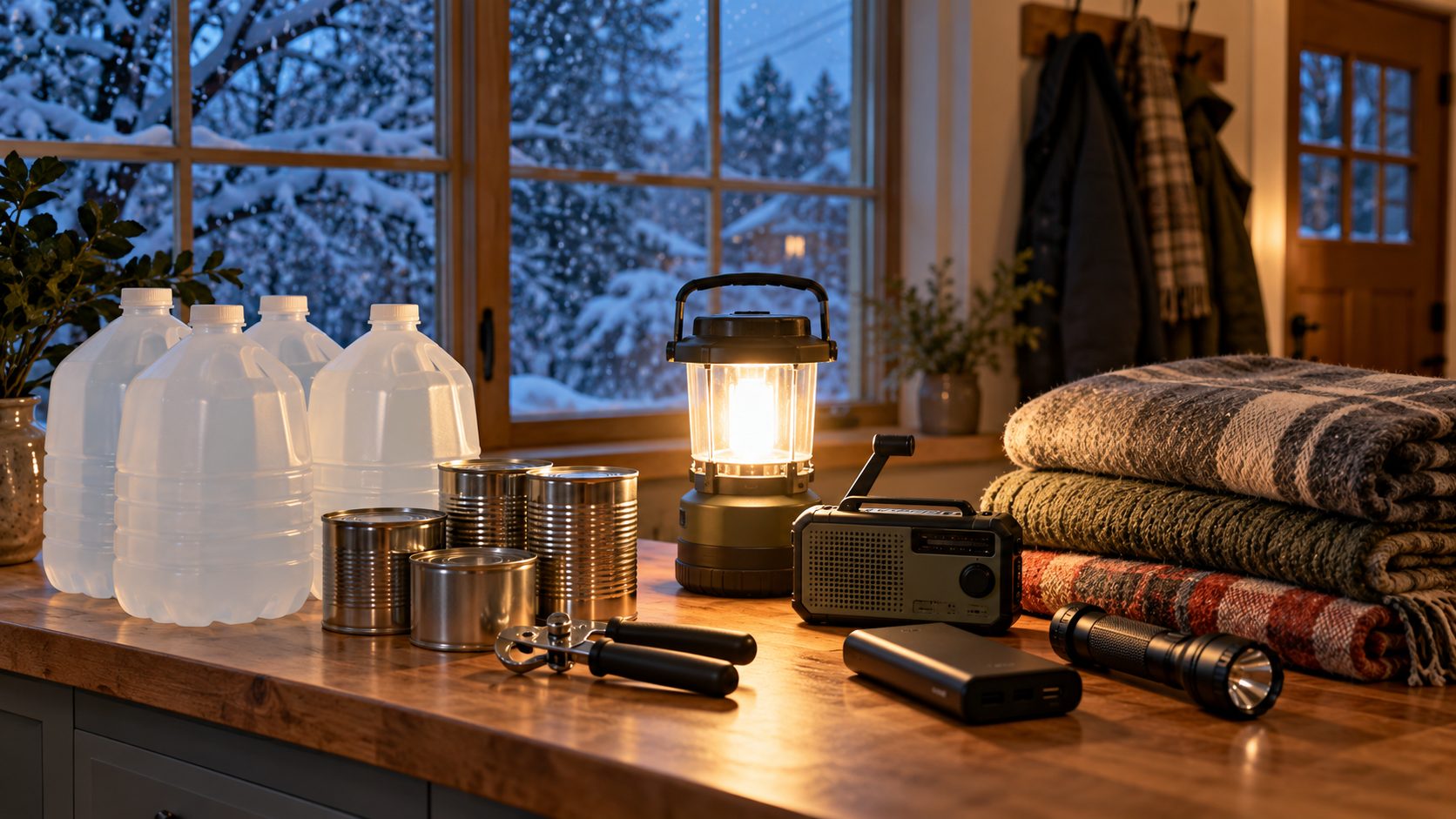
The photo above is an illustration, not a picture of our own supplies.
How long should you prepare to be stuck at home?
Plan for at least two weeks at home. The American Red Cross recommends a Stay-at-Home Kit with at least two weeks of supplies for a winter storm, plus a Go-Kit with at least three days of supplies in case you need to leave to stay warm somewhere else. The Red Cross also says to “be ready to live without power, gas, and water.”
The type of storm changes the math:
| Storm type | What the National Weather Service says | What it means for your plan |
|---|---|---|
| Heavy snow | A winter storm warning means travel will become difficult or impossible in some places | Roads and schools may close for a few days. The power may stay on. |
| Ice storm | An ice storm warning is usually issued for about 1/4 inch of ice or more, which will likely lead to snapped power lines and falling tree branches | Power outages are likely. Repair crews may have a lot to fix, so plan for the long end. |
| Extreme cold | A wind chill warning means wind and cold will cause frostbite and lead to hypothermia if you don’t take precautions | The wind chill is about danger to people. Pipes freeze from the air temperature itself, so protect exposed pipes before a hard freeze. |
Those descriptions come from the National Weather Service’s winter alert definitions.
If hard freezes are rare where you live, like much of Texas and the South, you may not own much cold-weather gear. Skip the shopping spree and start with a plan for heat, water, and food that doesn’t depend on the grid.
The exception is a short snow closure. If your heat, power, and water are expected to stay on, a few days of food and water may be enough. If ice is in the forecast, or the outage risk is real, plan for the full two weeks.
Before winter starts: the work that matters most
Do the slow work before any storm is in the forecast. Some of it is cheap, like caulk and a pipe sleeve. Some of it, like backup heat and fuel, takes money and planning, which is the reason to start in the fall.
Seal the house and check your alarms. Ready.gov’s winter weather guidance starts with insulation, caulking, and weather stripping, plus smoke alarms and carbon monoxide detectors with battery backups. Test yours and put in fresh batteries.
Protect your pipes. The American Red Cross’s frozen pipe guidance says the pipes that freeze most often are outdoor hose bibs, pool and sprinkler lines, pipes in unheated spaces like basements, crawl spaces, attics, garages, and kitchen cabinets, and pipes along poorly insulated outside walls. It recommends insulating both hot and cold pipes in those spots, for example with pipe sleeves or UL-listed heat tape. It also says to remove, drain, and store outdoor hoses and to drain the outdoor faucets.
Find your main water shutoff. If a pipe bursts, you want the water off in seconds, not a hunt for the valve with a flashlight. Find it, make sure it turns, and take a photo of where it is. Our guide on how to shut off your water main walks through finding the valve and turning it. If you keep a family binder, the Family Emergency Binder has a utility shutoffs page with a spot for that photo, so the next person in your house can find it too.
Decide how you’ll stay warm without power. In a hard freeze, heat is the first thing an outage takes away and the hardest to replace. Extra blankets, warm layers, and sleeping bags are the base of the plan for older kids and adults. A fireplace or wood stove needs dry firewood stacked close to the house. A propane or kerosene heater has to be a model made for indoor use, run exactly as its manual says, with a carbon monoxide alarm nearby. The CPSC says to keep curtains, furniture, bedding, clothes, and papers at least 3 feet from a space heater, and to turn it off when you sleep or leave the room. Also decide where you’ll go if the house gets too cold to stay. The Red Cross suggests a friend’s house, a public library, or a warming center, and its Go-Kit of at least three days of supplies is what you grab on the way out. That backup plan matters most if you have a baby, because the CDC says infants under one year old should never sleep in a cold room. Our guide on how to stay warm without power walks through each option, from safest to never.
Restock your car kit. Ready.gov’s car list is jumper cables, sand, a flashlight, warm clothes, blankets, bottled water, and non-perishable snacks, plus a full tank of gas. Here’s our full list for a car emergency kit for winter driving.
Get a shovel and ice melt. The Red Cross recommends having a snow shovel and ice-melting products to keep your walkways safe. Buy them before you need them.
Sign up for local alerts. Ready.gov recommends signing up for your community’s warning system. A NOAA Weather Radio also carries alerts, so you hear about a storm even if the internet goes down.
Test your gear before you need it
A family of five in the Houston area who lived through the February 2021 Texas storm wrote up what went wrong for them. The writer had never actually started the generator they were counting on. The internet on their phones went down with the power, and the cold weakened their car batteries. By the third day they were talking about rationing firewood. As he put it, “you can’t just buy something, stick it in the garage” and expect it to work when you need it.
Run through this list once before winter:
- Start your generator outdoors, well away from the house, and let it run under a load for a while. If it won’t start, you want to know now. Then reread how far a generator should be from the house.
- Turn on the weather radio and find your local station.
- Charge every power bank and check that each one still holds a charge.
- Check flashlights and lanterns, and replace old batteries. Batteries expire.
- Put a stopper in the tub, fill it a few inches, and check the next morning that the water is still there. That same Houston family planned to fill the tubs for flushing, then realized they had nothing to hold the water in until they turned up an old stopper.
- Count your firewood or fuel and ask whether it would last a week, not a weekend.
Winter storm emergency supplies
Here’s what a two-week Stay-at-Home Kit covers, built from the Red Cross and Ready.gov lists. Check off what you already own before you shop.
- Water: at least one gallon per person per day for drinking (Red Cross), plus separate water for flushing.
- Food: two weeks of food that needs no cooking and no refrigeration, and a manual can opener.
- Medicine: a one-month supply of needed medications and medical supplies (Red Cross), and a written list of medications and doses.
- Heat: blankets, sleeping bags, hats, and mittens for everyone, and fuel for whatever backup heat you’ve chosen.
- Light and power: flashlights, lanterns, extra batteries, charged power banks, and a way to charge your phone.
- Information: a battery-powered or hand-crank radio.
- Safety: working smoke and carbon monoxide alarms with battery backup, and a first aid kit.
- Outside: a snow shovel, ice melt, and full gas tanks or fuel cans.
- Pets: food, water, and any medicine your pets need. Ready.gov reminds you to plan for them too.
Your water math
Water adds up faster than most people expect. At the Red Cross minimum of one gallon per person per day:
| People in the house | 3 days | 1 week | 2 weeks |
|---|---|---|---|
| 1 | 3 gallons | 7 gallons | 14 gallons |
| 2 | 6 gallons | 14 gallons | 28 gallons |
| 4 | 12 gallons | 28 gallons | 56 gallons |
| 6 | 18 gallons | 42 gallons | 84 gallons |
That’s drinking water only. Flushing, washing, and freeze-dried meals all need more, which is why the tub matters. Our guide to storing water in a small space has ideas if you’re short on room.
What to do when a winter storm watch is issued
A winter storm watch means a storm is possible. Ready.gov says watches are usually issued 12 to 48 hours before a winter storm, while the Red Cross describes the watch window as 36 to 48 hours. Either way, this is your window to check the kit, fill the gaps, and fuel up, not to build two weeks of supplies from scratch. The Red Cross also uses the term winter storm outlook for conditions possible in the next two to five days. If you hear one, start here early.
Top up water. Check what you have against the table above. For a family of four over two weeks, that’s 56 gallons, which is why the bulk of it belongs in the before-winter kit.
Fill gaps in food that doesn’t need a stove. Canned goods, peanut butter, crackers, cereal, and a manual can opener. Add a few warm, comforting things if you have a safe way to heat them outdoors, like soup or oatmeal. Cold dinners get old fast, especially for kids.
Refill medications if you haven’t already. The Red Cross suggests a one-month supply of the medicines and medical supplies your household needs.
Fill up on fuel and cash. Top off every vehicle, gas can, and propane tank. Gas stations may not be able to pump without power, and roads may close. The ice storm family mentioned above found that their propane heater went through about one canister a day. Yours will differ, so check your heater’s manual for its run time per tank and count your fuel against the days you might need it. Pull some cash in small bills too, since card readers and ATMs may not work without power. Then charge everything: phones, power banks, laptops, anything rechargeable.
What to do when the winter storm warning comes
A winter storm warning means heavy snow, freezing rain, or sleet is happening or about to. Ready.gov says warnings are usually issued 12 to 24 hours before the storm starts. By now, the work moves from the store to the house.
Do the chores that need power and water. Run the dishwasher, do the laundry, and have everyone shower. A Texas family who went through the 2021 outage in an all-electric home said in their video that they learned this one the hard way.
Fill the bathtub and some jugs. If the pipes freeze or the water system loses pressure, tub water can flush toilets. Here’s how to flush a toilet when the power is out. Keep drinking water separate, in clean, covered containers.
Keep the pipes from freezing. The Red Cross recommends opening kitchen and bathroom cabinet doors so warmer air reaches the plumbing, letting cold water drip from faucets served by exposed pipes, and keeping the thermostat at the same temperature day and night. If you’ll be away, it says to leave the heat on, set no lower than 55°F. Dripping helps, but it isn’t a guarantee. The same Texas family’s pipes froze even with the faucets dripping, which is why the full tub matters.
Pick one warm room. Choose a room with few windows where everyone can sleep. The CDC recommends closing off rooms you don’t need, stuffing towels or rags in the cracks under doors, and covering windows with blankets at night.
Bring supplies close. Firewood near the door, flashlights in each room, and the radio where everyone can hear it.
Write down the bath temperature your kids like. The same Texas family heated bath water on a stove during the outage and said it’s easy to get it too hot for a child. Knowing your usual temperature, and checking it with a thermometer, gives you a target.
During the storm: the rules that prevent the worst outcomes
Stay home if you can. Generators, grills, and camp stoves stay outdoors, and any fuel-burning heater you use inside has to be made for indoor use and run exactly as its manual says.
The Consumer Product Safety Commission says more than 200 people in the U.S. die every year from accidental non-fire carbon monoxide poisoning associated with consumer products, and more than 100 of those deaths are linked to portable generators. Its rules:
- Use a generator outside only, at least 20 feet from the house, with the exhaust facing away.
- Never use one inside a home or garage, even with the doors and windows open.
- Install carbon monoxide alarms that run on batteries, or have a battery backup, on every level of the home and outside sleeping areas.
Never heat your home with a gas oven or stovetop, a rule Ready.gov and the Red Cross both repeat. Grills and camp stoves stay outside too. The Red Cross says that if you start to feel sick, dizzy, or weak, get to fresh air right away. Then call 911.
If you can avoid driving, do. If you do get trapped in your car, Ready.gov says to stay inside it. If you run the engine for heat, the National Weather Service says to run it about 10 minutes each hour, clear snow from the exhaust pipe, and crack a window for fresh air, all to avoid carbon monoxide poisoning.
Ready.gov and the Red Cross both warn that overexertion from shoveling snow can bring on a heart attack, so go slowly and take breaks.
According to Ready.gov, the signs of hypothermia include shivering, exhaustion, confusion, fumbling hands, memory loss, slurred speech, and drowsiness, and a body temperature below 95 degrees is an emergency, so get medical help. While you wait, warm the center of the body first: chest, neck, head, and groin. Frostbite shows up as numbness and white or grayish-yellow, firm or waxy skin. Ready.gov says not to massage frostbitten skin or use a heating pad on it.
The CDC says infants under one year old should never sleep in a cold room, and adults over 65 should check the temperature in their home often during extreme cold.
Food and water when the power stays out
Use refrigerated food while it’s still safe, and keep the doors shut. The CDC says that if the doors stay closed, food stays safe for up to 4 hours in a refrigerator, 48 hours in a full freezer, and 24 hours in a half-full freezer. Our guides on how long food lasts in the fridge without power and keeping food cold during a long outage cover when to toss things and how to stretch the cold with coolers and ice. When in doubt, use a thermometer: Ready.gov says to throw out food if its temperature is 40 degrees or higher.
Cook outside, or not at all. A camp stove or grill works outside, away from windows and doors, and never indoors or in the garage. Here are safe ways to cook when the power is out.
Watch for a water advisory. If water pressure drops or service is disrupted, your utility may issue a boil-water notice. That Texas family got one in 2021. It’s another reason to keep stored drinking water separate from the tub water you use for flushing.
Keep a paper list of phone numbers. Cell data can fail along with the power, as it did for the Houston family. A written contact list and a battery radio keep you connected when your phone can’t. Our family emergency communication plan shows how to set that up.
The printable winter storm checklist, page by page
The action steps above are on two letter-size pages, in the order you’ll need them. The safety details, like hypothermia and frostbite signs, space heater clearance, and running a stuck car’s engine, stay in this guide. The boxes are fillable, so you can type into them in a PDF reader or print the pages blank and use a pen. Grab the free printable, then work through it like this.
Page 1: before winter, your kit, and your water
The top line reads “Plan for at least two weeks at home,” which matches the Red Cross’s at-least-two-weeks kit. It also calls an ice storm the long end, because the National Weather Service ties an ice storm warning to about a quarter inch of ice or more.
The left column opens with “Before winter,” nine boxes for the slow work: seal drafts, test smoke and carbon monoxide alarms and put in fresh batteries, insulate exposed hot and cold pipes, drain outdoor hoses and faucets, find and photograph the main water shutoff, choose a safe backup heat source, decide where you’ll go if the house gets too cold, buy a shovel and ice melt, and sign up for alerts. Under it, “Test your gear” has six boxes from the gear test above: run the generator outdoors under a load, find your station on the weather radio, check that each power bank holds a charge, swap old flashlight batteries, run the overnight tub-stopper test, and count your firewood or fuel against a week.
The right column is the two-week stay-at-home kit in ten boxes, ending with the three-day Go-Kit. Tick a box only when the item is in the house, not when it’s on a shopping list. Below the kit sits the water table from this guide, for 1, 2, 4, and 6 people. Circle your row. If your household is a size the table skips, multiply people by days: three people for two weeks is 42 gallons of drinking water.
Three blanks run across the bottom. Under “Our main water shutoff is at,” write the spot in words someone else could follow, like “basement, left of the water heater.” Under “If the house gets too cold we go to,” write a real place with a name, such as a relative’s house, the public library, or your local warming center. Under “Alerts we signed up for,” write the name of the alert service and the weather radio station you found. The page asks where the shutoff is, never an account number.
Page 2: watch, warning, storm, and outage
Keep page 2 where you’ll see it when a storm is in the forecast, like the inside of a kitchen cabinet or the front of your binder. The left column covers the two alerts. “At the watch” has five boxes: check the kit and fill the gaps, refill medications, fill up on fuel, pull cash in small bills, and charge everything. “At the warning” has five more: dishes, laundry, and showers; fill the tub and some jugs, with drinking water kept separate; open sink cabinets, drip cold water, and hold the thermostat steady; set up one warm room; and bring firewood, flashlights, and the radio close.
The right column covers the storm itself. “During the storm” lists staying home and off the roads, keeping generators, grills, and camp stoves outdoors (a generator at least 20 feet from the house), never heating with the oven, shoveling slowly, and checking on neighbors. “If the power stays out” has four boxes: keep the fridge and freezer shut, throw out perishable food that reaches 40°F or warmer, cook outdoors only, and keep drinking water apart from flush water. The 4-hour, 48-hour, and 24-hour food times are printed next to the first box.
A boxed car kit follows, with eight items for winter driving, from jumper cables and sand to a full tank, and the reminder to stay inside your car if you get trapped. The card leaves out the exhaust-pipe rule, which is in the during-the-storm section above. The red box at the bottom of the page repeats the carbon monoxide rules: no generator, grill, or camp stove inside a home or garage, even with the doors open; alarms on every level and outside sleeping areas; and fresh air, then 911, if you feel sick, dizzy, or weak.
Both pages have a notes box. Use it for the things that are only true at your house, like which pipe froze last time or which neighbor has a generator.
The whole checklist at a glance
| When | What to do |
|---|---|
| Before winter | Build the two-week kit (water, no-cook food, medicine); seal drafts; test smoke and carbon monoxide alarms; insulate exposed pipes; find and photograph the water shutoff; choose a safe backup heat source; restock the car kit; buy a shovel and ice melt; sign up for alerts; test the generator, radio, power banks, flashlights, and tub stopper |
| At the watch | Check the kit and fill gaps (water at 1 gallon per person per day, no-cook food, a manual can opener, medication refills); fuel for cars, cans, and propane; small bills; charge everything |
| At the warning | Laundry, dishes, showers; fill the tub and jugs; open sink cabinets and drip cold water; set up one warm room; bring firewood and lights close |
| During | Generators outside, 20 feet out; no oven heat; stay off roads; shovel slowly; watch for hypothermia and frostbite; check on neighbors |
| If the power stays out | Keep fridge and freezer doors shut (a closed fridge can keep food safe for up to 4 hours); check temperatures and toss perishable food at 40°F or warmer; cook outdoors only; keep drinking water separate from flush water |
Frequently asked questions
What’s the difference between a winter storm watch and a warning?
A watch means a significant winter storm is possible, and Ready.gov says it’s usually issued 12 to 48 hours ahead. A warning means heavy snow, freezing rain, or sleet is happening or about to, usually 12 to 24 hours ahead. A winter weather advisory is a step below a warning: wintry weather is expected and will be a significant inconvenience, but it shouldn’t reach warning levels.
How do you prepare for an ice storm?
The same way you prepare for a winter storm, with more weight on the power going out. The National Weather Service issues an ice storm warning for about a quarter inch of ice or more and says that much ice will likely snap power lines and bring down tree branches. Plan heat, water, and food for the long end of the outage. Keep generators, grills, and camp stoves outdoors, and use only heaters made for indoor use inside.
Should you fill your bathtub before a winter storm?
Yes, if there’s any chance your pipes will freeze or your water service will lose pressure. Tub water is for flushing toilets and washing, not drinking. Store drinking water separately in clean, covered containers. Check first that your stopper holds water overnight.
What should you not do during a winter storm?
Don’t heat your home with a gas oven or stovetop. Don’t run a generator, grill, or camp stove inside your home or garage, even with the doors open. Don’t drive unless you have to. Don’t overdo the snow shoveling. Each of those rules comes from Ready.gov, the Red Cross, the CDC, or the CPSC.
How do you prepare for a winter storm in an apartment?
Most of this guide still applies: water, no-cook food, medicine, warm layers, one warm room, charged power banks, and a plan for where you’ll go if your unit gets too cold, like a friend’s home, a public library, or a warming center. Two things change. A portable generator has to run at least 20 feet from the home, per the CPSC, which usually rules it out on an apartment balcony or patio. And you may not have access to the main water shutoff, so ask your landlord or building manager now where it is and who to call if a pipe bursts.
Should you drip hot or cold water to keep pipes from freezing?
The American Red Cross says to let cold water drip from faucets served by exposed pipes. Even a trickle helps. Open the cabinet doors under sinks on outside walls too. If your local water utility gives different instructions, follow your utility.
What food should you buy before a winter storm?
Food that needs no cooking and no refrigeration: canned meat, fish, beans, and soup, peanut butter, crackers, cereal, dried fruit, and shelf-stable milk. Don’t forget a manual can opener. If you plan on freeze-dried meals, remember they need extra water.
Can you use a propane heater indoors?
Only a heater the manufacturer makes and labels for indoor use, run exactly as its manual says, with a working carbon monoxide alarm nearby. Heaters sold for patios, garages, or camping stay outside, along with grills and camp stoves. The CDC also says to check with your local fire department that kerosene heaters are legal where you live. Our stay-warm guide covers which heat sources are safe.
Your next step
You don’t have to do all of this tonight. Print the checklist and start with five boxes this week: test your carbon monoxide alarms, find and photograph your water shutoff, start your generator or check your backup heat, set aside water using the table above, and charge every power bank. Fuel and medicine refills come next, and they shouldn’t wait for the watch either. A watch can come as little as 12 hours before a storm, and in the ice storm journal above, propane was gone from the shelves two days before the ice.
The binder
The part of being prepared most families never finish
The Family Emergency Binder puts your family's contacts, documents, and plans in one place: start with the essentials, then build on it a few sittings at a time. $19, instant download.
See what's inside